PDF下载 ( 829 KB)

高脂血症性急性胰腺炎合并脂肪性肝病的分子机制
DOI: 10.12449/JCH260333
利益冲突声明:本文不存在任何利益冲突。
作者贡献声明:董说、王莹对研究思路和文章撰写有关键贡献;王希望、金晶晶、魏凯参与修改文章;王晓对文章关键内容进行指导与修改。
Molecular mechanisms of hyperlipidemic acute pancreatitis comorbid with fatty liver disease
-
摘要: 高脂血症性急性胰腺炎和脂肪性肝病均与脂质代谢紊乱有关,二者在临床上常合并存在。其发生机制涉及高甘油三酯血症、代谢综合征、肥胖及胰岛素抵抗等多种因素的相互作用,这些因素可形成恶性循环,共同促进疾病进展。高脂血症性急性胰腺炎在临床上具有病情重、并发症发生率高、病死率高及易复发等特点,若治疗延误,易导致多器官损伤,甚至引发多器官功能衰竭,严重威胁患者生命。本文从高脂血症性急性胰腺炎合并脂肪性肝病相关的多种信号调控通路入手,分析并探讨二者协同致病的潜在分子机制,从而为该共患病的早期预防与治疗提供一定的参考依据。Abstract: Both hyperlipidemic acute pancreatitis and fatty liver disease are associated with lipid metabolism disorders and are commonly comorbid with each other in clinical practice. The pathogenesis of such comorbidity involves the interaction between multiple factors such as hypertriglyceridemia, metabolic syndrome, obesity, and insulin resistance, and these factors may form a vicious cycle and jointly promote disease progression. In clinical practice, hyperlipidemic acute pancreatitis is characterized by severe disease conditions, a high incidence rate of complications, a high mortality rate, and a tendency for recurrence, and it can easily lead to multi-organ damage and even multiple organ failure without timely treatment, posing a serious threat to the life of patients. Starting from the various signaling pathways associated with hyperlipidemic acute pancreatitis comorbid with fatty liver disease, this article discusses the potential molecular mechanisms of synergistic pathogenesis between hyperlipidemic acute pancreatitis and fatty liver disease, so as to provide a reference for the early prevention and treatment of such comorbidity.
-
Key words:
- Pancreatitis /
- Hyperlipidemias /
- Fatty Liver /
- Signaling Pathway
-
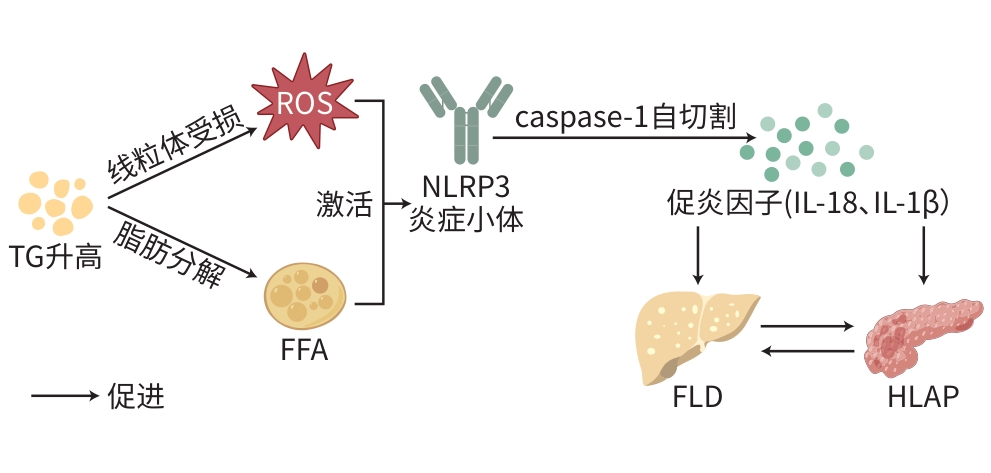
注: TG,甘油三酯;ROS,活性氧;FFA,游离脂肪酸;NLRP3,核苷酸结合寡聚结构域样受体家族热蛋白结构域相关蛋白3;IL-18,白细胞介素18;IL-1β,白细胞介素1β;FLD,脂肪性肝病;HLAP,高脂血症性急性胰腺炎。
图 1 HLAP合并FLD中NLRP3炎症小体通路分子机制
Figure 1. Molecular mechanism of the NLRP3 inflammasome pathway in HLAP combined with FLD
-
[1] ZHOU WD, LIU QF, WANG ZJ, et al. Analysis of the clinical profile and treatment efficiency of hyperlipidemic acute pancreatitis[J]. Lipids Health Dis, 2024, 23( 1): 70. DOI: 10.1186/s12944-024-02057-5. [2] LI S, ZHOU J, LUO GX, et al. Comparison of clinical characteristics between first-episode and recurrent acute hypertriglyceridemic pancreatitis: a national multicenter clinical research[J]. Chin J Dig Surg, 2024, 23( 5): 703- 711. DOI: 10.3760/cma.j.cn115610-20240308-00146.李帅, 周晶, 罗贵贤, 等. 首发和复发急性高甘油三酯血症胰腺炎临床特征比较的全国多中心临床研究[J]. 中华消化外科杂志, 2024, 23( 5): 703- 711. DOI: 10.3760/cma.j.cn115610-20240308-00146. [3] LI WJ, LI ZF, ZHANG Q, et al. The association between gallstone and biliary pancreatitis[J]. J Clin Hepatol, 2024, 40( 10): 2116- 2120. DOI: 10.12449/JCH241031.李玮佳, 李振方, 张倩, 等. 胆道结石与胆源性胰腺炎的关系[J]. 临床肝胆病杂志, 2024, 40( 10): 2116- 2120. DOI: 10.12449/JCH241031. [4] LI XY, KE L, DONG J, et al. Significantly different clinical features between hypertriglyceridemia and biliary acute pancreatitis: A retrospective study of 730 patients from a tertiary center[J]. BMC Gastroenterol, 2018, 18( 1): 89. DOI: 10.1186/s12876-018-0821-z. [5] QIU MH, ZHOU XY, ZIPPI M, et al. Comprehensive review on the pathogenesis of hypertriglyceridaemia-associated acute pancreatitis[J]. Ann Med, 2023, 55( 2): 2265939. DOI: 10.1080/07853890.2023.2265939. [6] GARG R, RUSTAGI T. Management of hypertriglyceridemia induced acute pancreatitis[J]. Biomed Res Int, 2018, 2018: 4721357. DOI: 10.1155/2018/4721357. [7] POUWELS S, SAKRAN N, GRAHAM Y, et al. Non-alcoholic fatty liver disease(NAFLD): A review of pathophysiology, clinical management and effects of weight loss[J]. BMC Endocr Disord, 2022, 22( 1): 63. DOI: 10.1186/s12902-022-00980-1. [8] GU XY, HUANG ZC, YING X, et al. Ferroptosis exacerbates hyperlipidemic acute pancreatitis by enhancing lipid peroxidation and modulating the immune microenvironment[J]. Cell Death Discov, 2024, 10( 1): 242. DOI: 10.1038/s41420-024-02007-1. [9] VIOLLET B. The energy sensor AMPK: Adaptations to exercise, nutritional and hormonal signals[M]// Hormones, Metabolism and the Benefits of Exercise. Cham: Springer International Publishing, 2017: 13- 24. DOI: 10.1007/978-3-319-72790-5_2. [10] KE R, XU QC, LI C, et al. Mechanisms of AMPK in the maintenance of ATP balance during energy metabolism[J]. Cell Biol Int, 2018, 42( 4): 384- 392. DOI: 10.1002/cbin.10915. [11] ROACH PJ. AMPK → ULK1 → autophagy[J]. Mol Cell Biol, 2011, 31( 15): 3082- 3084. DOI: 10.1128/MCB.05565-11. [12] FORETZ M, EVEN PC, VIOLLET B. AMPK activation reduces hepatic lipid content by increasing fat oxidation in vivo[J]. Int J Mol Sci, 2018, 19( 9): 2826. DOI: 10.3390/ijms19092826. [13] JUNG TW, KYUNG EJ, KIM HC, et al. Protectin DX ameliorates hepatic steatosis by suppression of endoplasmic reticulum stress via AMPK-induced ORP150 expression[J]. J Pharmacol Exp Ther, 2018, 365( 3): 485- 493. DOI: 10.1124/jpet.117.246686. [14] ONG G, RAGETLI R, MNICH K, et al. IRE1 signaling increases PERK expression during chronic ER stress[J]. Cell Death Dis, 2024, 15( 4): 276. DOI: 10.1038/s41419-024-06663-0. [15] GENTILE D, ESPOSITO M, GRUMATI P. Metabolic adaption of cancer cells toward autophagy: Is there a role for ER-phagy[J]. Front Mol Biosci, 2022, 9: 930223. DOI: 10.3389/fmolb.2022.930223. [16] JEON YG, KIM YY, LEE G, et al. Physiological and pathological roles of lipogenesis[J]. Nat Metab, 2023, 5( 5): 735- 759. DOI: 10.1038/s42255-023-00786-y. [17] LI MX, MU DZ. Mitophagy and nervous system disease[J]. Chin J Contemp Pediatr, 2017, 19( 6): 724- 729. DOI: 10.7499/j.issn.1008-8830.2017.06.021.李明熹, 母得志. 线粒体自噬与神经系统疾病[J]. 中国当代儿科杂志, 2017, 19( 6): 724- 729. DOI: 10.7499/j.issn.1008-8830.2017.06.021. [18] LIU Q, GU XY, LIU XD, et al. Long-chain fatty acids- The turning point between‘mild’ and‘severe’ acute pancreatitis[J]. Heliyon, 2024, 10( 11): e31296. DOI: 10.1016/j.heliyon.2024.e31296. [19] ZHAO N, XIAO X, CAO LX. The role and molecular mechanisms of endoplasmic reticulum stress in autophagy regulation[J]. Prog Physiol Sci, 2023, 54( 5): 426- 432. DOI: 10.20059/j.cnki.pps.2023.08.1040.赵楠, 肖雪, 曹兰秀. 内质网应激在细胞自噬调控中的作用及其分子机制[J]. 生理科学进展, 2023, 54( 5): 426- 432. DOI: 10.20059/j.cnki.pps.2023.08.1040. [20] MONCAN M, MNICH K, BLOMME A, et al. Regulation of lipid metabolism by the unfolded protein response[J]. J Cell Mol Med, 2021, 25( 3): 1359- 1370. DOI: 10.1111/jcmm.16255. [21] KWON J, KIM J, KIM KI. Crosstalk between endoplasmic reticulum stress response and autophagy in human diseases[J]. Anim Cells Syst, 2023, 27( 1): 29- 37. DOI: 10.1080/19768354.2023.2181217. [22] VAN HERPEN NA, SCHRAUWEN-HINDERLING VB. Lipid accumulation in non-adipose tissue and lipotoxicity[J]. Physiol Behav, 2008, 94( 2): 231- 241. DOI: 10.1016/j.physbeh.2007.11.049. [23] TANASE DM, GOSAV EM, COSTEA CF, et al. The intricate relationship between type 2 diabetes mellitus(T2DM), insulin resistance(IR), and nonalcoholic fatty liver disease(NAFLD)[J]. J Diabetes Res, 2020, 2020: 3920196. DOI: 10.1155/2020/3920196. [24] DAKAL TC, XIAO F, BHUSAL CK, et al. Lipids dysregulation in diseases: Core concepts, targets and treatment strategies[J]. Lipids Health Dis, 2025, 24( 1): 61. DOI: 10.1186/s12944-024-02425-1. [25] CERK IK, WECHSELBERGER L, OBERER M. Adipose triglyceride lipase regulation: An overview[J]. Curr Protein Pept Sci, 2017, 19( 2): 221- 233. DOI: 10.2174/1389203718666170918160110 [26] PARK JY, KIM MJ, KIM YK, et al. Ceramide induces apoptosis via caspase-dependent and caspase-independent pathways in mesenchymal stem cells derived from human adipose tissue[J]. Arch Toxicol, 2011, 85( 9): 1057- 1065. DOI: 10.1007/s00204-011-0645-x. [27] ZHANG QL, SHEN XT, YUAN X, et al. Lipopolysaccharide binding protein resists hepatic oxidative stress by regulating lipid droplet homeostasis[J]. Nat Commun, 2024, 15( 1): 3213. DOI: 10.1038/s41467-024-47553-5. [28] HIDALGO NJ, PANDO E, ALBERTI P, et al. The role of high serum triglyceride levels on pancreatic necrosis development and related complications[J]. BMC Gastroenterol, 2023, 23( 1): 51. DOI: 10.1186/s12876-023-02684-9. [29] KELLEY N, JELTEMA D, DUAN YH, et al. The NLRP3 inflammasome: An overview of mechanisms of activation and regulation[J]. Int J Mol Sci, 2019, 20( 13): 3328. DOI: 10.3390/ijms20133328. [30] YANG Y, WANG HN, KOUADIR M, et al. Recent advances in the mechanisms of NLRP3 inflammasome activation and its inhibitors[J]. Cell Death Dis, 2019, 10( 2): 128. DOI: 10.1038/s41419-019-1413-8. [31] SCHMACKE NA, HORNUNG V. Decoding NLRP3: Phase separation enters the scene[J]. Cell Res, 2025, 35( 6): 391- 392. DOI: 10.1038/s41422-025-01120-9. [32] LU Z, LIU L, ZHAO SX, et al. Apigenin attenuates atherosclerosis and non-alcoholic fatty liver disease through inhibition of NLRP3 inflammasome in mice[J]. Sci Rep, 2023, 13( 1): 7996. DOI: 10.1038/s41598-023-34654-2. [33] OSMAN HA, ABUHAMDAH SMA, HASSAN MH, et al. NLRP3 inflammasome pathway involved in the pathogenesis of metabolic associated fatty liver disease[J]. Sci Rep, 2024, 14( 1): 19648. DOI: 10.1038/s41598-024-69764-y. [34] WREE A, MCGEOUGH MD, INZAUGARAT ME, et al. NLRP3 inflammasome driven liver injury and fibrosis: Roles of IL-17 and TNF in mice[J]. Hepatology, 2018, 67( 2): 736- 749. DOI: 10.1002/hep.29523. [35] LIU PX, CHENG HL, ROBERTS TM, et al. Targeting the phosphoinositide 3-kinase pathway in cancer[J]. Nat Rev Drug Discov, 2009, 8( 8): 627- 644. DOI: 10.1038/nrd2926. [36] SOLINAS G, BECATTINI B. PI3K and AKT at the interface of signaling and metabolism[J]. Curr Top Microbiol Immunol, 2022, 436: 311- 336. DOI: 10.1007/978-3-031-06566-8_13. [37] SHAO CP, XU YQ. PI3K/AKT signaling pathway plays an important role in the pathogenesis of metabolic dysfunction-associated steatotic liver disease[J]. Sci Rep, 2025, 15: 20593. DOI: 10.1038/s41598-025-07612-3. [38] LI JX, DUAN JM, SUN YW, et al. Phillygenin rescues impaired autophagy flux by modulating the PI3K/Akt/mToR signaling pathway in a rat model of severe acute pancreatitis[J]. Int J Immunopathol Pharmacol, 2024, 38: 03946320241309260. DOI: 10.1177/03946320241309260. -

 下载:
下载:
 本文二维码
本文二维码
图(2)
计量
- 文章访问数: 647
- HTML全文浏览量: 316
- PDF下载量: 126
- 被引次数: 0