PDF下载 ( 791 KB)

聚乙二醇干扰素α-2b治疗乙型肝炎代偿期肝硬化效果和安全性的真实世界研究
DOI: 10.12449/JCH260716
Efficacy and safety of pegylated interferon α-2b in treatment of patients with hepatitis B virus-related compensated liver cirrhosis: A real-world study
-
摘要:
目的 探讨聚乙二醇干扰素α-2b(PEG-IFN-α-2b)在乙型肝炎肝硬化患者中的抗病毒疗效,评估该方案的安全性与耐受性,为临床优化乙型肝炎代偿期肝硬化患者的治疗策略提供循证医学证据。 方法 采用前瞻性研究设计,纳入2023年1月—2024年3月在太原市第三人民医院就诊的乙型肝炎代偿期肝硬化患者115例和慢性乙型肝炎患者114例为研究对象。初治患者接受PEG-IFN-α-2b单药治疗,核苷(酸)类似物(NA)经治患者加用PEG-IFN-α-2b联合治疗,乙型肝炎代偿期肝硬化患者于基线及治疗12周、24周、36周和48周进行随访,慢性乙型肝炎患者于基线和随访结束时采集样本,检测病毒学指标、血常规和肝功能。计数资料组间比较采用χ2检验。符合正态分布的计量资料两组间比较采用成组t检验,组内不同时间点比较采用单因素重复测量方差分析,进一步两两比较采用Bonferroni法;不符合正态分布的计量资料两组间比较采用Mann-Whitney U检验,组内不同时间点比较采用Friedman检验,进一步两两比较采用Nemenyi检验。使用多因素Logistic逐步回归模型分析影响临床治愈的因素。 结果 乙型肝炎代偿期肝硬化组患者的平均年龄显著高于慢性乙型肝炎组[(43.50±9.97)岁 vs(40.90±8.16)岁,t=2.160,P=0.032],基线乙型肝炎病毒e抗原阳性比例显著高于慢性乙型肝炎组(28.70% vs 15.79%,χ2=4.788,P=0.029),血小板显著低于慢性乙型肝炎组[(178.67±55.07)×109/L vs (194.93±55.79)×109/L,t=2.217,P=0.028]。随访终点时,乙型肝炎代偿期肝硬化组乙型肝炎病毒表面抗原阴转率(10.38% vs 33.04%)和乙型肝炎病毒表面抗体阳性率(0.00% vs 19.64%)均显著低于慢性乙型肝炎组(χ2值分别为14.988、21.041,P值均<0.001);乙型肝炎代偿期肝硬化组转氨酶水平[ALT:31.00(19.00~47.50)U/L vs 40.00(27.00~57.00)U/L,Z=2.433;AST:31.00(23.00~45.50)U/L vs 37.00(25.00~52.00)U/L,Z=1.963]显著低于慢性乙型肝炎组(P值均<0.05),白细胞[(4.02±1.56)×109/L vs (3.59±1.24)×109/L,t=2.272]、中性粒细胞[(2.39±1.17)×109/L vs (1.87±0.94)×109/L,t=3.284]、血小板[(143.93±68.10)×109/L vs (121.88±49.72)×109/L,t=2.588]均显著高于慢性乙型肝炎组(P值均<0.05)。乙型肝炎病毒表面抗原低水平(比值比=0.997,95%置信区间:0.996~0.999)和NA经治(比值比=5.889,95%置信区间:2.195~17.330)是实现临床治愈的正向预测因素,肝硬化(比值比=0.177,95%置信区间:0.063~0.470)是实现临床治愈的负向预测因素(P值均<0.001)。随访期间,无患者出现肝功能急性失代偿或进展为肝细胞癌,主要不良事件为发热、乏力、白细胞和血小板减少、体重下降、脱发和甲状腺功能异常。乙型肝炎代偿期肝硬化的亚组分析中,无论初治还是NA经治,治疗36周[初治:99.25(5.87~1 212.35)IU/mL;NA经治:205.94(14.00~737.80)IU/mL]和48周[初治:85.45(0.58~827.56)IU/mL;NA经治:45.28(0.16~267.27)IU/mL]的乙型肝炎病毒表面抗原水平均显著低于基线[初治:403.47(36.94~2 569.02)IU/mL;NA经治:427.03(65.64~1 552.65)IU/mL](P值均<0.05)。治疗过程中转氨酶水平显著升高,白细胞、中性粒细胞、血小板、血红蛋白水平均显著降低(P值均<0.05)。 结论 有限疗程的PEG-IFN-α-2b治疗乙型肝炎代偿期肝硬化实现临床治愈的比例虽相对较低,但仍可显著降低乙型肝炎病毒表面抗原水平,且该方案的安全性和耐受性良好,未发生疾病进展。 Abstract:Objective To investigate the antiviral efficacy of pegylated interferon α-2b (PEG-IFN-α-2b) in patients with HBV-related liver cirrhosis, to assess the safety and tolerability of this regimen, and to provide evidence-based medical evidence for optimizing the treatment strategies for patients with HBV-related compensated liver cirrhosis. Methods A prospective study was conducted among 115 patients with HBV-related compensated liver cirrhosis and 114 patients with CHB who attended Third People’s Hospital of Taiyuan from January 2023 to March 2024. Treatment-naïve patients received PEG-IFN-α-2b monotherapy, while the patients once treated with nucleos(t)ide analogues (NAs) received PEG-IFN-α-2b add-on therapy. The patients with HBV-related compensated liver cirrhosis were followed up at baseline and at 12, 24, 36, and 48 weeks of treatment. Samples were collected from CHB patients at baseline and at the end of follow-up to assess virological indicators, routine blood test results, and liver function. The chi-square test was used for comparison of categorical data between groups; the independent samples t-test was used for comparison of normally distributed continuous data between two groups, and the one-way repeated measures analysis of variance was used for comparison among different time ponts within the same group,and the Bonferroni was applied for post-hoc pairwise comparisons; the Mann-Whitney U test was used for comparison of non-normally distributed continuous data between two groups, and the Friedman test was used for comparison across different time points within the same group, and the Nemenyi test was utilized for subsequent pairwise comparisons. The multivariate stepwise Logistic regression analysis was used to investigate the influencing factors for clinical cure. Results Compared with the CHB group, the HBV-related compensated liver cirrhosis group had a significantly higher mean age (43.50±9.97 years vs 40.90±8.16 years, t=2.160, P=0.032), a significantly higher proportion of patients with hepatitis B e antigen at baseline (28.70% vs 15.79%, χ2=4.788, P=0.029), and a significantly lower platelet level [(178.67±55.07)×109/L vs (194.93±55.79)×109/L, t=2.217, P=0.028]. Compared with the CHB group at the end of follow-up, the HBV-related compensated liver cirrhosis group had significantly lower HBV surface antigen (HBsAg) clearance rate (10.38% vs 33.04%, χ2=14.988, P<0.001) and HBV surface antibody positive rate (0.00% vs 19.64%, χ2 =21.041, P<0.001). Compared with the CHB group at the end of follow-up,the HBV-related compensated liver cirrhosis group had significantly lower aminotransferase levels [ALT: 31.00(19.00~47.50) U/L vs 40.00(27.00~57.00) U/L, Z=2.433, P<0.05; AST: 31.00(23.00~45.50) U/L vs 37.00(25.00~52.00) U/L, Z=1.963, P<0.05], but significantly higher level of white blood cells (WBC) [(4.02±1.56)×109/L vs (3.59±1.24)×109/L, t=2.272, P<0.05], neutrophils [(2.39±1.17)×109/L vs (1.87±0.94)×109/L, t=3.284, P<0.05], and platelets [(143.93±68.10)×109/L vs (121.88±49.72)×109/L, t=2.588, P<0.05]. A lower level of HBsAg (OR=0.997, 95%CI: 0.996 — 0.999, P<0.001) and previous treatment with NAs (OR=5.889, 95%CI: 2.195 — 17.330, P<0.001) were positive predictive factors for clinical cure, while liver cirrhosis (OR=0.177, 95%CI: 0.063 — 0.470, P<0.001) was a negative predictive factor for clinical cure. During follow-up, no patients experienced acute decompensation or progression to hepatocellular carcinoma, and the main adverse events included fever, fatigue, reductions in WBC and platelets, weight loss, alopecia, and thyroid dysfunction. In the subgroup analysis of HBV-related compensated liver cirrhosis, in both the treatment-naïve patients and the patients previously treated with NAs, there was a significant reduction in HBsAg level from baseline to week 36 of treatment [treatment-naïve: 99.25 (5.87 — 1 212.35) IU/mL vs 403.47 (36.94 — 2 569.02) IU/mL, P<0.05; previously treated with NAs: 205.94 (14.00 — 737.80) IU/mL vs 427.03 (65.64 — 1 552.65) IU/mL, P<0.05] and week 48 of treatment [treatment-naïve: 85.45 (0.58 — 827.56) IU/mL vs 403.47 (36.94 — 2 569.02) IU/mL, P<0.05; previously treated with NAs: 45.28 (0.16 — 267.27) IU/mL vs 427.03 (65.64 — 1 552.65) IU/mL, P<0.05]. There were significant increases in the levels of aminotransferases during treatment, as well as significant reductions in the levels of WBC, neutrophils, platelets, and hemoglobin (all P<0.05). Conclusion Although a finite course of PEG-IFN-α-2b therapy has achieved a relatively low rate of clinical cure in the treatment of HBV-related compensated liver cirrhosis, it can still significantly reduce the level of HBsAg, and this treatment regimen has good safety and tolerability, without accelerating disease progression. -
Key words:
- Hepatitis B Virus /
- Liver Cirrhosis /
- Interferon-alpha /
- Therapeutics
-
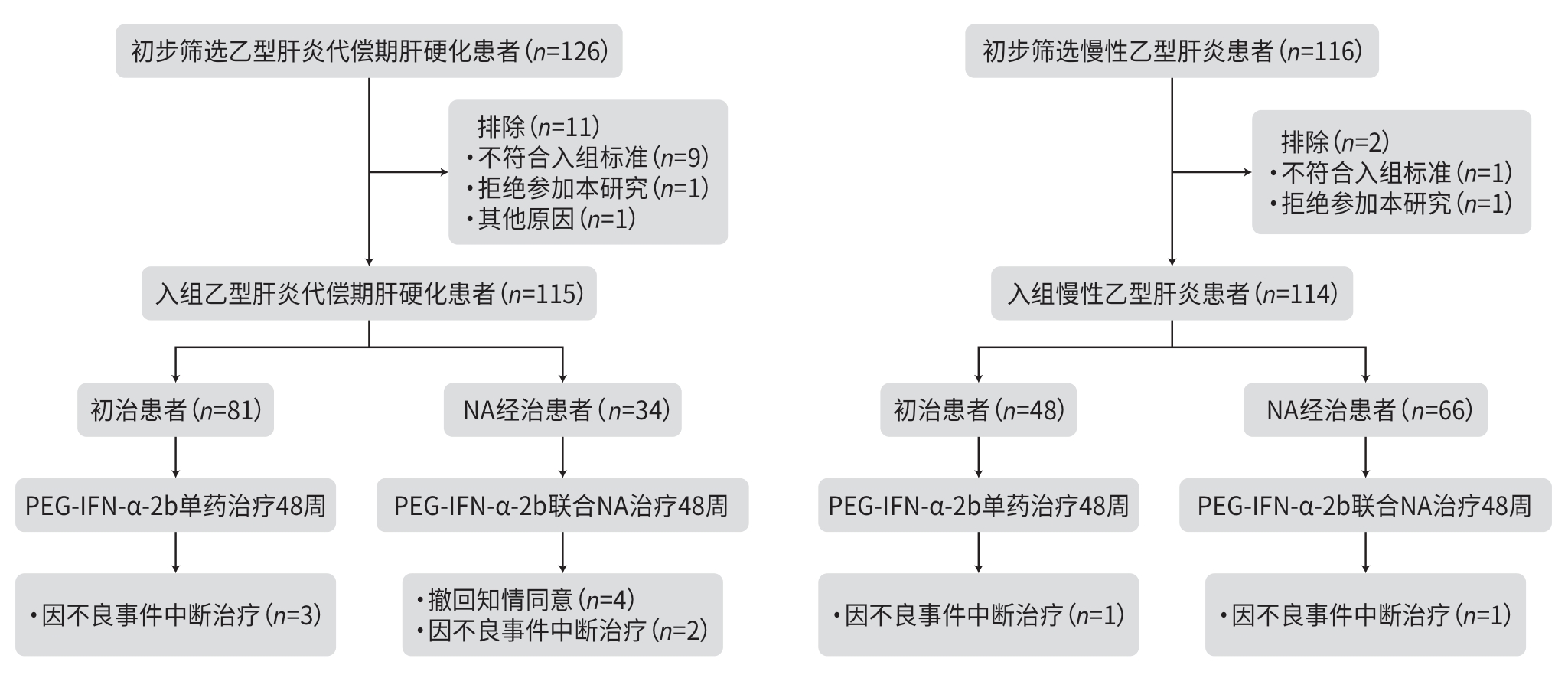
注: PEG-IFN-α-2b,聚乙二醇干扰素α-2b;NA,核苷(酸)类似物;CONSORT,临床研究报告规范。
图 1 CONSORT流程示意图
Figure 1. Consolidated standards of reporting trials flow diagram
表 1 乙型肝炎代偿期肝硬化组和慢性乙型肝炎组基线临床特征比较
Table 1. Comparison of baseline clinical characteristics between compensated HBV-liver cirrhosis and chronic hepatitis B
指标 乙型肝炎代偿期肝硬化组(n=115) 慢性乙型肝炎组(n=114) 统计值 P值 男/女(例) 81/34 73/41 χ2=1.065 0.302 年龄(岁) 43.50±9.97 40.90±8.16 t=2.160 0.032 乙型肝炎家族史[例(%)] 26(22.61) 38(33.33) χ2=3.759 0.052 肝癌家族史[例(%)] 25(21.74) 33(28.95) χ2=1.215 0.270 吸烟史[例(%)] 19(16.52) 23(20.18) χ2=0.296 0.587 饮酒史[例(%)] 13(11.30) 7(6.14) χ2=0.044 0.833 HBV DNA阳性[例(%)] 50(43.48) 47(41.23) χ2=1.759 0.185 HBsAg(IU/mL) 403.47(48.56~2 315.14) 888.62(88.54~3 071.87) Z=1.530 0.506 HBeAg阳性[例(%)] 33(28.70) 18(15.79) χ2=4.788 0.029 ALT(U/L) 26.00(19.00~38.00) 24.50(16.75~34.25) Z=1.790 0.154 AST(U/L) 24.00(20.00~31.00) 23.00(19.75~30.00) Z=1.578 0.114 Alb(g/L) 45.29±4.99 46.44±4.33 t=1.845 0.066 白细胞(×109/L) 5.69±1.50 5.46±1.69 t=1.125 0.261 中性粒细胞(×109/L) 3.36±1.19 3.14±1.31 t=1.297 0.196 血小板(×109/L) 178.67±55.07 194.93±55.79 t=2.217 0.028 血红蛋白(g/L) 149.44±18.75 147.48±18.96 t=0.766 0.445 注:HBV,乙型肝炎病毒;HBsAg,乙型肝炎病毒表面抗原;HBeAg,乙型肝炎病毒e抗原;ALT,丙氨酸氨基转移酶;AST,天冬氨酸氨基转移酶;Alb,白蛋白。
 下载: 导出CSV
表 2 乙型肝炎代偿期肝硬化组和慢性乙型肝炎组随访终点临床特征比较
Table 2. Comparison of clinical characteristics at the end of therapy between compensated HBV-liver cirrhosis and chronic hepatitis B
指标 乙型肝炎代偿期肝硬化组(n=106) 慢性乙型肝炎组(n=112) 统计值 P值 HBV DNA阳性[例(%)] 10(9.43) 10(8.93) χ2=0.011 0.916 HBsAg阴性[例(%)] 11(10.38) 37(33.04) χ2=14.988 <0.001 HBsAb阳性[例(%)] 0(0.00) 22(19.64) χ2=21.041 <0.001 HBsAg(IU/mL) 70.60(2.56~360.06) 27.10(0.00~1 138.64) Z=0.867 0.383 HBeAg阳性[例(%)] 19(17.92) 10(8.93) χ2=3.081 0.079 ALT(U/L) 31.00(19.00~47.50) 40.00(27.00~57.00) Z=2.433 0.015 AST(U/L) 31.00(23.00~45.50) 37.00(25.00~52.00) Z=1.963 0.049 Alb(g/L) 45.00±3.62 44.50±3.38 t=0.963 0.337 白细胞(×109/L) 4.02±1.56 3.59±1.24 t=2.272 0.024 中性粒细胞(×109/L) 2.39±1.17 1.87±0.94 t=3.284 0.001 血小板(×109/L) 143.93±68.10 121.88±49.72 t=2.588 0.010 血红蛋白(g/L) 137.33±22.20 131.90±19.01 t=1.816 0.071 注:HBV,乙型肝炎病毒;HBsAg,乙型肝炎病毒表面抗原;HBsAb,乙型肝炎病毒表面抗体;HBeAg,乙型肝炎病毒e抗原;ALT,丙氨酸氨基转移酶;AST,天冬氨酸氨基转移酶;Alb,白蛋白。
下载: 导出CSV
表 3 慢性HBV感染者实现临床治愈的多因素分析
Table 3. Multivariate model analysis of clinical cure of chronic HBV infection
因素 β值 SE Wald χ2 OR 95%CI P值 性别 0.561 0.708 0.793 1.753 0.437~7.200 0.428 年龄 -0.057 0.030 1.911 0.945 0.900~0.999 0.056 HBV DNA阳性 0.315 0.544 0.580 1.371 0.479~4.108 0.562 HBsAg -0.003 0.001 3.845 0.997 0.996~0.999 <0.001 HBeAg阳性 -0.685 0.716 0.956 0.504 0.111~1.927 0.339 ALT -0.018 0.031 0.577 0.982 0.922~1.036 0.564 AST 0.014 0.053 0.269 1.014 0.913~1.125 0.788 Alb 0.042 0.047 0.889 1.043 0.940~1.138 0.374 白细胞 0.114 0.367 0.310 1.120 0.531~2.279 0.756 中性粒细胞 -0.072 0.464 0.155 0.945 0.374~2.355 0.877 血小板 0.002 0.006 0.411 1.002 0.992~1.013 0.681 血红蛋白 0.032 0.019 1.645 1.032 0.996~1.075 0.100 肝硬化 -1.730 0.510 3.393 0.177 0.063~0.470 <0.001 NA经治 1.773 0.522 3.394 5.889 2.195~17.330 <0.001 注:HBV,乙型肝炎病毒;HBsAg,乙型肝炎病毒表面抗原;HBeAg,乙型肝炎病毒e抗原;OR,比值比;CI,置信区间;SE,标准误;ALT,丙氨酸氨基转移酶;AST,天冬氨酸氨基转移酶;Alb,白蛋白;NA,核苷(酸)类似物。计数资料赋值:性别:男=1,女=0;HBV DNA阳性:是=1,否=0;HBeAg阳性:是=1,否=0;肝硬化:是=1,否=0;NA经治:是=1,否=0。
下载: 导出CSV
表 4 乙型肝炎代偿期肝硬化组和慢性乙型肝炎组不良反应发生率比较
Table 4. Comparison of major side effects between compensated HBV-liver cirrhosis and chronic hepatitis B
主要不良事件 乙型肝炎代偿期肝硬化组(n=115) 慢性乙型肝炎组(n=114) χ2值 P值 发热[例(%)] 115(100.00) 114(100.00) 乏力[例(%)] 114(99.13) 112(98.25) <0.001 0.994 白细胞减少[例(%)] 113(98.26) 110(96.49) 0.180 0.671 血小板减少[例(%)] 112(97.39) 107(93.86) 0.969 0.325 体重下降[例(%)] 107(93.04) 99(86.84) 1.799 0.180 脱发[例(%)] 92(80.00) 89(78.07) 0.038 0.844 甲状腺功能异常[例(%)] 17(14.78) 19(16.67) 0.044 0.834
下载: 导出CSV
表 5 初治和NA经治乙型肝炎代偿期肝硬化患者基线临床特征
Table 5. Baseline clinical characteristics of treatment-naïve and NAs-experienced HBV-related compensated liver cirrhosis
指标 初治组(n=81) 经治组(n=34) 统计值 P值 男/女(例) 56/25 25/9 χ2=0.222 0.638 年龄(岁) 44.32±9.76 41.56±10.33 t=1.361 0.176 乙型肝炎家族史[例(%)] 15(18.52) 11(32.25) χ2=2.620 0.106 肝癌家族史[例(%)] 14(17.28) 11(32.25) χ2=3.196 0.074 吸烟史[例(%)] 7(8.64) 12(35.29) χ2=12.331 <0.001 饮酒史[例(%)] 2(2.47) 11(32.25) χ2=21.224 <0.001 HBV DNA阳性[例(%)] 32(39.51) 18(52.94) χ2=1.759 0.185 HBsAg(IU/mL) 403.47(36.94~2 569.02) 427.03(65.64~1 552.65) Z=0.214 0.830 HBeAg阳性[例(%)] 20(24.69) 13(38.24) χ2=2.147 0.143 ALT(U/L) 26.00(19.00~38.50) 26.00(18.75~37.25) Z=0.196 0.844 AST(U/L) 24.00(20.00~33.00) 24.00(21.00~31.00) Z=0.208 0.837 Alb(g/L) 45.26±5.52 45.35±3.51 t=0.091 0.927 白细胞(×109/L) 5.59±1.41 5.95±1.69 t=1.182 0.240 中性粒细胞(×109/L) 3.25±1.14 3.61±1.29 t=1.482 0.141 血小板(×109/L) 177.69±54.44 180.82±57.33 t=0.273 0.786 血红蛋白(g/L) 149.00±18.79 150.36±18.91 t=0.358 0.721 注:HBV,乙型肝炎病毒;HBsAg,乙型肝炎病毒表面抗原;HBeAg,乙型肝炎病毒e抗原;ALT,丙氨酸氨基转移酶;AST,天冬氨酸氨基转移酶;Alb,白蛋白;NA,核苷(酸)类似物。
下载: 导出CSV
表 6 初治乙型肝炎代偿期肝硬化患者治疗过程中病毒学、肝功能、血常规指标的变化
Table 6. The changes in virological, liver function and blood routine indices during treatment in treatment-naïve HBV related compensated liver cirrhosis
指标 基线(n=81) 12周(n=81) 24周(n=78) 36周(n=78) 48周(n=78) 统计值 P值 HBV DNA阳性[例(%)] 32(39.51) 11(13.58)1) 9(11.53)1) 7(8.97)1) 7(8.97)1) χ2=20.009 <0.001 HBsAg阴性[例(%)] 0(0.00) 1(1.23) 4(5.13)1) 5(6.41)1) 6(7.69)1) χ2=6.475 0.011 HBsAg(IU/mL) 403.47
(36.94~2 569.02)361.42
(46.29~1 716.08)254.29
(18.67~1 532.64)99.25
(5.87~1 212.35)1)85.45
(0.58~827.56)1)Q=17.459 0.002 HBeAg阳性[例(%)] 20(24.69) 19(23.46) 16(20.51) 13(16.67) 12(14.81) χ2=2.141 0.143 ALT(U/L) 26.00
(19.00~38.50)41.00
(28.50~63.00)1)38.00
(25.25~55.25)1)35.00
(24.00~56.00)1)32.00
(19.00~49.00)Q=11.881 0.018 AST(U/L) 24.00
(20.00~31.00)45.00
(33.50~68.00)1)39.00
(28.00~55.00)1)41.00
(26.75~63.25)1)32.50
(22.75~53.75)1)Q=55.913 <0.001 Alb(g/L) 45.26±5.52 44.39±3.61 44.91±3.22 44.94±4.56 44.68±3.53 F=0.128 0.968 白细胞(×109/L) 5.59±1.41 3.55±1.461) 3.81±1.811) 3.52±1.221) 3.96±1.571) F=21.347 <0.001 中性粒细胞(×109/L) 3.25±1.14 1.94±0.991) 2.10±1.251) 1.94±0.741) 2.35±1.171) F=11.566 <0.001 血小板(×109/L) 177.69±54.44 110.42±46.621) 124.72±57.14 1) 133.81±52.731) 141.30±65.051) F=9.861 <0.001 血红蛋白(g/L) 149.00±18.79 136.49±20.871) 136.08±17.14 1) 137.42±19.831) 137.01±21.891) F=3.325 0.014 注:与基线比较,1)P<0.05。HBV,乙型肝炎病毒;HBsAg,乙型肝炎病毒表面抗原;HBeAg,乙型肝炎病毒e抗原;ALT,丙氨酸氨基转移酶;AST,天冬氨酸氨基转移酶;Alb,白蛋白。
下载: 导出CSV
表 7 NA经治乙型肝炎代偿期肝硬化患者治疗过程中病毒学、肝功能、血常规指标的变化
Table 7. The changes in virological, liver function and blood routine indices during treatment in NAs-experienced HBV related compensated liver cirrhosis
指标 基线(n=34) 12周(n=32) 24周(n=28) 36周(n=28) 48周(n=28) 统计值 P值 HBV DNA阳性[例(%)] 18(52.94) 6(18.75)1) 4(14.29)1) 4(14.29)1) 3(10.71)1) χ2=12.650 <0.001 HBsAg阴性[例(%)] 0(0.00) 1(3.13) 4(14.29)1) 4(14.29)1) 5(17.86)1) χ2=6.244 0.014 HBsAg(IU/mL) 427.03
(65.64~1 552.65)283.26
(20.19~1 451.88)244.74
(47.83~662.39)205.94
(14.00~737.80)1)45.28
(0.16~267.27)1)Q=12.832 0.012 HBeAg阳性[例(%)] 13(38.24) 11(34.38) 10(34.38) 9(31.03) 7(24.14) χ2=1.436 0.231 ALT(U/L) 26.00
(18.75~37.25)42.50
(29.50~83.25)1)41.00
(28.25~69.00)1)32.00
(26.00~46.00)31.00
(18.75~41.75)Q=3.690 0.045 AST(U/L) 24.00
(21.00~31.00)50.00
(34.25~67.25)1)46.00
(31.75~60.00)1)36.00
(28.50~48.50)1)29.00
(24.00~40.00)Q=16.447 0.003 Alb(g/L) 45.35±3.51 43.91±2.52 43.48±3.87 45.77±5.97 45.61±4.00 F=2.132 0.132 白细胞(×109/L) 5.95±1.69 3.24±0.661) 3.22±1.211) 3.90±1.461) 4.15±1.551) F=11.207 <0.001 中性粒细胞(×109/L) 3.61±1.29 1.72±0.621) 1.81±0.961) 2.70±1.541) 2.50±1.211) F=3.265 0.035 血小板(×109/L) 180.82±57.33 109.29±39.581) 114.54±47.811) 123.02±63.101) 151.36±77.401) F=5.909 0.001 血红蛋白(g/L) 150.36±18.91 134.31±16.751) 130.90±18.721) 130.62±22.161) 138.37±23.611) F=3.049 0.032 注:与基线比较,1)P<0.05。HBsAg,乙型肝炎病毒表面抗原;HBeAg,乙型肝炎病毒e抗原;ALT,丙氨酸氨基转移酶;AST,天冬氨酸氨基转移酶;Alb,白蛋白;NA,核苷(酸)类似物。
下载: 导出CSV
-
[1] Cui F Q, Shen L P, Li L, et al. Prevention of chronic hepatitis B after 3 decades of escalating vaccination policy, China[J]. Emerg Infect Dis, 2017, 23( 5): 765- 772. DOI: 10.3201/eid2305.161477. [2] Liu J, Liang W N, Jing W Z, et al. Countdown to 2030: Eliminating hepatitis B disease, China[J]. Bull World Health Organ, 2019, 97( 3): 230- 238. DOI: 10.2471/BLT.18.219469. [3] Cao G Y, Liu J, Liu M. Trends in mortality of liver disease due to hepatitis B in China from 1990 to 2019: Findings from the Global Burden of Disease Study[J]. Chin Med J, 2022, 135( 17): 2049- 2055. DOI: 10.1097/CM9.0000000000002331. [4] Moini M, Fung S. HBsAg loss as a treatment endpoint for chronic HBV infection: HBV cure[J]. Viruses, 2022, 14( 4): 657. DOI: 10.3390/v14040657. [5] Yeo Y H, Ho H J, Yang H I, et al. Factors associated with rates of HBsAg seroclearance in adults with chronic HBV infection: A systematic review and meta-analysis[J]. Gastroenterology, 2019, 156( 3): 635- 646. DOI: 10.1053/j.gastro.2018.10.027. [6] Zhang Yang, Li Yongsheng, Wang Jing. Effect of ganfule capsule,tenofovir amibufenamide tablets combined with polyethylene glycol interferon α-2b in patients with chronic hepatitis B and its influence on immune function[J]. J Clin Exp Med, 2024, 23( 21): 2268- 2271. DOI: 10.3969/j.issn.1671-4695.2024.21.008.张阳, 李永胜, 王婧. 肝复乐胶囊、艾米替诺福韦片联合聚乙二醇干扰素α-2b治疗慢性乙型病毒性肝炎的临床疗效及对免疫功能的影响[J]. 临床和实验医学杂志, 2024, 23( 21): 2268- 2271. DOI: 10.3969/j.issn.1671-4695.2024.21.008. [7] Hu P, Shang J, Zhang W H, et al. HBsAg loss with peg-interferon Alfa-2a in hepatitis B patients with partial response to nucleos(t)ide analog: New switch study[J]. J Clin Transl Hepatol, 2018, 6( 1): 25- 34. DOI: 10.14218/JCTH.2017.00072. [8] Wu F P, Yang Y, Li M, et al. Add-on pegylated interferon augments hepatitis B surface antigen clearance vs continuous nucleos(t)ide analog monotherapy in Chinese patients with chronic hepatitis B and hepatitis B surface antigen≤1500 IU/mL: An observational study[J]. World J Gastroenterol, 2020, 26( 13): 1525- 1539. DOI: 10.3748/wjg.v26.i13.1525. [9] Chinese Society of Hepatology, Chinese Medical Association. Chinese guidelines on the management of liver cirrhosis[J]. J Clin Hepatol, 2019, 35( 11): 2408- 2425. DOI: 10.3969/j.issn.1001-5256.2019.11.006.中华医学会肝病学分会. 肝硬化诊治指南[J]. 临床肝胆病杂志, 2019, 35( 11): 2408- 2425. DOI: 10.3969/j.issn.1001-5256.2019.11.006. [10] Chinese Society of Hepatology, Chinese Medical Association; Chinese Society of Infectious Diseases, Chinese Medical Association. Guidelines for the prevention and treatment of chronic hepatitis B(2022 version)[J]. Chin J Infect Dis, 2023, 41( 1): 3- 28. DOI: 10.3760/cma.j.cn311365-20230220-00050.中华医学会肝病学分会, 中华医学会感染病学分会. 慢性乙型肝炎防治指南(2022年版)[J]. 中华传染病杂志, 2023, 41( 1): 3- 28. DOI: 10.3760/cma.j.cn311365-20230220-00050. [11] Ning Q, Han M F, Sun Y T, et al. Switching from entecavir to PegIFN alfa-2a in patients with HBeAg-positive chronic hepatitis B: A randomised open-label trial(OSST trial)[J]. J Hepatol, 2014, 61( 4): 777- 784. DOI: 10.1016/j.jhep.2014.05.044. [12] Han C, Jin L L, Zhu M J, et al. Efficacy and predictors of pegylated-interferon in hepatitis B surface antigen seroclearance in immune active and inactive chronic hepatitis B patients[J]. J Virus Erad, 2025, 11( 4): 100616. DOI: 10.1016/j.jve.2025.100616. [13] García-López M, Lens S, Pallett L J, et al. HBV suppression by nucleos(t)ide analogues reduces PD-1 expression on liver-resident T cells[J]. Liver Int, 2025, 45( 11): e70338. DOI: 10.1111/liv.70338. [14] Khanam A, Chua JV, Kottilil S. Immunopathology of chronic hepatitis B infection: Role of innate and adaptive immune response in disease progression[J]. Int J Mol Sci, 2021, 22( 11): 5497. DOI: 10.3390/ijms22115497. [15] Huang Y, Qi M, Liao C J, et al. Analysis of the efficacy and safety of PEGylated interferon-α2b treatment in inactive hepatitis B surface antigen carriers[J]. Infect Dis Ther, 2021, 10( 4): 2323- 2331. DOI: 10.1007/s40121-021-00511-w. [16] Cao Z H, Liu Y L, Ma L N, et al. A potent hepatitis B surface antigen response in subjects with inactive hepatitis B surface antigen carrier treated with pegylated-interferon alpha[J]. Hepatology, 2017, 66( 4): 1058- 1066. DOI: 10.1002/hep.29213. [17] Ren H, Huang Y. Effects of pegylated interferon-α based therapies on functional cure and the risk of hepatocellular carcinoma development in patients with chronic hepatitis B[J]. J Viral Hepat, 2019, 26( Suppl 1): 5- 31. DOI: 10.1111/jvh.13150. [18] Bai Q Q, Li R Y, He X, et al. Single-cell landscape of immune cells during the progression from HBV infection to HBV cirrhosis and HBV-associated hepatocellular carcinoma[J]. Front Immunol, 2023, 14: 1320414. DOI: 10.3389/fimmu.2023.1320414. [19] Sun R N, Li J W, Lin X Y, et al. Peripheral immune characteristics of hepatitis B virus-related hepatocellular carcinoma[J]. Front Immunol, 2023, 14: 1079495. DOI: 10.3389/fimmu.2023.1079495. [20] Qin Lei, Li Guangpeng, Shen Peijun, et al. Effect of pegylated interferon-α-2b therapy on cytotoxicity of virus-specific CD8+ T cells in HBeAg-negative patients with chronic hepatitis B virus infection[J]. J Clin Hepatol, 2025, 41( 4): 628- 636. DOI: 10.12449/JCH250406.秦蕾, 李广鹏, 申培君, 等. 聚乙二醇干扰素-α-2b对HBeAg阴性慢性HBV感染者HBV特异性CD8+T淋巴细胞杀伤功能的影响[J]. 临床肝胆病杂志, 2025, 41( 4): 628- 636. DOI: 10.12449/JCH250406. [21] Lee H W, Yip T C, Tse Y K, et al. Hepatic decompensation in cirrhotic patients receiving antiviral therapy for chronic hepatitis B[J]. Clin Gastroenterol Hepatol, 2021, 19( 9): 1950- 1958. DOI: 10.1016/j.cgh.2020.08.064. [22] Yang D H, Wang W P, Zhang Q, et al. Hepatocellular carcinoma progression in hepatitis B virus-related cirrhosis patients receiving nucleoside(acid) analogs therapy: A retrospective cross-sectional study[J]. World J Gastroenterol, 2021, 27( 17): 2025- 2038. DOI: 10.3748/wjg.v27.i17.2025. [23] Li S Y, Li H, Xiong Y L, et al. Peginterferon is preferable to entecavir for prevention of unfavourable events in patients with HBeAg-positive chronic hepatitis B: A five-year observational cohort study[J]. J Viral Hepat, 2017, 24( Suppl 1): 12- 20. DOI: 10.1111/jvh.12755. [24] Erken R, Loukachov V V, de Niet A, et al. A prospective five-year follow-up after peg-interferon plus nucleotide analogue treatment or no treatment in HBeAg negative chronic hepatitis B patients[J]. J Clin Exp Hepatol, 2022, 12( 3): 735- 744. DOI: 10.1016/j.jceh.2021.12.011. [25] Mao Q G, Liang H Q, Yin Y L, et al. Comparison of Interferon-α-based therapy and nucleos(t)ide analogs in preventing adverse outcomes in patients with chronic hepatitis B[J]. Clin Res Hepatol Gastroenterol, 2022, 46( 1): 101758. DOI: 10.1016/j.clinre.2021.101758. -

 本文二维码
本文二维码
计量
- 文章访问数: 795
- HTML全文浏览量: 111
- PDF下载量: 66
- 被引次数: 0