PDF下载 ( 12076 KB)

功能基因组分析联合个体化药物筛选治疗常染色体显性多囊肾病合并先天性肝纤维化1例报告
DOI: 10.12449/JCH260725
Clinical effect of functional genomic analysis combined with individualized drug selection in treatment of autosomal dominant polycystic kidney disease with congenital hepatic fibrosis: A case report
-
摘要: 常染色体显性多囊肾病是一种系统性遗传性肾脏疾病,可累及多脏器,其中肝脏受累的表现之一为先天性肝纤维化,是本病的重要并发症。现有治疗手段主要为对症管理,特异性药物托伐普坦应用受限且无法纠正遗传缺陷。本文报道1例常染色体显性多囊肾病合并先天性肝纤维化患者,通过外周血功能基因组分析结合药物敏感性预测平台筛选出西罗莫司作为个体化治疗方案。患者接受治疗后症状明显改善,生活质量提升,肾脏体积稳定。本案例提示,功能基因组学在指导遗传性罕见疾病个体化治疗中具有潜在价值,为类似患者提供了新的治疗思路与实践路径。
-
关键词:
- 多囊肾, 常染色体显性 /
- 肝纤维化 /
- 表观基因组学 /
- 精准医学
Abstract: Autosomal dominant polycystic kidney disease (ADPKD) is a systemic hereditary renal disorder and can affect multiple organs, and congenital hepatic fibrosis is one of the manifestations of liver involvement and is an important complication of ADPKD. Symptomatic management is currently the main treatment method for this disease, and disease-specific drugs such as tolvaptan have limited indications and cannot correct the underlying genetic defect. This article reports a case of ADPKD with congenital hepatic fibrosis, and sirolimus was identified as the individualized treatment regimen based on peripheral blood functional genomic analysis and drug sensitivity prediction platform. The patient achieved significant improvements in symptoms and quality of life after treatment, with a stable kidney volume. This case shows that functional genomics has a potential value in guiding individualized treatment of rare genetic disorders, which provides new treatment ideas and practice paths for similar patients. -
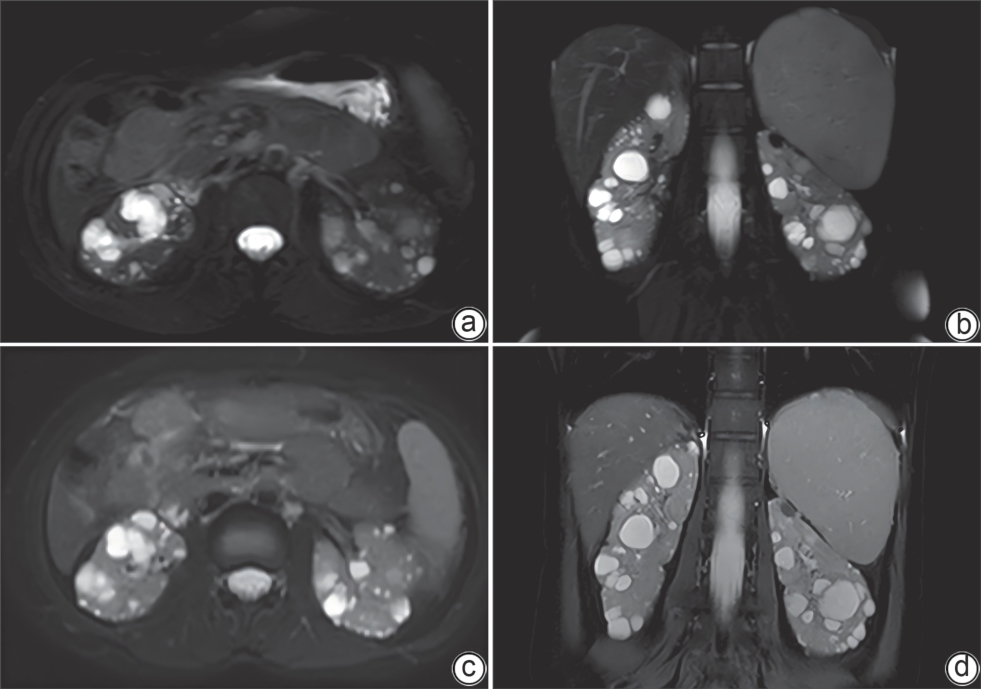
注: a、b,治疗前(2024-09-08)的横断面和冠状面T2WI:双肾多发囊性病变显示为高信号;c、d,治疗后(2025-07-21)的横断面和冠状面T2WI:双肾多发囊性病变与治疗前相比,形态、大小均变化不明显。T2WI,T2加权成像。
图 1 肝脏磁共振成像
Figure 1. The magnetic resonance images of liver
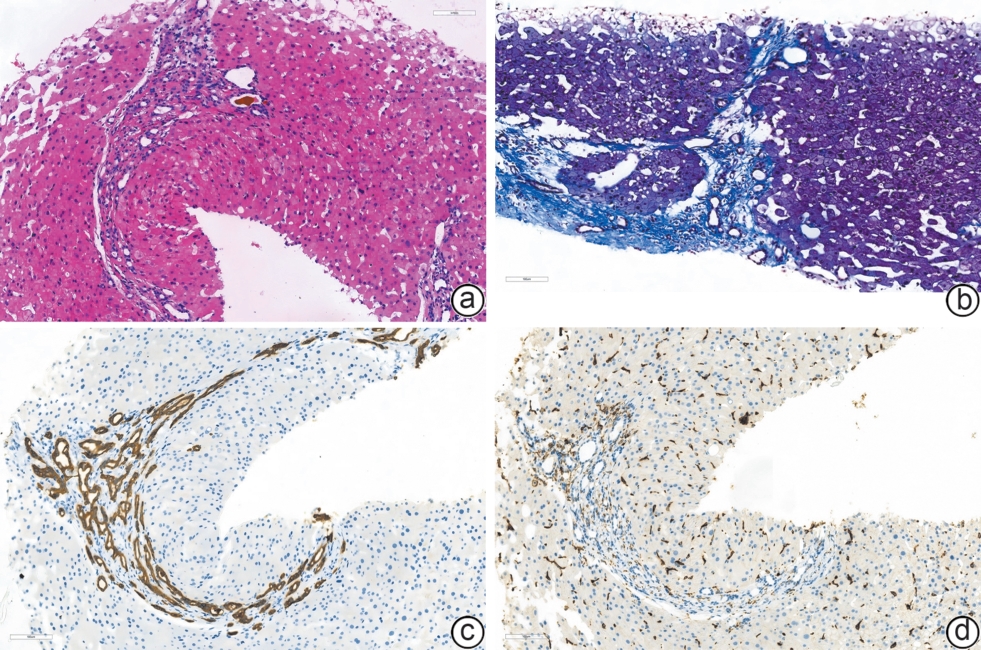
注: a,苏木精-伊红染色(+);b,马松染色(+);c,CK19(+);d,CD68(散在+)。CK19,细胞角蛋白19;CD68,分化簇68。
图 2 肝组织病理(×20)
Figure 2. Liver pathology (×20)
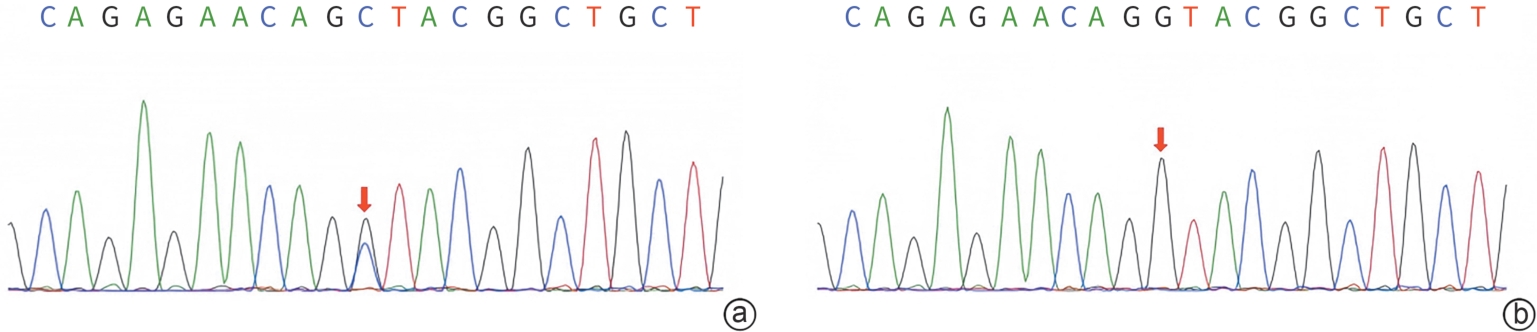
注: a,患者PKD1存在一处杂合变异c.4455C>G(p.Tyr1485Ter);b,患者母亲未检出该位点。PKD1,多囊肾病1型致病基因。
图 3 基因检测分析
Figure 3. Genetic testing analysis
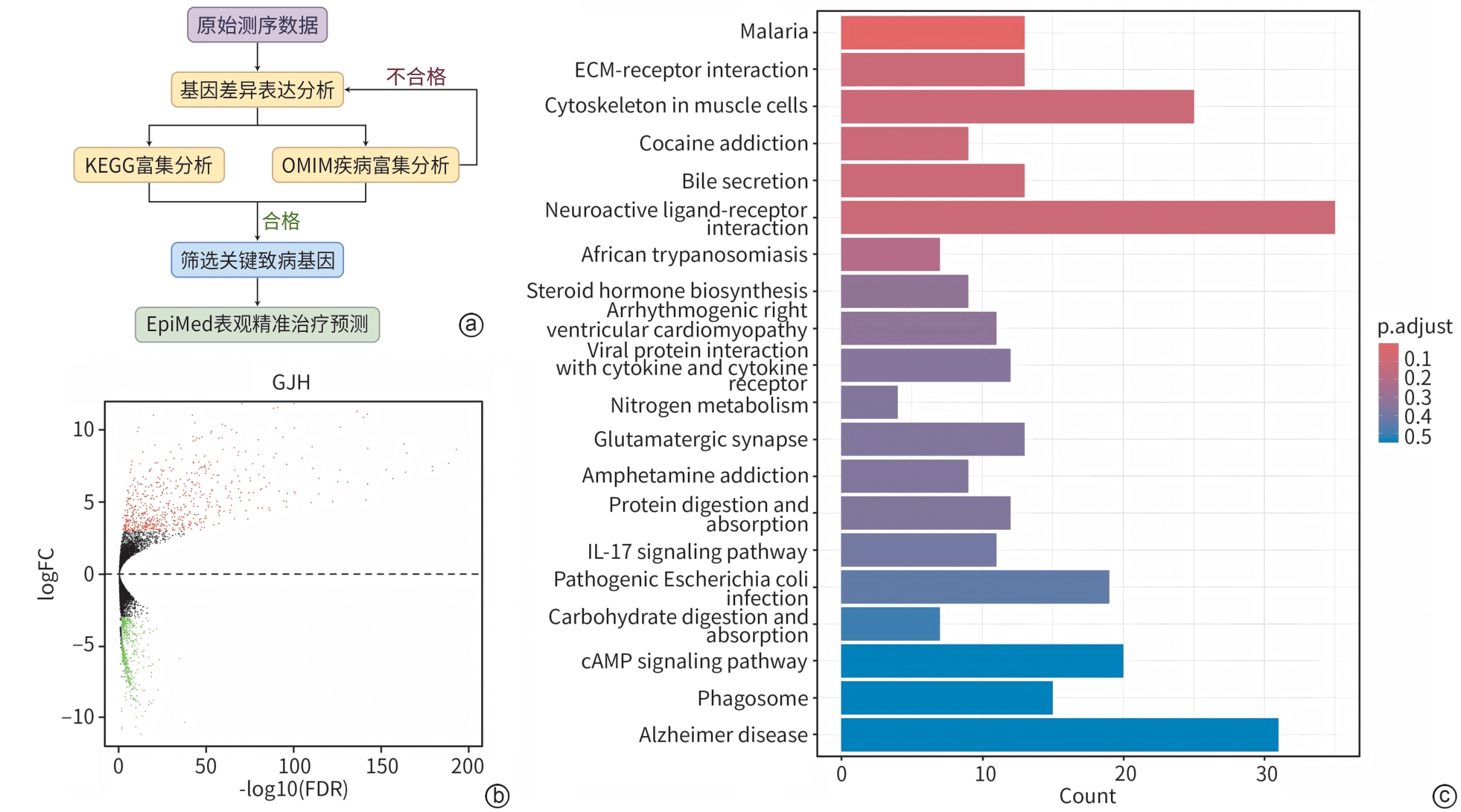
注: a,外周血行全转录组测序分析流程;b,患者与正常人相比外周血差异表达基因(红色:显著上调基因,绿色:显著下调基因,黑色:无显著表达差异基因);c,差异表达基因通路富集分析。KEGG,京都基因与基因组百科全书;OMIM,在线人类孟德尔遗传数据库;EpiMed,表观基因组精准药物预测平台。
图 4 全转录组测序分析
Figure 4. RNA-seq analysis
表 1 患者治疗前和治疗后检查结果比较
Table 1. Comparison of test results before and after the patient’s treatment
指标 治疗前
(2024-09-08)治疗后3个月
(2025-02-11)治疗后6个月
(2025-05-16)治疗后8个月
(2025-07-21)白细胞(×109/L) 2.77 4.54 5.40 4.64 中性粒细胞(×109/L) 1.38 2.55 3.71 2.90 血小板(×109/L) 100 124 134 158 丙氨酸氨基转移酶(U/L) 16 22 27 16 天冬氨酸氨基转移酶(U/L) 19 21 25 21 肌酐(μmol/L) 51 53 52 49 凝血酶原时间(s) 11.1 11.9 12.0 12.3 尿酸(μmol/L) 412 269 260 245 肾小球滤过率(mL/min) 137 124 125 138 肝脏 超声:肝右前叶稍高回
声(约31 mm×24 mm)超声:肝左叶增大
(120 mm×74 mm),
肝右叶实性结节(约
20 mm×15 mm)超声:肝左叶大小
116 mm×71 mm,肝右
叶实性结节(约20 mm×
15 mm)核磁:肝脏形态规整,体
积增大,肝表面光滑,肝
左外叶獭尾样伸向左侧脾脏 超声:厚51 mm,
长152 mm超声:厚45 mm,
长135 mm超声:厚47 mm,
长133 mm核磁:厚48 mm,斜径
133 mm肾脏 核磁:双肾多发囊肿
(较大者约2.9 cm,部分
复杂囊肿可能)超声:双肾多发囊肿
(其中一个约
31 mm×22 mm)核磁:双肾多发囊肿(较
大者约2.9 cm,部分复杂
囊肿可能)肾脏体积 右:240.52 cm3;
左:223.58 cm3右:244.89 cm3;
左:221.07 cm3肾脏总体积 464.10 cm3 465.96 cm3  下载: 导出CSV
表 2 基于功能基因组学的EpiMed平台药物预测结果
Table 2. Drug prediction results of the EpiMed platform based on functional genomics
药物类型 候选敏感药物 靶向药物 达沙替尼 利尿药物 呋塞米、螺内酯、氨苯蝶啶、布美他尼 免疫调节药物 硫唑嘌呤、西罗莫司、他克莫司 抗病毒药物 利托那韦 其他药物 秋水仙碱、西咪替丁、硝苯地平、氨基己酸、酚妥拉明 中药 连翘、丹参、木香、山茱萸等 注:EpiMed,表观基因组精准药物预测平台。
下载: 导出CSV
-
[1] Boletta A, Caplan M J. Physiologic mechanisms underlying polycystic kidney disease[J]. Physiol Rev, 2025, 105( 3): 1553- 1607. DOI: 10.1152/physrev.00018.2024. [2] Xu D C, Ma Y Y, Gu X C, et al. Novel mutations in the PKD1 and PKD2 genes of Chinese patients with autosomal dominant polycystic kidney disease[J]. Kidney Blood Press Res, 2018, 43( 2): 297- 309. DOI: 10.1159/000487899. [3] Liu B, Chen S C, Yang Y M, et al. Identification of novel PKD1 and PKD2 mutations in a Chinese population with autosomal dominant polycystic kidney disease[J]. Sci Rep, 2015, 5: 17468. DOI: 10.1038/srep17468. [4] Torres V E, Harris P C, Pirson Y. Autosomal dominant polycystic kidney disease[J]. Lancet, 2007, 369( 9569): 1287- 1301. DOI: 10.1016/S0140-6736(07)60601-1. [5] Chapman A B, Devuyst O, Eckardt K U, et al. Autosomal-dominant polycystic kidney disease(ADPKD): Executive summary from a Kidney Disease: Improving Global Outcomes(KDIGO) Controversies Conference[J]. Kidney Int, 2015, 88( 1): 17- 27. DOI: 10.1038/ki.2015.59. [6] Zheng Lingling, Liu Nannan, Ma Junjun, et al. Family analysis of congenital liver fibrosis complicated with autosomal dominant polycystic kidney disease[J]. Chin Hepatol, 2022, 27( 8): 943- 945. DOI: 10.14000/j.cnki.issn.1008-1704.2022.08.023.郑玲玲, 刘南南, 马珺珺, 等. 先天性肝纤维化合并常染色体显性遗传性多囊肾病家系分析[J]. 肝脏, 2022, 27( 8): 943- 945. DOI: 10.14000/j.cnki.issn.1008-1704.2022.08.023. [7] Jdiaa S S, Mustafa R A, Yu A S L. Treatment of autosomal-dominant polycystic kidney disease[J]. Am J Kidney Dis, 2025, 85( 4): 491- 500. DOI: 10.1053/j.ajkd.2024.08.008. [8] Gittus M, Haley H, Harris T, et al. Commentary: Tolvaptan for autosomal dominant polycystic kidney disease(ADPKD)-an update[J]. BMC Nephrol, 2025, 26( 1): 79. DOI: 10.1186/s12882-025-03960-4. [9] Torres V E, Chapman A B, Devuyst O, et al. Tolvaptan in later-stage autosomal dominant polycystic kidney disease[J]. N Engl J Med, 2017, 377( 20): 1930- 1942. DOI: 10.1056/nejmoa1710030. [10] Collins F S, Varmus H. A new initiative on precision medicine[J]. N Engl J Med, 2015, 372( 9): 793- 795. DOI: 10.1056/NEJMp1500523. [11] Zhang J D, Chen H R, Shi L, et al. Quantitative transcriptome-based analysis predicts a combination therapy for severe haemophilia B: A case report[J]. Br J Haematol, 2024, 204( 3): 1105- 1108. DOI: 10.1111/bjh.19261. [12] Zhang Jundong, Yang Bo, Chen Haoran, et al. Bioinformatics analysis of the influence of coronavirus infection on hematopoietic system and potential intervention drugs and their significance for COVID-19[J]. J Exp Hematol, 2021, 29( 3): 975- 982. DOI: 10.19746/j.cnki.issn.1009-2137.2021.03.051.张钧栋, 杨波, 陈浩然, 等. 冠状病毒感染对造血系统影响及潜在干预药物的生物信息学分析及其对新型冠状病毒肺炎的意义[J]. 中国实验血液学杂志, 2021, 29( 3): 975- 982. DOI: 10.19746/j.cnki.issn1009-2137.2021.03.051. [13] Lu Xuechun, Chi Xiaohua, Yang Bo, et al. Gene expression profile analysis of T lymphocytes involved in pathogenesis of severe aplastic Anemia by using bioinformatics method as a novel way of drug screening[J]. J Exp Hematol, 2010, 18( 2): 416- 420.卢学春, 迟小华, 杨波, 等. 重型再生障碍性贫血发病相关T淋巴细胞基因表达谱的生物信息学分析及作为药物筛选新方法的探索[J]. 中国实验血液学杂志, 2010, 18( 2): 416- 420. [14] Yu C C, Lee A F, Kohl S, et al. PKD2 founder mutation is the most common mutation of polycystic kidney disease in Taiwan[J]. NPJ Genom Med, 2022, 7( 1): 40. DOI: 10.1038/s41525-022-00309-w. [15] Hogan M C, Bakeberg J L, Gainullin V G, et al. Identification of biomarkers for PKD1 using urinary exosomes[J]. J Am Soc Nephrol, 2015, 26( 7): 1661- 1670. DOI: 10.1681/ASN.2014040354. [16] Richards S, Aziz N, Bale S, et al. ACMG Laboratory Quality Assurance Committee. Standards and guidelines for the interpretation of sequence variants: a joint consensus recommendation of the American College of Medical Genetics and Genomics and the Association for Molecular Pathology[J]. Genet Med, 2015, 17( 5): 405- 424. DOI: 10.1038/gim.2015.30. [17] Lamb J, Crawford E D, Peck D, et al. The Connectivity Map: Using gene-expression signatures to connect small molecules, genes, and disease[J]. Science, 2006, 313( 5795): 1929- 1935. DOI: 10.1126/science.1132939. [18] Serra A L, Poster D, Kistler A D, et al. Sirolimus and kidney growth in autosomal dominant polycystic kidney disease[J]. N Engl J Med, 2010, 363( 9): 820- 829. DOI: 10.1056/NEJMoa0907419. [19] Walz G, Budde K, Mannaa M, et al. Everolimus in patients with autosomal dominant polycystic kidney disease[J]. N Engl J Med, 2010, 363( 9): 830- 840. DOI: 10.1056/NEJMoa1003491. [20] Irazabal M V, Rangel L J, Bergstralh E J, et al. Imaging classification of autosomal dominant polycystic kidney disease: A simple model for selecting patients for clinical trials[J]. J Am Soc Nephrol, 2015, 26( 1): 160- 172. DOI: 10.1681/ASN.2013101138. [21] Ruggenenti P, Gentile G, Perico N, et al. Effect of sirolimus on disease progression in patients with autosomal dominant polycystic kidney disease and CKD stages 3b-4[J]. Clin J Am Soc Nephrol, 2016, 11( 5): 785- 794. DOI: 10.2215/cjn.09900915. [22] Shillingford J M, Murcia N S, Larson C H, et al. The mTOR pathway is regulated by polycystin-1, and its inhibition reverses renal cystogenesis in polycystic kidney disease[J]. Proc Natl Acad Sci USA, 2006, 103( 14): 5466- 5471. DOI: 10.1073/pnas.0509694103. [23] Neef M, Ledermann M, Saegesser H, et al. Low-dose oral rapamycin treatment reduces fibrogenesis, improves liver function, and prolongs survival in rats with established liver cirrhosis[J]. J Hepatol, 2006, 45( 6): 786- 796. DOI: 10.1016/j.jhep.2006.07.030. [24] Gomez-manjarres D C, Axell-house D B, Patel D C, et al. Sirolimus suppresses circulating fibrocytes in idiopathic pulmonary fibrosis in a randomized controlled crossover trial[J]. JCI Insight, 2023, 8( 8): e166901. DOI: 10.1172/jci.insight.166901. -

 本文二维码
本文二维码
计量
- 文章访问数: 509
- HTML全文浏览量: 156
- PDF下载量: 56
- 被引次数: 0