PDF下载 ( 1395 KB)

产丁酸菌及丁酸盐在肝细胞癌治疗中的作用
DOI: 10.12449/JCH260730
利益冲突声明:本文不存在任何利益冲突。
作者贡献声明:殷璐负责撰写与修改文章;王海清负责拟定文章方向,指导写作并最终定稿。
Research advances in butyrogenic microbes and butyrate in the treatment of hepatocellular carcinoma
-
摘要: 肝细胞癌(HCC)是一种高病死率的肝脏恶性肿瘤,其发生发展与肠道菌群及代谢产物密切相关。丁酸盐是由肠道微生物代谢产生的一种短链脂肪酸,在保护肠道屏障、调节免疫应答以及抗肿瘤效应等方面均发挥重要作用。HCC患者普遍伴有肠道产丁酸菌丰度降低和丁酸盐代谢失调现象,这为基于微生物及代谢产物的HCC治疗提供了思路。现有研究初步表明,产丁酸菌及丁酸盐对HCC治疗兼具疗效预测与协同增效作用,其临床应用前景广阔。本文系统阐述两者在HCC进展中的特征,归纳其联合系统治疗策略的相关研究进展,同时为今后研究方向提供新见解,以推进其临床实践。Abstract: Hepatocellular carcinoma (HCC) is a hepatic malignancy with a high mortality rate, and the development and progression of HCC is closely associated with gut microbiota and their metabolites. Butyrate is a kind of short-chain fatty acid produced by gut microbiota through metabolism, and it plays an important role in various aspects such as protecting intestinal barrier, regulating immune response, and exerting an antitumor effect. Notably, there is a reduction in the abundance of butyrogenic microbes and dysregulation of butyrate metabolism in patients with HCC, which provides new ideas for the treatment of HCC based on microbes and their metabolites. Current studies have preliminarily shown that butyrogenic microbes and butyrate exhibit both predictive and synergistic effects in the treatment of HCC and thus have broad prospects for clinical application. This article systematically elaborates on their characteristics in the progression of HCC, summarizes related research advances in their combination with systemic treatment strategies, and provides new insights for future research directions, in order to promote their clinical application.
-
Key words:
- Carcinoma, Hepatocellular /
- Gastrointestinal Microbiome /
- Butyrates /
- Therapeutics
-
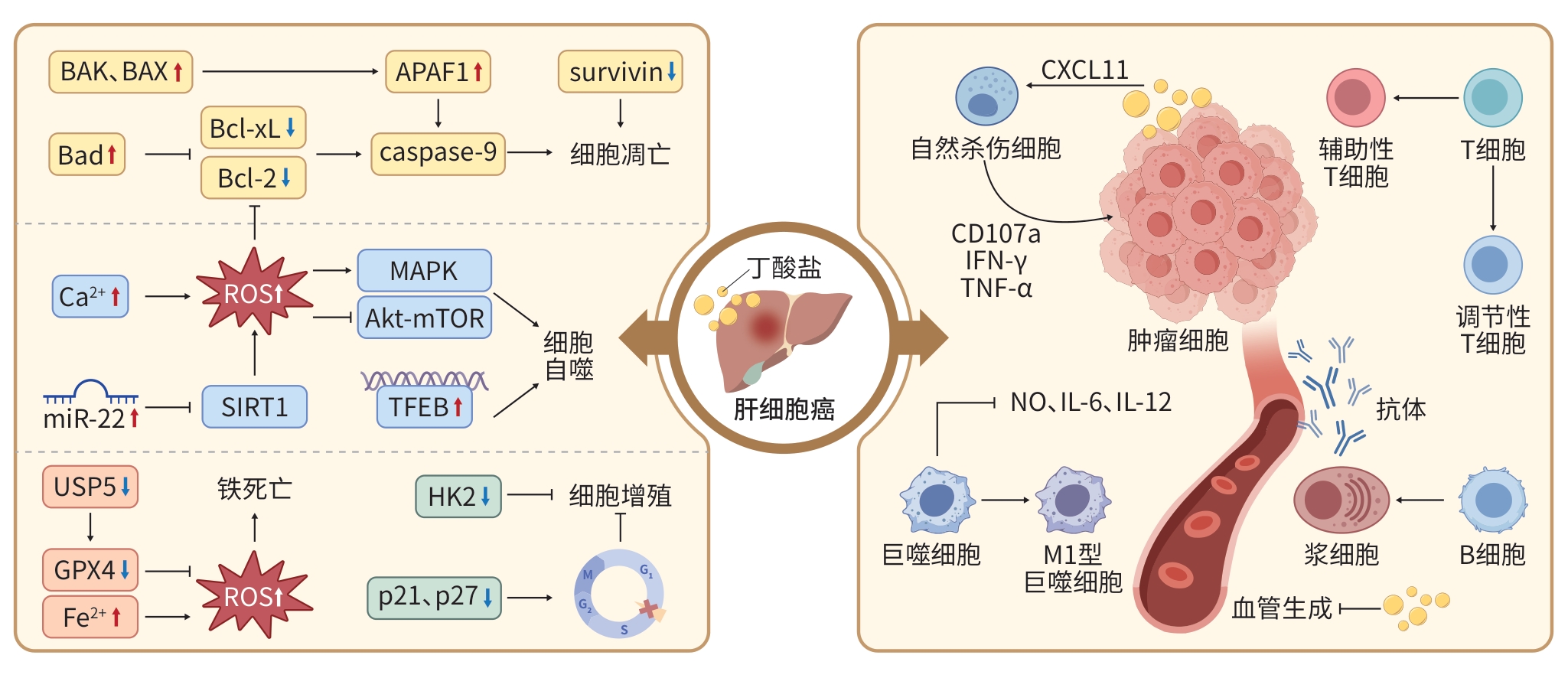
注: BAK,Bcl-2同源杀伤蛋白;BAX,Bcl-2相关X蛋白;APAF1,凋亡蛋白酶激活因子1;survivin,存活素;Bad,Bcl-2相关细胞死亡激动因子;Bcl-xL,Bcl-2样蛋白1长亚型;caspase-9,胱天蛋白酶-9;ROS,活性氧;MAPK,促分裂原活化的蛋白质激酶;Akt-mTOR,蛋白激酶B-哺乳动物雷帕霉素靶蛋白;miR-22,微RNA-22;SIRT1,沉默信息调节因子2相关酶1;TFEB,转录因子EB;USP5,泛素特异性蛋白酶5;GPX4,谷胱甘肽过氧化物酶4;HK2,己糖激酶2;p21,细胞周期蛋白依赖性激酶抑制剂1A;p27,细胞周期蛋白依赖性激酶抑制剂1B;CXCL11,趋化因子C-X-C基序配体11;CD107a,溶酶体相关膜蛋白1;IFN-γ,干扰素γ;TNF-α,肿瘤坏死因子α;NO,一氧化氮;IL,白细胞介素。
图 1 丁酸盐抗HCC的作用机制
Figure 1. Mechanisms of butyrate against HCC
-
[1] Llovet J M, Pinyol R, Kelley R K, et al. Molecular pathogenesis and systemic therapies for hepatocellular carcinoma[J]. Nat Cancer, 2022, 3( 4): 386- 401. DOI: 10.1038/s43018-022-00357-2. [2] Yang X P, Yang C, Zhang S, et al. Precision treatment in advanced hepatocellular carcinoma[J]. Cancer Cell, 2024, 42( 2): 180- 197. DOI: 10.1016/j.ccell.2024.01.007. [3] Tilg H, Adolph T E, Trauner M. Gut-liver axis: Pathophysiological concepts and clinical implications[J]. Cell Metab, 2022, 34( 11): 1700- 1718. DOI: 10.1016/j.cmet.2022.09.017. [4] Cui Yan, Jiao Junzhe, Yan Ruijuan, et al. The role of gut microbiota homeostasis in the occurrence and development of hepatocellular carcinoma and targeted intervention strategies[J]. J Clin Hepatol, 2025, 41( 9): 1913- 1919. DOI: 10.12449/JCH250930.崔艳, 焦俊喆, 闫瑞娟, 等. 肠道菌群稳态在肝细胞癌发生发展中的作用及相关靶向干预策略[J]. 临床肝胆病杂志, 2025, 41( 9): 1913- 1919. DOI: 10.12449/JCH250930. [5] Schneider K M, Mohs A, Gui W F, et al. Imbalanced gut microbiota fuels hepatocellular carcinoma development by shaping the hepatic inflammatory microenvironment[J]. Nat Commun, 2022, 13( 1): 3964. DOI: 10.1038/s41467-022-31312-5. [6] Mukhopadhya I, Louis P. Gut microbiota-derived short-chain fatty acids and their role in human health and disease[J]. Nat Rev Microbiol, 2025, 23( 10): 635- 651. DOI: 10.1038/s41579-025-01183-w. [7] Sun J Z, Chen S Q, Zang D, et al. Butyrate as a promising therapeutic target in cancer: From pathogenesis to clinic(Review)[J]. Int J Oncol, 2024, 64( 4): 44. DOI: 10.3892/ijo.2024.5632 [8] Hodgkinson K, El Abbar F, Dobranowski P, et al. Butyrate’s role in human health and the current progress towards its clinical application to treat gastrointestinal disease[J]. Clin Nutr, 2023, 42( 2): 61- 75. DOI: 10.1016/j.clnu.2022.10.024. [9] Singh V, Lee G, Son H, et al. Butyrate producers,“The Sentinel of Gut”: Their intestinal significance with and beyond butyrate, and prospective use as microbial therapeutics[J]. Front Microbiol, 2023, 13: 1103836. DOI: 10.3389/fmicb.2022.1103836. [10] Salvi P S, Cowles R A. Butyrate and the intestinal epithelium: Modulation of proliferation and inflammation in homeostasis and disease[J]. Cells, 2021, 10( 7): 1775. DOI: 10.3390/cells10071775. [11] Gasaly N, Hermoso M A, Gotteland M. Butyrate and the fine-tuning of colonic homeostasis: Implication for inflammatory bowel diseases[J]. Int J Mol Sci, 2021, 22( 6): 3061. DOI: 10.3390/ijms22063061. [12] Pant K, Venugopal S K, Lorenzo Pisarello M J, et al. The role of gut microbiome-derived short-chain fatty acid butyrate in hepatobiliary diseases[J]. Am J Pathol, 2023, 193( 10): 1455- 1467. DOI: 10.1016/j.ajpath.2023.06.007. [13] Zheng M X, Yang X Y, Wu Q Y, et al. Butyrate attenuates hepatic steatosis induced by a high-fat and fiber-deficient diet via the hepatic GPR41/43-CaMKII/HDAC1-CREB pathway[J]. Mol Nutr Food Res, 2023, 67( 1): 2200597. DOI: 10.1002/mnfr.202200597. [14] Ren Z G, Li A, Jiang J W, et al. Gut microbiome analysis as a tool towards targeted non-invasive biomarkers for early hepatocellular carcinoma[J]. Gut, 2019, 68( 6): 1014- 1023. DOI: 10.1136/gutjnl-2017-315084. [15] Huo R, Chen Y L, Li J, et al. Altered gut microbiota composition and its potential association in patients with advanced hepatocellular carcinoma[J]. Curr Oncol, 2023, 30( 2): 1818- 1830. DOI: 10.3390/curroncol30020141. [16] Zhang M H, Huang X F, Zhang Y L, et al. Gut microbial metabolite butyrate suppresses hepatocellular carcinoma growth via CXCL11-dependent enhancement of natural killer cell infiltration[J]. Gut Microbes, 2025, 17( 1): 2519706. DOI: 10.1080/19490976.2025.2519706. [17] Zheng R P, Wang G Q, Pang Z Q, et al. Liver cirrhosis contributes to the disorder of gut microbiota in patients with hepatocellular carcinoma[J]. Cancer Med, 2020, 9( 12): 4232- 4250. DOI: 10.1002/cam4.3045. [18] Li R X, Yi X Z, Yang J H, et al. Gut microbiome signatures in the progression of hepatitis B virus-induced liver disease[J]. Front Microbiol, 2022, 13: 916061. DOI: 10.3389/fmicb.2022.916061. [19] Lapidot Y, Amir A, Nosenko R, et al. Alterations in the gut microbiome in the progression of cirrhosis to hepatocellular carcinoma[J]. mSystems, 2020, 5( 3): e00153-20. DOI: 10.1128/mSystems.00153-20. [20] Ma C, Yang J, Fu X N, et al. Microbial characteristics of gut microbiome dysbiosis in patients with chronic liver disease[J]. World J Hepatol, 2025, 17( 5): 106124. DOI: 10.4254/wjh.v17.i5.106124. [21] Jinato T, Anuntakarun S, Satthawiwat N, et al. Distinct alterations of gut microbiota between viral- and non-viral-related hepatocellular carcinoma[J]. Appl Microbiol Biotechnol, 2024, 108( 1): 34. DOI: 10.1007/s00253-023-12845-1. [22] Liu Q S, Li F, Zhuang Y Y, et al. Alteration in gut microbiota associated with hepatitis B and non-hepatitis virus related hepatocellular carcinoma[J]. Gut Pathog, 2019, 11: 1. DOI: 10.1186/s13099-018-0281-6. [23] Yan F N, Zhang Q, Shi K, et al. Gut microbiota dysbiosis with hepatitis B virus liver disease and association with immune response[J]. Front Cell Infect Microbiol, 2023, 13: 1152987. DOI: 10.3389/fcimb.2023.1152987. [24] Kim S J, Jung C W, Anh N H, et al. Metabolic phenotyping combined with transcriptomics metadata fortifies the diagnosis of early-stage Hepatocellular carcinoma[J]. J Adv Res, 2025, 74: 153- 163. DOI: 10.1016/j.jare.2024.09.007. [25] Che Y B, Chen G Y, Guo Q Q, et al. Gut microbial metabolite butyrate improves anticancer therapy by regulating intracellular calcium homeostasis[J]. Hepatology, 2023, 78( 1): 88- 102. DOI: 10.1097/HEP.0000000000000047. [26] Behary J, Amorim N, Jiang X T, et al. Gut microbiota impact on the peripheral immune response in non-alcoholic fatty liver disease related hepatocellular carcinoma[J]. Nat Commun, 2021, 12( 1): 187. DOI: 10.1038/s41467-020-20422-7. [27] Yu Q, Dai W Q, Ji J, et al. Sodium butyrate inhibits aerobic glycolysis of hepatocellular carcinoma cells via the c-myc/hexokinase 2 pathway[J]. J Cell Mol Med, 2022, 26( 10): 3031- 3045. DOI: 10.1111/jcmm.17322. [28] Wang H G, Huang X D, Shen P, et al. Anticancer effects of sodium butyrate on hepatocellular carcinoma cells in vitro[J]. Int J Mol Med, 2013, 31( 4): 967- 974. DOI: 10.3892/ijmm.2013.1285. [29] Sanaei M, Kavoosi F, Safari M. Effect of 5’-Fluoro-2’-Deoxycytidine and sodium butyrate on the gene expression of the intrinsic apoptotic pathway, p21, p27, and p53 genes expression, cell viability, and apoptosis in human hepatocellular carcinoma cell lines[J]. Adv Biomed Res, 2023, 12: 24. DOI: 10.4103/abr.abr_211_21. [30] Pant K, Yadav A K, Gupta P, et al. Butyrate induces ROS-mediated apoptosis by modulating miR-22/SIRT-1 pathway in hepatic cancer cells[J]. Redox Biol, 2017, 12: 340- 349. DOI: 10.1016/j.redox.2017.03.006. [31] Pant K, Saraya A, Venugopal S K. Oxidative stress plays a key role in butyrate-mediated autophagy via Akt/mTOR pathway in hepatoma cells[J]. Chem Biol Interact, 2017, 273: 99- 106. DOI: 10.1016/j.cbi.2017.06.001. [32] Chang Q M, Mao H R, Feng J F, et al. Sodium butyrate increases USP5-mediated ubiquitination degradation of GPX4 and enhances anti-cancer efficacy of anti-PD-1 antibody[J]. Biochem Pharmacol, 2025, 237: 116927. DOI: 10.1016/j.bcp.2025.116927. [33] Shalhoub H, Gonzalez P, Dos Santos A, et al. Simultaneous activation and blockade of autophagy to fight hepatocellular carcinoma[J]. Autophagy Rep, 2024, 3( 1): 2326241. DOI: 10.1080/27694127.2024.2326241. [34] de Oliveira Andrade F, Furtado K S, Heidor R, et al. Antiangiogenic effects of the chemopreventive agent tributyrin, a butyric acid prodrug, during the promotion phase of hepatocarcinogenesis[J]. Carcinogenesis, 2019, 40( 8): 979- 988. DOI: 10.1093/carcin/bgy190. [35] Yamamoto K, Kuzuya T, Honda T, et al. Relationship between adverse events and microbiomes in advanced hepatocellular carcinoma patients treated with sorafenib[J]. Anticancer Res, 2020, 40( 2): 665- 676. DOI: 10.21873/anticanres.13996. [36] Inukai Y, Yamamoto K, Honda T, et al. Differences in the intestinal microbiome associated with diarrhea during lenvatinib treatment for hepatocellular carcinoma[J]. Dig Dis, 2023, 41( 1): 138- 147. DOI: 10.1159/000524298. [37] Ponziani F R, de Luca A, Picca A, et al. Gut dysbiosis and fecal calprotectin predict response to immune checkpoint inhibitors in patients with hepatocellular carcinoma[J]. Hepatol Commun, 2022, 6( 6): 1492- 1501. DOI: 10.1002/hep4.1905. [38] Lee P C, Wu C J, Hung Y W, et al. Distinct gut microbiota but common metabolomic signatures between viral and MASLD HCC contribute to outcomes of combination immunotherapy[J]. Hepatology, 2025. DOI: 10.1097/HEP.0000000000001446. [39] Hashem H R, Yehia T, Azab M, et al. Gut microbiome dysbiosis in hepatocellular carcinoma patients with persistent HCV viremia versus viral clearance: A cross-sectional study[J]. Gut Pathog, 2025, 17( 1): 88. DOI: 10.1186/s13099-025-00761-w. [40] Zhao C B, Zhang Z L, Ding R L, et al. Genes modulating butyrate metabolism for assessing clinical prognosis and responses to systematic therapies in hepatocellular carcinoma[J]. Biomolecules, 2022, 13( 1): 52. DOI: 10.3390/biom13010052. [41] Jing G X, Xu W Q, Ma W, et al. Echinacea purpurea polysaccharide intervene in hepatocellular carcinoma via modulation of gut microbiota to inhibit TLR4/NF-κB pathway[J]. Int J Biol Macromol, 2024, 261( Pt 2): 129917. DOI: 10.1016/j.ijbiomac.2024.129917. [42] Shou J W, Shaw P C. Berberine activates PPARδ and promotes gut microbiota-derived butyric acid to suppress hepatocellular carcinoma[J]. Phytomedicine, 2023, 115: 154842. DOI: 10.1016/j.phymed.2023.154842. [43] He Huaxing, Liu Lulin, Liu Yingyin, et al. Sodium butyrate and sorafenib synergistically inhibit hepatocellular carcinoma cells possibly by inducing ferroptosis through inhibiting YAP[J]. J South Med Univ, 2024, 44( 7): 1425- 1430. DOI: 10.12122/j.issn.1673-4254.2024.07.23.何华星, 刘璐琳, 刘颖茵, 等. 丁酸钠与索拉非尼可能通过YAP诱导铁死亡协同抑制肝癌细胞增殖[J]. 南方医科大学学报, 2024, 44( 7): 1425- 1430. DOI: 10.12122/j.issn.1673-4254.2024.07.23. [44] Kumar M, Kaur R, Kanthaje S, et al. Bacterial metabolite butyrate in modulating sorafenib-targeted microRNAs to curtail its resistance in hepatocellular carcinoma[J]. J Cancer Res Clin Oncol, 2023, 149( 9): 5823- 5839. DOI: 10.1007/s00432-022-04544-7. [45] Zhu X H, Li K, Liu G C, et al. Microbial metabolite butyrate promotes anti-PD-1 antitumor efficacy by modulating T cell receptor signaling of cytotoxic CD8 T cell[J]. Gut Microbes, 2023, 15( 2): 2249143. DOI: 10.1080/19490976.2023.2249143. [46] Pant K, Mishra A K, Pradhan S M, et al. Butyrate inhibits HBV replication and HBV-induced hepatoma cell proliferation via modulating SIRT-1/Ac-p53 regulatory axis[J]. Mol Carcinog, 2019, 58( 4): 524- 532. DOI: 10.1002/mc.22946. [47] Zhang F F, Ekk Lo, Chen C J, et al. Probiotics mixture, prohep: A potential adjuvant for low-dose sorafenib in metabolic dysfunction-associated steatotic liver disease-associated hepatocellular carcinoma suppression through modulating gut microbiota[J]. Probiotics Antimicrob Proteins, 2025. DOI: 10.1007/s12602-025-10593-4. [48] Nouso K, Shiota S, Fujita R, et al. Effect of butyrate-producing enterobacteria on advanced hepatocellular carcinoma treatment with atezolizumab and bevacizumab[J]. Cancer Med, 2023, 12( 17): 17849- 17855. DOI: 10.1002/cam4.6416. [49] Lu K, Dong S W, Wu X Y, et al. Probiotics in cancer[J]. Front Oncol, 2021, 11: 638148. DOI: 10.3389/fonc.2021.638148. -

 下载:
下载:
 本文二维码
本文二维码
图(1)
计量
- 文章访问数: 406
- HTML全文浏览量: 157
- PDF下载量: 51
- 被引次数: 0