PDF下载 ( 1353 KB)

胰腺导管腺癌术后早期肝转移的危险因素及机制
DOI: 10.12449/JCH260735
Risk factors for early postoperative liver metastasis in pancreatic ductal adenocarcinoma and related mechanisms
-
摘要: 胰腺导管腺癌恶性程度高、预后极差,术后早期肝转移是影响预后的关键因素之一。本文结合近年临床与基础研究,概述胰腺导管腺癌术后早期肝转移的临床危险因素,并从肿瘤来源外泌体驱动的肝脏转移前微环境构建、转移相关巨噬细胞与中性粒细胞胞外诱捕网维持的促转移微环境、肿瘤细胞侵袭与肝向性迁移,以及肝内免疫代谢适应和纤维化重塑等方面,系统梳理术后早期肝转移的关键分子事件,以期为围手术期风险分层与干预策略的制订提供理论依据。Abstract: Pancreatic ductal adenocarcinoma (PDAC) is highly malignant and often has an extremely poor prognosis, and early postoperative liver metastasis is one of the key influencing factors for prognosis. With reference to the clinical and experimental studies in recent years, this article reviews the clinical risk factors for early liver metastasis after PDAC and systematically elaborates on major molecular events underlying early postoperative liver metastasis from various aspects of construction of the pre-metastatic niche in the liver driven by tumor-derived exosomes, the pro-metastatic microenvironment maintained by metastasis-associated macrophages and neutrophil extracellular traps, the invasive phenotype and liver-tropic migration of tumor cells, intrahepatic immunometabolic adaptation, and fibrotic remodeling, in order to provide a theoretical basis for perioperative risk stratification and the development of intervention strategies.
-
Key words:
- Carcinoma, Pancreatic Ductal /
- Neoplasm Metastasis /
- Risk Factors
-
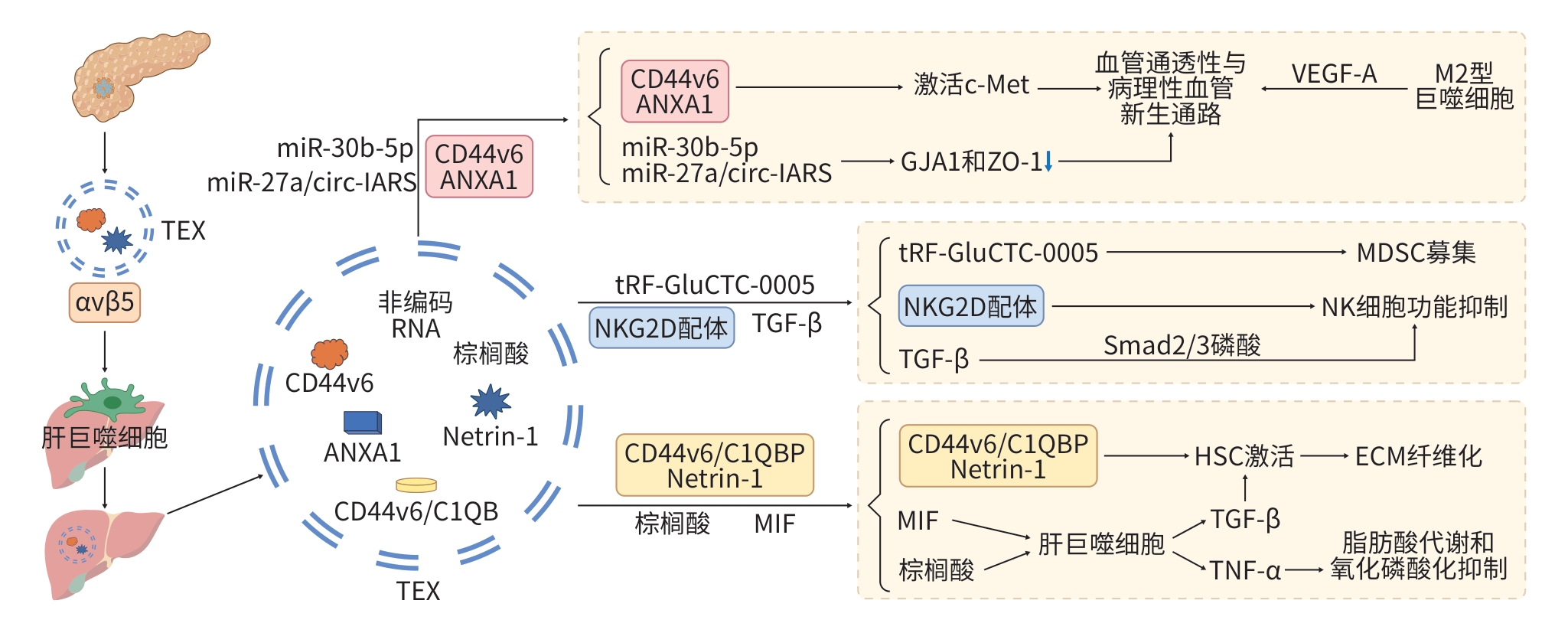
注: TEX,肿瘤细胞来源外泌体;TNF-α,肿瘤坏死因子α;TGF-β,转化生长因子β;VEGF-A,血管内皮生长因子A;MIF,巨噬细胞迁移抑制因子;GJA1,缝隙连接蛋白A1;ZO-1,紧密连接蛋白1;MDSC,髓源性抑制性细胞;HSC,肝星状细胞;ECM,细胞外基质;PMN,转移前微环境;NKG2D,自然杀伤细胞2族成员D;Smad,母系抗十五表态蛋白同源物;CD44v6,CD44变异体6;ANXA1,膜联蛋白A1;c-Met,肝细胞生长因子受体;miR-30b-5p,微RNA-30b-5p;miR-27a,微RNA-27a;circ-IARS,环状RNA-IARS;tRF-GluCTC-0005,谷氨酸tRNA来源片段GluCTC-0005;NK细胞,自然杀伤细胞;C1QBP,补体C1q结合蛋白;Netrin-1,轴突导向因子1。
图 1 TEX介导PMN形成的相关机制
Figure 1. Mechanisms of tumor cell-derived exosome-mediated formation of the pre-metastatic niche
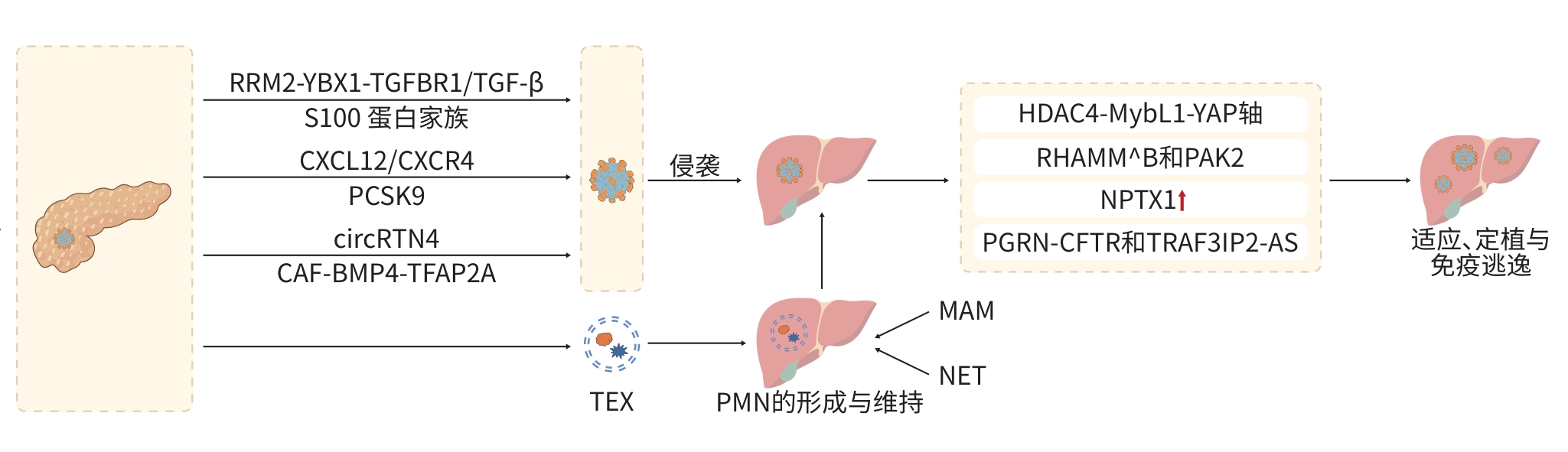
注: TEX,肿瘤细胞来源外泌体;PMN,转移前微环境;MAM,转移相关巨噬细胞;NET,中性粒细胞胞外诱捕网;CAF,癌相关成纤维细胞;CXCL12,CXC亚族趋化因子配体12;CXCR4,CXC亚族趋化因子受体4;circRTN4,环状RNA网状蛋白4;PCSK9,前蛋白转化酶枯草芽孢杆菌蛋白酶9;TFAP2A,转录因子AP-2α;BMP4,骨形态发生蛋白4;TGF-β,转化生长因子β;RRM2,核糖核苷二磷酸还原酶M2;YBX1,Y盒结合蛋白1;HDAC4,组蛋白去乙酰化酶4;PAK2,p21活化激酶2;NPTX1,神经元特异性五聚蛋白1;RGRN,前颗粒蛋白;CFTR,囊性纤维化跨膜传导调节蛋白;TGFBR1,转化生长因子β受体1;S100蛋白家族,S100钙结合蛋白家族;MybL1,Myb样转录因子1;YAP,Yes相关蛋白;RHAMM^B,透明质酸介导运动受体B异构体;TRAF3IP2-AS1,TRAF3IP2反义RNA 1。
图 2 胰腺导管腺癌肝转移相关机制
Figure 2. Mechanisms underlying liver metastasis in ductal adenocarcinoma of pancreas
-
[1] Stoop T F, Javed A A, Oba A, et al. Pancreatic cancer[J]. Lancet, 2025, 405( 10485): 1182- 1202. DOI: 10.1016/S0140-6736(25)00261-2. [2] Boubaddi M, Rossi J, Marichez A, et al. Preoperative prognostic factors in resectable pancreatic cancer: State of the art and prospects[J]. Ann Surg Oncol, 2025, 32( 6): 4117- 4127. DOI: 10.1245/s10434-025-17062-w. [3] D’Ambra V, Ricci C, Ingaldi C, et al. Predictive factors for long-term survival in pancreatic ductal adenocarcinoma that underwent surgery: A systematic review and meta-analysis of literature[J]. Updates Surg, 2026, 78( 2): 509- 518. DOI: 10.1007/s13304-025-02382-z. [4] Rajagopalan A, Aroori S, Russell T B, et al. Five-year recurrence/survival after pancreatoduodenectomy for pancreatic adenocarcinoma: Does pre-existing diabetes matter? Results from the Recurrence After Whipple’s(RAW) study[J]. HPB, 2024, 26( 8): 981- 989. DOI: 10.1016/j.hpb.2024.04.010. [5] Groot V P, Rezaee N, Wu W C, et al. Patterns, timing, and predictors of recurrence following pancreatectomy for pancreatic ductal adenocarcinoma[J]. Ann Surg, 2018, 267( 5): 936- 945. DOI: 10.1097/SLA.0000000000002234. [6] Tanaka M, Mihaljevic A L, Probst P, et al. Meta-analysis of recurrence pattern after resection for pancreatic cancer[J]. Br J Surg, 2019, 106( 12): 1590- 1601. DOI: 10.1002/bjs.11295. [7] Leonhardt C S, Gustorff C, Klaiber U, et al. Prognostic factors for early recurrence after resection of pancreatic cancer: A systematic review and meta-analysis[J]. Gastroenterology, 2024, 167( 5): 977- 992. DOI: 10.1053/j.gastro.2024.05.028. [8] Zhang X P, Xu S, Gao Y X, et al. Early and late recurrence patterns of pancreatic ductal adenocarcinoma after pancreaticoduodenectomy: A multicenter study[J]. Int J Surg, 2023, 109( 4): 785- 793. DOI: 10.1097/JS9.0000000000000296. [9] Murakawa M, Kawahara S, Takahashi D, et al. Risk factors for early recurrence in patients with pancreatic ductal adenocarcinoma who underwent curative resection[J]. World J Surg Oncol, 2023, 21( 1): 263. DOI: 10.1186/s12957-023-03141-3. [10] Zambirinis C P, Midya A, Chakraborty J, et al. Recurrence after resection of pancreatic cancer: Can radiomics predict patients at greatest risk of liver metastasis?[J]. Ann Surg Oncol, 2022, 29( 8): 4962- 4974. DOI: 10.1245/s10434-022-11579-0. [11] Tong J S, Jiang W, Mao S Q, et al. Development and validation of a nomogram to predict liver metastasis for pancreatic ductal adenocarcinoma after radical resection[J]. Front Oncol, 2022, 12: 1040411. DOI: 10.3389/fonc.2022.1040411. [12] Shirai Y, Kimura N, Tanaka H, et al. Risk factors for early liver recurrence after pancreatic cancer resection[J]. Pancreas, 2025, 54( 4): e324- e330. DOI: 10.1097/MPA.0000000000002441. [13] Tong J S, Wu S D, Lu C J, et al. Risk factors of early liver metastasis for pancreatic ductal adenocarcinoma after radical resection[J]. Gastroenterol Res Pract, 2022, 2022: 8061879. DOI: 10.1155/2022/8061879. [14] Kishi Y, Nara S, Esaki M, et al. Feasibility of resecting the portal vein only when necessary during pancreatoduodenectomy for pancreatic cancer[J]. BJS Open, 2019, 3( 3): 327- 335. DOI: 10.1002/bjs5.50130. [15] Yuan Z Y, Shu Z Y, Peng J X, et al. Prediction of postoperative liver metastasis in pancreatic ductal adenocarcinoma based on multiparametric magnetic resonance radiomics combined with serological markers: A cohort study of machine learning[J]. Abdom Radiol, 2024, 49( 1): 117- 130. DOI: 10.1007/s00261-023-04047-0. [16] Luo X, Lin X C, Lin R G, et al. The CA125 level postoperative change rule and its prognostic significance in patients with resectable pancreatic cancer[J]. BMC Cancer, 2023, 23( 1): 832. DOI: 10.1186/s12885-023-11346-8. [17] Zhu H, Zhou Y Y, Shen D Y, et al. An interpretable machine learning model for predicting early liver metastasis after pancreatic cancer surgery[J]. BMC Cancer, 2025, 25( 1): 1117. DOI: 10.1186/s12885-025-14503-3. [18] Judge S J, Manin E, Chou J, et al. Influence of biologic sex and obesity on liver recurrence and survival in patients undergoing upfront surgery for pancreatic adenocarcinoma[J]. Cancer, 2025, 131( 18): e70088. DOI: 10.1002/cncr.70088. [19] Bojmar L, Zambirinis C P, Hernandez J M, et al. Multi-parametric atlas of the pre-metastatic liver for prediction of metastatic outcome in early-stage pancreatic cancer[J]. Nat Med, 2024, 30( 8): 2170- 2180. DOI: 10.1038/s41591-024-03075-7. [20] Shang D, Xie C, Hu J, et al. Pancreatic cancer cell-derived exosomal microRNA-27a promotes angiogenesis of human microvascular endothelial cells in pancreatic cancer via BTG2[J]. J Cell Mol Med, 2020, 24( 1): 588- 604. DOI: 10.1111/jcmm.14766. [21] Novizio N, Belvedere R, Pessolano E, et al. ANXA1 contained in EVs regulates macrophage polarization in tumor microenvironment and promotes pancreatic cancer progression and metastasis[J]. Int J Mol Sci, 2021, 22( 20): 11018. DOI: 10.3390/ijms222011018. [22] Zhao J G, Schlößer H A, Wang Z F, et al. Tumor-derived extracellular vesicles inhibit natural killer cell function in pancreatic cancer[J]. Cancers, 2019, 11( 6): 874. DOI: 10.3390/cancers11060874. [23] Chen W, Peng W, Wang R H, et al. Exosome-derived tRNA fragments tRF-GluCTC-0005 promotes pancreatic cancer liver metastasis by activating hepatic stellate cells[J]. Cell Death Dis, 2024, 15: 102. DOI: 10.1038/s41419-024-06482-3. [24] Xie Z B, Gao Y, Ho C, et al. Exosome-delivered CD44v6/C1QBP complex drives pancreatic cancer liver metastasis by promoting fibrotic liver microenvironment[J]. Gut, 2022, 71( 3): 568- 579. DOI: 10.1136/gutjnl-2020-323014. [25] Li D Q, Chu X Y, Ma Y S, et al. Tumor-derived exosomes: Unravelling the pathogenesis of pancreatic cancer with liver metastases and exploring the potential for clinical translation[J]. Cancer Lett, 2024, 611: 217403. DOI: 10.1016/j.canlet.2024.217403. [26] Quaranta V, Rainer C, Nielsen S R, et al. Macrophage-derived granulin drives resistance to immune checkpoint inhibition in metastatic pancreatic cancer[J]. Cancer Res, 2018, 78( 15): 4253- 4269. DOI: 10.1158/0008-5472.CAN-17-3876. [27] Nielsen S R, Quaranta V, Linford A, et al. Macrophage-secreted granulin supports pancreatic cancer metastasis by inducing liver fibrosis[J]. Nat Cell Biol, 2016, 18( 5): 549- 560. DOI: 10.1038/ncb3340. [28] Bellomo G, Rainer C, Quaranta V, et al. Chemotherapy-induced infiltration of neutrophils promotes pancreatic cancer metastasis via Gas6/AXL signalling axis[J]. Gut, 2022, 71( 11): 2284- 2299. DOI: 10.1136/gutjnl-2021-325272. [29] Xu W C, Liu J Z, Liu Q F, et al. NFE2-driven neutrophil polarization promotes pancreatic cancer liver metastasis progression[J]. Cell Rep, 2025, 44( 2): 115226. DOI: 10.1016/j.celrep.2024.115226. [30] Li L, McAllister F, Maitra A. The liver casts a wide NET for metastatic pancreatic cancer[J]. Nat Med, 2024, 30( 8): 2125- 2126. DOI: 10.1038/s41591-024-03112-5. [31] Ivey A D, Pratt H G, Niemann B, et al. Pancreatectomy induces cancer-promoting neutrophil extracellular traps[J]. Ann Surg Oncol, 2024, 31( 6): 3707- 3717. DOI: 10.1245/s10434-023-14841-1. [32] Wong C H, Lou U K, Fung F K, et al. CircRTN4 promotes pancreatic cancer progression through a novel circRNA-miRNA-lncRNA pathway and stabilizing epithelial-mesenchymal transition protein[J]. Mol Cancer, 2022, 21( 1): 10. DOI: 10.1186/s12943-021-01481-w. [33] Chen H, Wang X X, Liu S, et al. Circular RNA in pancreatic cancer: Biogenesis, mechanism, function and clinical application[J]. Int J Med Sci, 2025, 22( 7): 1612- 1629. DOI: 10.7150/ijms.107773. [34] Al-Ismaeel Q, Neal C P, Al-Mahmoodi H, et al. ZEB1 and IL-6/11-STAT3 signalling cooperate to define invasive potential of pancreatic cancer cells via differential regulation of the expression of S100 proteins[J]. Br J Cancer, 2019, 121( 1): 65- 75. DOI: 10.1038/s41416-019-0483-9. [35] Ostrand-Rosenberg S, Huecksteadt T, Sanders K. The receptor for advanced glycation endproducts(RAGE) and its ligands S100A8/A9 and high mobility group box protein 1(HMGB1) are key regulators of myeloid-derived suppressor cells[J]. Cancers, 2023, 15( 4): 1026. DOI: 10.3390/cancers15041026. [36] Wu Y, Zhou Q, Guo F Y, et al. S100 proteins in pancreatic cancer: Current knowledge and future perspectives[J]. Front Oncol, 2021, 11: 711180. DOI: 10.3389/fonc.2021.711180. [37] Du Z Y, Zhang Q, Xiang X X, et al. RRM2 promotes liver metastasis of pancreatic cancer by stabilizing YBX1 and activating the TGF-beta pathway[J]. iScience, 2024, 27( 10): 110864. DOI: 10.1016/j.isci.2024.110864. [38] Roberto M, Arrivi G, Di Civita M A, et al. The role of CXCL12 axis in pancreatic cancer: New biomarkers and potential targets[J]. Front Oncol, 2023, 13: 1154581. DOI: 10.3389/fonc.2023.1154581. [39] Rademaker G, Hernandez G A, Seo Y, et al. PCSK9 drives sterol-dependent metastatic organ choice in pancreatic cancer[J]. Nature, 2025, 643( 8074): 1381- 1390. DOI: 10.1038/s41586-025-09017-8. [40] Luo J X, Ding Z Z, Chen D J, et al. TFAP2A enhances tumor stemness and promotes metastasis in pancreatic ductal adenocarcinoma[J]. iScience, 2025, 28( 8): 113060. DOI: 10.1016/j.isci.2025.113060. [41] Yamaguchi N, Wu Y G, Ravetch E, et al. A targetable secreted neural protein drives pancreatic cancer metastatic colonization and HIF1α nuclear retention[J]. Cancer Discov, 2024, 14( 12): 2489- 2508. DOI: 10.1158/2159-8290.CD-23-1323. [42] Choi S, Wang D R, Chen X, et al. Function and clinical relevance of RHAMM isoforms in pancreatic tumor progression[J]. Mol Cancer, 2019, 18( 1): 92. DOI: 10.1186/s12943-019-1018-y. [43] Dai Dayou, Zhang Zhigang, Li Hui. Effect of CHRNA5 in occurrence and development of pancreas cancer and its mechanism[J]. J Jilin Univ: Med Edit, 2025, 51( 6): 1518- 1531. DOI: 10.13481/j.1671-587X.20250608.戴大有, 张志刚, 李慧. CHRNA5在胰腺癌发生发展过程中的作用及其机制[J]. 吉林大学学报(医学版), 2025, 51( 6): 1518- 1531. DOI: 10.13481/j.1671-587X.20250608. [44] Astuti Y, Raymant M, Quaranta V, et al. Efferocytosis reprograms the tumor microenvironment to promote pancreatic cancer liver metastasis[J]. Nat Cancer, 2024, 5( 5): 774- 790. DOI: 10.1038/s43018-024-00731-2. [45] Wu Y D, Huang X X, Zhang H X, et al. TRAF3IP2-AS1 deficiency induces necroptosis to promote pancreatic cancer liver metastasis[J]. Cancer Res, 2025, 85( 17): 3292- 3312. DOI: 10.1158/0008-5472.CAN-24-4784. [46] Yang H, Li Z Y, Zhu S Q, et al. Molecular mechanisms of pancreatic cancer liver metastasis: The role of PAK2[J]. Front Immunol, 2024, 15: 1347683. DOI: 10.3389/fimmu.2024.1347683. [47] Wu M G, Sarkar C, Guo B. Regulation of cancer metastasis by PAK2[J]. Int J Mol Sci, 2024, 25( 24): 13443. DOI: 10.3390/ijms252413443. [48] Edderkaoui M, Elmadbouh O H M, Lim A, et al. HDAC4/MybL1/YAP novel signaling axis is required for pancreatic cancer metastasis to the liver[J]. Int J Biol Sci, 2025, 21( 15): 6907- 6925. DOI: 10.7150/ijbs.102132. [49] Mao W H, Mai J, Peng H, et al. YAP in pancreatic cancer: Oncogenic role and therapeutic strategy[J]. Theranostics, 2021, 11( 4): 1753- 1762. DOI: 10.7150/thno.53438. -

 下载:
下载:
 本文二维码
本文二维码
计量
- 文章访问数: 361
- HTML全文浏览量: 268
- PDF下载量: 49
- 被引次数: 0