PDF下载 ( 797 KB)

肝窦内皮细胞在对乙酰氨基酚所致肝损伤中的作用及其机制
DOI: 10.12449/JCH260836
利益冲突声明:本文不存在任何利益冲突。
作者贡献声明:彭璐负责文章撰写;张琦和祝欣欣负责资料收集整理;曲爱娟和王艳负责文章修改及定稿。
Role and mechanism of liver sinusoidal endothelial cells in acetaminophen-induced liver injury
-
摘要: 对乙酰氨基酚过量所致肝损伤是急性肝衰竭的主要病因之一,其机制复杂。在此过程中,肝窦内皮细胞损伤是关键的早期环节,由氧化应激、细胞凋亡、纤溶/凝血系统失衡等因素共同介导。由此引发的肝窦内皮细胞功能障碍,会进一步造成肝窦微循环紊乱、炎症反应放大,并损害肝脏的再生修复能力,最终导致肝细胞坏死。本文旨在系统阐述肝窦内皮细胞在对乙酰氨基酚诱导肝损伤中的关键作用及其分子机制,以期为开发新的治疗策略与研究方向提供理论依据。
-
关键词:
- 肝窦内皮细胞 /
- 醋氨酚 /
- 化学性与药物性肝损伤
Abstract: Liver injury due to acetaminophen overdose is one of the main causes of acute liver failure, with a complex pathogenesis. In this process, liver sinusoidal endothelial cell (LSEC) injury is a key early event jointly mediated by factors such as oxidative stress, cell apoptosis, and imbalance between fibrinolysis and coagulation. Subsequent LSEC dysfunction further induces sinusoidal microcirculatory disturbances, amplifies the inflammatory response, impairs the regeneration and repair abilities of the liver, and finally causes hepatocyte necrosis. This article systematically elaborates on the critical role and molecular mechanism of LSEC in acetaminophen-induced liver injury, in order to provide a theoretical basis for novel therapeutic strategies and research directions. -
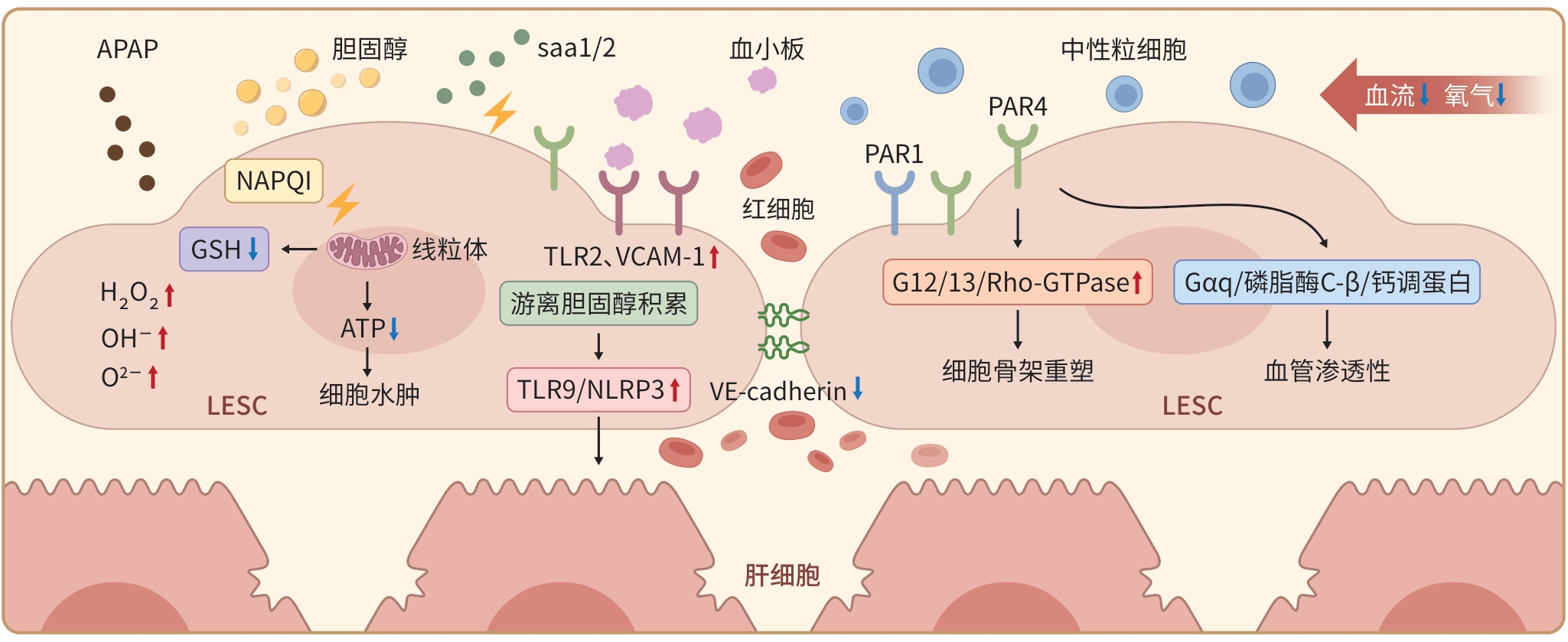
注: APAP,对乙酰氨基酚;NAPQI,N-乙酰基-P-苯醌亚胺;GSH,谷胱甘肽;TLR9,Toll样受体9;NLRP3,核苷酸结合寡聚结构域样受体家族热蛋白结构域相关蛋白3;saa1/2,血清淀粉样物质A1/2;TLR2,Toll样受体2;VCAM-1,血管细胞黏附分子1;PAR1,蛋白酶激活受体1;PAR4,蛋白酶激活受体4;ATP,腺苷三磷酸;LSEC,肝窦内皮细胞;VE-cadherin,钙黏蛋白;H2O2,过氧化氢,GTPase,鸟苷三磷酸酶;G12/13,鸟嘌呤核苷酸结合蛋白α12/13亚基;Gαq,鸟嘌呤核苷酸结合蛋白αq亚基。
图 1 APAP诱导LSEC损伤的机制
Figure 1. Mechanisms of APAP-induced LSEC injury
-
[1] Hoofnagle J H, Björnsson E S. Drug-induced liver injury-types and phenotypes[J]. N Engl J Med, 2019, 381( 3): 264- 273. DOI: 10.1056/NEJMra1816149. [2] Shen T, Liu Y X, Shang J, et al. Incidence and etiology of drug-induced liver injury in China’s mainland[J]. Gastroenterology, 2019, 156( 8): 2230- 2241. DOI: 10.1053/j.gastro.2019.02.002. [3] Stravitz R T, Lee W M. Acute liver failure[J]. Lancet, 2019, 394( 10201): 869- 881. DOI: 10.1016/S0140-6736(19)31894-X. [4] Pedre B, Barayeu U, Ezeriņa D, et al. The mechanism of action of N-acetylcysteine(NAC): The emerging role of H2S and sulfane sulfur species[J]. Pharmacol Ther, 2021, 228: 107916. DOI: 10.1016/j.pharmthera.2021.107916. [5] Jaeschke H, McGill M R, Ramachandran A. Oxidant stress, mitochondria, and cell death mechanisms in drug-induced liver injury: Lessons learned from acetaminophen hepatotoxicity[J]. Drug Metab Rev, 2012, 44( 1): 88- 106. DOI: 10.3109/03602532.2011.602688. [6] Krenkel O, Mossanen J C, Tacke F. Immune mechanisms in acetaminophen-induced acute liver failure[J]. Hepatobiliary Surg Nutr, 2014, 3( 6): 331- 343. DOI: 10.3978/j.issn.2304-3881.2014.11.01. [7] Uzi D, Barda L, Scaiewicz V, et al. CHOP is a critical regulator of acetaminophen-induced hepatotoxicity[J]. J Hepatol, 2013, 59( 3): 495- 503. DOI: 10.1016/j.jhep.2013.04.024. [8] Ni H M, McGill M R, Chao X J, et al. Removal of acetaminophen protein adducts by autophagy protects against acetaminophen-induced liver injury in mice[J]. J Hepatol, 2016, 65( 2): 354- 362. DOI: 10.1016/j.jhep.2016.04.025. [9] DeLeve L D, Maretti-Mira A C. Liver sinusoidal endothelial cell: An update[J]. Semin Liver Dis, 2017, 37( 4): 377- 387. DOI: 10.1055/s-0037-1617455. [10] Shetty S, Lalor P F, Adams D H. Liver sinusoidal endothelial cells- gatekeepers of hepatic immunity[J]. Nat Rev Gastroenterol Hepatol, 2018, 15( 9): 555- 567. DOI: 10.1038/s41575-018-0020-y. [11] McConnell M J, Kostallari E, Ibrahim S H, et al. The evolving role of liver sinusoidal endothelial cells in liver health and disease[J]. Hepatology, 2023, 78( 2): 649- 669. DOI: 10.1097/HEP.0000000000000207. [12] Gracia-Sancho J, Caparrós E, Fernández-Iglesias A, et al. Role of liver sinusoidal endothelial cells in liver diseases[J]. Nat Rev Gastroenterol Hepatol, 2021, 18( 6): 411- 431. DOI: 10.1038/s41575-020-00411-3. [13] Shimada H, Yokotobi A, Yamamoto N, et al. Inhibition of 15-prostaglandin dehydrogenase attenuates acetaminophen-induced liver injury via suppression of apoptosis in liver endothelial cells[J]. Prostaglandins Leukot Essent Fat Acids, 2024, 202: 102640. DOI: 10.1016/j.plefa.2024.102640. [14] Rajala R, Cleuren A C A, Griffin C T. Acetaminophen overdose reveals PAR4 as a low-expressing but potent receptor on the hepatic endothelium in mice[J]. Arterioscler Thromb Vasc Biol, 2025, 45( 1): 53- 71. DOI: 10.1161/ATVBAHA.124.321353. [15] Wang H L, Burke L J, Patel J, et al. Imaging-based vascular-related biomarkers for early detection of acetaminophen-induced liver injury[J]. Theranostics, 2020, 10( 15): 6715- 6727. DOI: 10.7150/thno.44900. [16] You K, Wang Y, Chen X X, et al. Neutralizing serum amyloid a protects against sinusoidal endothelial cell damage and platelet aggregation during acetaminophen-induced liver injury[J]. Biochem Biophys Res Commun, 2023, 639: 20- 28. DOI: 10.1016/j.bbrc.2022.11.079. [17] Gao S Q, Silasi-Mansat R, Behar A R, et al. Excessive plasmin compromises hepatic sinusoidal vascular integrity after acetaminophen overdose[J]. Hepatology, 2018, 68( 5): 1991- 2003. DOI: 10.1002/hep.30070. [18] Yang Y L, Sangwung P, Kondo R, et al. Alcohol-induced Hsp90 acetylation is a novel driver of liver sinusoidal endothelial dysfunction and alcohol-related liver disease[J]. J Hepatol, 2021, 75( 2): 377- 386. DOI: 10.1016/j.jhep.2021.02.028. [19] Kaczara P, Czyzynska-Cichon I, Kus E, et al. Liver sinusoidal endothelial cells rely on oxidative phosphorylation but avoid processing long-chain fatty acids in their mitochondria[J]. Cell Mol Biol Lett, 2024, 29( 1): 67. DOI: 10.1186/s11658-024-00584-8. [20] Jaeschke H, Adelusi O B, Akakpo J Y, et al. Recommendations for the use of the acetaminophen hepatotoxicity model for mechanistic studies and how to avoid common pitfalls[J]. Acta Pharm Sin B, 2021, 11( 12): 3740- 3755. DOI: 10.1016/j.apsb.2021.09.023. [21] Li R S, Wu H J, Xu Y, et al. Underlying mechanisms and treatment of acetaminophen-induced liver injury(Review)[J]. Mol Med Rep, 2025, 31( 4): 106. DOI: 10.3892/mmr.2025.13471. [22] Badmann A, Langsch S, Keogh A, et al. TRAIL enhances paracetamol-induced liver sinusoidal endothelial cell death in a Bim- and Bid-dependent manner[J]. Cell Death Dis, 2012, 3( 12): e447. DOI: 10.1038/cddis.2012.185. [23] Teratani T, Tomita K, Suzuki T, et al. Free cholesterol accumulation in liver sinusoidal endothelial cells exacerbates acetaminophen hepatotoxicity via TLR9 signaling[J]. J Hepatol, 2017, 67( 4): 780- 790. DOI: 10.1016/j.jhep.2017.05.020. [24] Jaeschke H, Umbaugh D S, Ramachandran A. Role of pyroptosis in acetaminophen-induced hepatotoxicity[J]. Livers, 2022, 2( 4): 425- 435. DOI: 10.3390/livers2040032. [25] Crosswhite P L, Podsiadlowska J J, Curtis C D, et al. CHD4-regulated plasmin activation impacts lymphovenous hemostasis and hepatic vascular integrity[J]. J Clin Invest, 2016, 126( 6): 2254- 2266. DOI: 10.1172/JCI84652. [26] Lin Y, Wozniak J M, Grimsey N J, et al. Phosphoproteomic analysis of protease-activated receptor-1 biased signaling reveals unique modulators of endothelial barrier function[J]. Proc Natl Acad Sci U S A, 2020, 117( 9): 5039- 5048. DOI: 10.1073/pnas.1917295117. [27] Buglak D B, Bougaran P, Kulikauskas M R, et al. Nuclear SUN1 stabilizes endothelial cell junctions via microtubules to regulate blood vessel formation[J]. eLife, 2023, 12: e83652. DOI: 10.7554/eLife.83652. [28] Porto H K P, Grando M D, Ramalho L N Z, et al. Exposure to acetaminophen impairs vasodilation, increases oxidative stress and changes arterial morphology of rats[J]. Arch Toxicol, 2019, 93( 7): 1955- 1964. DOI: 10.1007/s00204-019-02463-0. [29] Li M, Sun X H, Zhao J, et al. CCL5 deficiency promotes liver repair by improving inflammation resolution and liver regeneration through M2 macrophage polarization[J]. Cell Mol Immunol, 2020, 17( 7): 753- 764. DOI: 10.1038/s41423-019-0279-0. [30] Poisson J, Lemoinne S, Boulanger C, et al. Liver sinusoidal endothelial cells: Physiology and role in liver diseases[J]. J Hepatol, 2017, 66( 1): 212- 227. DOI: 10.1016/j.jhep.2016.07.009. [31] Woolbright B L, Jaeschke H. Role of the inflammasome in acetaminophen-induced liver injury and acute liver failure[J]. J Hepatol, 2017, 66( 4): 836- 848. DOI: 10.1016/j.jhep.2016.11.017. [32] Xie D N, Guo H L, Li M B, et al. Splenic monocytes mediate inflammatory response and exacerbate myocardial ischemia/reperfusion injury in a mitochondrial cell-free DNA-TLR9-NLRP3-dependent fashion[J]. Basic Res Cardiol, 2023, 118( 1): 44. DOI: 10.1007/s00395-023-01014-0. [33] Michalopoulos G K, Bhushan B. Liver regeneration: Biological and pathological mechanisms and implications[J]. Nat Rev Gastroenterol Hepatol, 2021, 18( 1): 40- 55. DOI: 10.1038/s41575-020-0342-4. [34] Bhushan B, Chavan H, Borude P, et al. Dual role of epidermal growth factor receptor in liver injury and regeneration after acetaminophen overdose in mice[J]. Toxicol Sci, 2017, 155( 2): 363- 378. DOI: 10.1093/toxsci/kfw213. [35] Hu S K, Liu S, Bian Y, et al. Single-cell spatial transcriptomics reveals a dynamic control of metabolic zonation and liver regeneration by endothelial cell Wnt2 and Wnt9b[J]. Cell Rep Med, 2022, 3( 10): 100754. DOI: 10.1016/j.xcrm.2022.100754. [36] Ben-Moshe S, Veg T, Manco R, et al. The spatiotemporal program of zonal liver regeneration following acute injury[J]. Cell Stem Cell, 2022, 29( 6): 973- 989.e10. DOI: 10.1016/j.stem.2022.04.008. [37] Xu C Y, Jiang J, An Y, et al. Angiotensin II type-2 receptor signaling facilitates liver injury repair and regeneration via inactivation of Hippo pathway[J]. Acta Pharmacol Sin, 2024, 45( 6): 1201- 1213. DOI: 10.1038/s41401-024-01249-0. [38] Forbes S J, Newsome P N. Liver regeneration-mechanisms and models to clinical application[J]. Nat Rev Gastroenterol Hepatol, 2016, 13( 8): 473- 485. DOI: 10.1038/nrgastro.2016.97. [39] Groeneveld D, Cline-Fedewa H, Baker K S, et al. Von Willebrand factor delays liver repair after acetaminophen-induced acute liver injury in mice[J]. J Hepatol, 2020, 72( 1): 146- 155. DOI: 10.1016/j.jhep.2019.09.030. [40] Chauhan A, Sheriff L, Hussain M T, et al. The platelet receptor CLEC-2 blocks neutrophil mediated hepatic recovery in acetaminophen induced acute liver failure[J]. Nat Commun, 2020, 11( 1): 1939. DOI: 10.1038/s41467-020-15584-3. [41] Gao J H, Lan T, Kostallari E, et al. Angiocrine signaling in sinusoidal homeostasis and liver diseases[J]. J Hepatol, 2024, 81( 3): 543- 561. DOI: 10.1016/j.jhep.2024.05.014. [42] Rani J, Dhull S B, Rose P K, et al. Drug-induced liver injury and anti-hepatotoxic effect of herbal compounds: A metabolic mechanism perspective[J]. Phytomedicine, 2024, 122: 155142. DOI: 10.1016/j.phymed.2023.155142. -

 下载:
下载:
 本文二维码
本文二维码
图(1)
计量
- 文章访问数: 4
- HTML全文浏览量: 1
- PDF下载量: 0
- 被引次数: 0