PDF下载 ( 1142 KB)

人类白细胞抗原基因检测在特异质型药物性肝损伤筛查中的应用
DOI: 10.12449/JCH260837
利益冲突声明:本文不存在任何利益冲突。
作者贡献声明:向雪雨负责检索文献,分析资料,拟定写作思路,撰写论文;石统东负责课题设计,修改论文,指导撰写文章并最后定稿。
Application value of human leukocyte antigen gene testing in screening for idiosyncratic drug-induced liver injury
-
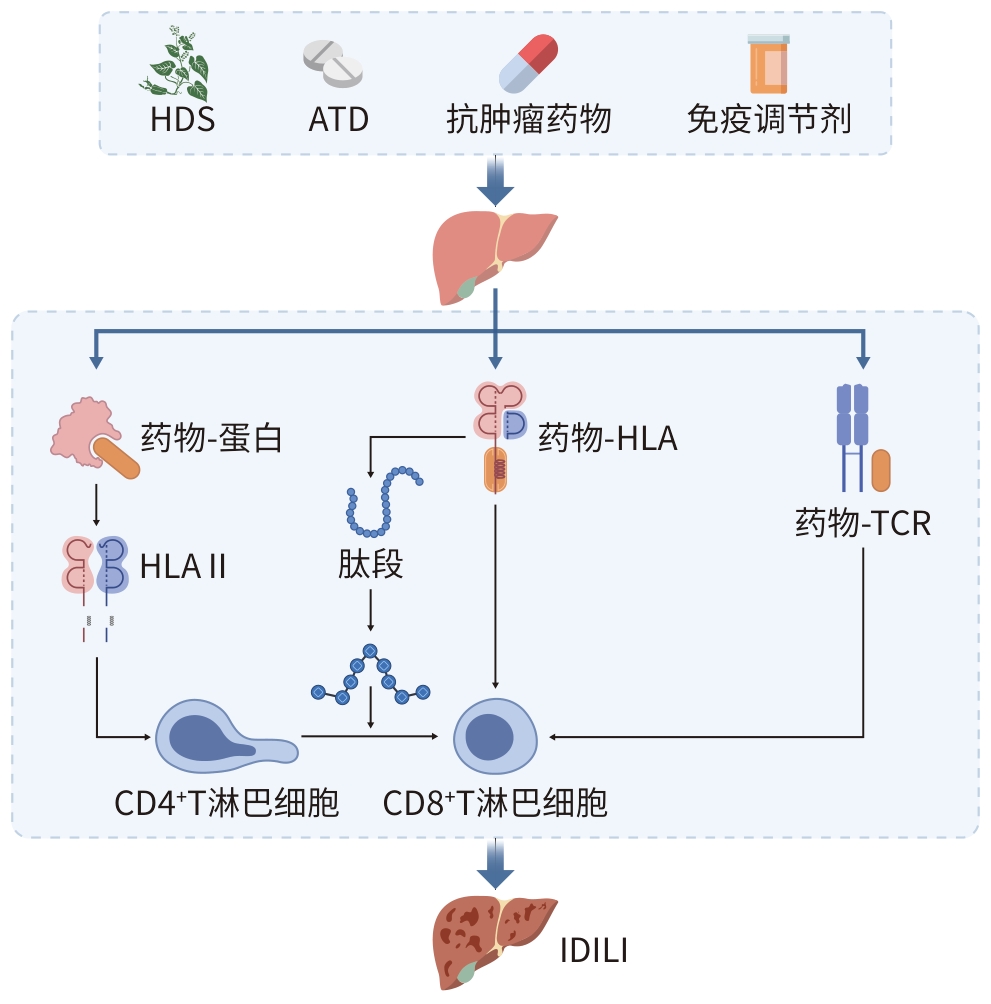
摘要: 特异质型药物性肝损伤(IDILI)因具有罕见性与难以预测性,且缺乏有效的体内外研究模型,其发病机制尚未完全阐明。近年来研究已证实,人类白细胞抗原(HLA)基因的多态性与多种药物所致IDILI的易感性显著相关。本文系统阐述了HLA基因检测在IDILI领域的最新研究进展,重点论述了特定HLA基因位点与常见导致药物性肝损伤药物的遗传易感性之间的关联,揭示了HLA基因检测在IDILI筛查中的重要意义。
-
关键词:
- 化学性与药物性肝损伤 /
- HLA抗原 /
- 基因组学
Abstract: The pathogenesis of idiosyncratic drug-induced liver injury (IDILI) remains unclear due to the rarity and unpredictability of IDILI and a lack of effective in vitro and in vivo models. Recent studies have shown that human leukocyte antigen (HLA) gene polymorphisms are significantly associated with the susceptibility to IDILI induced by various drugs. This article systematically reviews the latest research advances in HLA gene testing for IDILI, with a focus on the association between specific HLA gene loci and genetic susceptibility to drug-induced liver injury caused by commonly used drugs, in order to highlight the significance of HLA gene testing in IDILI screening.-
Key words:
- Chemical and Drug Induced Liver Injury /
- HLA Antigens /
- Genomics
-
[1] Hoofnagle J H, Björnsson E S. Drug-induced liver injury-types and phenotypes[J]. N Engl J Med, 2019, 381( 3): 264- 273. DOI: 10.1056/NEJMra1816149. [2] Teschke R, Uetrecht J. Mechanism of idiosyncratic drug induced liver injury(DILI): Unresolved basic issues[J]. Ann Transl Med, 2021, 9( 8): 730. DOI: 10.21037/atm-2020-ubih-05. [3] Kuna L, Bozic I, Kizivat T, et al. Models of drug induced liver injury(DILI)-current issues and future perspectives[J]. Curr Drug Metab, 2018, 19( 10): 830- 838. DOI: 10.2174/1389200219666180523095355. [4] Elzagallaai A A, Abuzgaia A M, Rieder M J. A comprehensive update on the human leukocyte antigen and idiosyncratic adverse drug reactions[J]. Expert Opinion on Drug Metabolism& Toxicology, 2025, 21( 5): 551- 562. DOI: 10.1080/17425255.2025.2455388. [5] Matzaraki V, Kumar V, Wijmenga C, et al. The MHC locus and genetic susceptibility to autoimmune and infectious diseases[J]. Genome Biol, 2017, 18( 1): 76. DOI: 10.1186/s13059-017-1207-1. [6] Zeng Xiangchang, Rao Tai, Chen Lulu, et al. Advances in immunogenetic mechanisms of drug-induced liver injury[J]. Chin J Clin Pharmacol Ther, 2025, 30( 8): 1133- 1146. DOI: 10.12092/j.issn.1009-2501.2025.08.016.曾祥昌, 饶泰, 陈露露, 等. 药物性肝损伤的免疫遗传学机制研究进展[J]. 中国临床药理学与治疗学, 2025, 30( 8): 1133- 1146. DOI: 10.12092/j.issn.1009-2501.2025.08.016. [7] Mosedale M, Watkins P B. Understanding idiosyncratic toxicity: Lessons learned from drug-induced liver injury[J]. J Med Chem, 2020, 63( 12): 6436- 6461. DOI: 10.1021/acs.jmedchem.9b01297. [8] Cho T, Uetrecht J. How reactive metabolites induce an immune response that sometimes leads to an idiosyncratic drug reaction[J]. Chem Res Toxicol, 2017, 30( 1): 295- 314. DOI: 10.1021/acs.chemrestox.6b00357. [9] Kim S H, Saide K, Farrell J, et al. Characterization of amoxicillin- and clavulanic acid-specific T cells in patients with amoxicillin-clavulanate-induced liver injury[J]. Hepatology, 2015, 62( 3): 887- 899. DOI: 10.1002/hep.27912. [10] Wang Yu, Li Shuang, Liu Chenghai. Immunological mechanism of drug-induced liver injury[J]. J Clin Hepatol, 2024, 40( 12): 2538- 2542. DOI: 10.12449/JCH241227.王宇, 李爽, 刘成海. 药物性肝损伤的免疫学机制[J]. 临床肝胆病杂志, 2024, 40( 12): 2538- 2542. DOI: 10.12449/JCH241227. [11] Ananthula S, Krishnaveni Sivakumar K, Cardone M, et al. Development of mouse models with restricted HLA-B 57: 01 presentation for the study of flucloxacillin-driven T-cell activation and tolerance in liver injury[J]. J Allergy Clin Immunol, 2023, 152( 2): 486- 499. DOI: 10.1016/j.jaci.2023.03.029. [12] Illing P T, Vivian J P, Dudek N L, et al. Immune self-reactivity triggered by drug-modified HLA-peptide repertoire[J]. Nature, 2012, 486( 7404): 554- 558. DOI: 10.1038/nature11147. [13] Thomson P J, Illing P T, Farrell J, et al. Modification of the cyclopropyl moiety of abacavir provides insight into the structure activity relationship between HLA-B*57: 01 binding and T-cell activation[J]. Allergy, 2020, 75( 3): 636- 647. DOI: 10.1111/all.14057. [14] Technology Committee on DILI Prevention and Management, Chinese Medical Biotechnology Association; Study Group of Drug-Induced Liver Disease, Chinese Medical Association for the Study of Liver Diseases. Chinese guideline for diagnosis and management of drug-induced liver injury(2023 version)[J]. Chin J Gastroenterol, 2023, 28( 7): 397- 431. DOI: 10.3760/cma.j.cn501113-20230419-00176.中国医药生物技术协会药物性肝损伤防治技术专业委员会, 中华医学会肝病学分会药物性肝病学组. 中国药物性肝损伤诊治指南(2023年版)[J]. 胃肠病学, 2023, 28( 7): 397- 431. DOI: 10.3760/cma.j.cn501113-20230419-00176. [15] Byeon J H, Kil J H, Ahn Y C, et al. Systematic review of published data on herb induced liver injury[J]. J Ethnopharmacol, 2019, 233: 190- 196. DOI: 10.1016/j.jep.2019.01.006. [16] Ma Z T, Shi Z, Xiao X H, et al. New insights into herb-induced liver injury[J]. Antioxid Redox Signal, 2023, 38( 16-18): 1138- 1149. DOI: 10.1089/ars.2022.0134. [17] Wang R, Qi X S, Yoshida E M, et al. Clinical characteristics and outcomes of traditional Chinese medicine-induced liver injury: A systematic review[J]. Expert Review of Gastroenterology& Hepatology, 2018, 12( 4): 425- 434. DOI: 10.1080/17474124.2018.1427581. [18] Li C P, Rao T, Chen X P, et al. HLA-B*35: 01 allele is a potential biomarker for predicting Polygonum multiflorum-induced liver injury in humans[J]. Hepatology, 2019, 70( 1): 346- 357. DOI: 10.1002/hep.30660. [19] Yang W N, Pang L L, Zhou J Y, et al. Single-nucleotide polymorphisms of HLA and Polygonum multiflorum-induced liver injury in the Han Chinese population[J]. World J Gastroenterol, 2020, 26( 12): 1329- 1339. DOI: 10.3748/wjg.v26.i12.1329. [20] Hoofnagle J H, Bonkovsky H L, Phillips E J, et al. HLA-B*35: 01 and green tea-induced liver injury[J]. Hepatology, 2021, 73( 6): 2484- 2493. DOI: 10.1002/hep.31538. [21] Vuppalanchi R, Bonkovsky H L, Ahmad J, et al. Garcinia cambogia, either alone or in combination with green tea, causes moderate to severe liver injury[J]. Clin Gastroenterol Hepatol, 2022, 20( 6): e1416- e1425. DOI: 10.1016/j.cgh.2021.08.015. [22] Halegoua-DeMarzio D, Navarro V, Ahmad J, et al. Liver injury associated with turmeric-a growing problem: Ten cases from the drug-induced liver injury network[DILIN][J]. Am J Med, 2023, 136( 2): 200- 206. DOI: 10.1016/j.amjmed.2022.09.026. [23] Kim B, Kim J, Yoon S Y, et al. HLA-DPB1*05: 01 and HLA-A*11: 01 is associated with adverse drug reactions to isoniazid and rifampin for treatment of latent tuberculosis infection in South Korea[J]. J Clin Med, 2024, 13( 12): 3563. DOI: 10.3390/jcm13123563. [24] Suvichapanich S, Wattanapokayakit S, Mushiroda T, et al. Genomewide association study confirming the association of NAT2 with susceptibility to antituberculosis drug-induced liver injury in Thai patients[J]. Antimicrob Agents Chemother, 2019, 63( 8): e02692-18. DOI: 10.1128/AAC.02692-18. [25] Spraggs C F, Schaid D J, Parham L R, et al. Abstract PD10-05: HLA-DQA1*02: 01/DRB1*07: 01 as a biomarker for lapatinib-induced hepatotoxicity: Prospective confirmation in a large randomised clinical trial(TEACH, EGF105485)[J]. Cancer Res, 2012, 72( 24_Supplement): PD10- 5-PD10- 05. DOI: 10.1158/0008-5472.sabcs12-pd10-05. [26] Parham L R, Briley L P, Li L, et al. Comprehensive genome-wide evaluation of lapatinib-induced liver injury yields a single genetic signal centered on known risk allele HLA-DRB1*07: 01[J]. Pharmacogenomics J, 2016, 16( 2): 180- 185. DOI: 10.1038/tpj.2015.40. [27] Xu C F, Johnson T, Wang X J, et al. HLA-B*57: 01 confers susceptibility to pazopanib-associated liver injury in patients with cancer[J]. Clin Cancer Res, 2016, 22( 6): 1371- 1377. DOI: 10.1158/1078-0432.CCR-15-2044. [28] Wang Yanxue, Lu Xingmeng, Li Shuting, et al. Analysis of 7 cases of multiple endocrine gland injury associated with immune checkpoint inhibitors in the treatment of primary liver cancer[J/CD]. Chin J Liver Dis Electron Version, 2025, 17( 2): 14- 19. DOI: 10.3969/j.issn.1674-7380.2025.02.003.王延雪, 鹿星梦, 李淑婷, 等. 免疫检查点抑制剂治疗原发性肝癌相关多内分泌腺体损伤7例分析[J/CD]. 中国肝脏病杂志(电子版), 2025, 17( 2): 14- 19. DOI: 10.3969/j.issn.1674-7380.2025.02.003. [29] Fontana R J, Li Y J, Chen V, et al. Genetic variants associated with immune-mediated liver injury from checkpoint inhibitors[J]. Hepatol Commun, 2024, 8( 9): e0518. DOI: 10.1097/HC9.0000000000000518. [30] Angela Y, Schaper-gerhardt K, Kochanek C, et al. HLA association with immune-mediated adverse events of checkpoint inhibitors[C]. 25th world congress of dermatology, Singapore, 2023. [31] Yi Xiancheng, Chen Pengfei, Cai Yiming. Research progress on the relationship between the effect of infliximab on Crohn’s disease and gene polymorphism[J]. Clin J Med Offic, 2025, 53( 2): 205- 208, 214.易显承, 陈鹏飞, 蔡一鸣. 英夫利昔单抗治疗克罗恩病效果与基因多态性关系研究进展[J]. 临床军医杂志, 2025, 53( 2): 205- 208, 214. [32] Bruno C D, Fremd B, Church R J, et al. HLA associations with infliximab-induced liver injury[J]. Pharmacogenomics J, 2020, 20( 5): 681- 686. DOI: 10.1038/s41397-020-0159-0. [33] Björnsson H K, Gudbjornsson B, Björnsson E S. Infliximab-induced liver injury: Clinical phenotypes, autoimmunity and the role of corticosteroid treatment[J]. J Hepatol, 2022, 76( 1): 86- 92. DOI: 10.1016/j.jhep.2021.08.024. [34] Daly A K, Donaldson P T, Bhatnagar P, et al. HLA-B*5701 genotype is a major determinant of drug-induced liver injury due to flucloxacillin[J]. Nat Genet, 2009, 41( 7): 816- 819. DOI: 10.1038/ng.379. [35] Singh S, Kumar P V S N K, Kumar J P, et al. Genetic and epigenetic basis of drug-induced liver injury[J]. Semin Liver Dis, 2023, 43( 2): 163- 175. DOI: 10.1055/a-2097-0531. [36] Petros Z, Makonnen E, Aklillu E. Genome-wide association studies for idiosyncratic drug-induced hepatotoxicity: Looking back-looking forward to next-generation innovation[J]. OMICS, 2017, 21( 3): 123- 131. DOI: 10.1089/omi.2017.0006. [37] Lucena M I, Molokhia M, Shen Y F, et al. Susceptibility to amoxicillin-clavulanate-induced liver injury is influenced by multiple HLA class I and II alleles[J]. Gastroenterology, 2011, 141( 1): 338- 347. DOI: 10.1053/j.gastro.2011.04.001. [38] Nicoletti P, Dellinger A, Li Y J, et al. Identification of reduced ERAP2 expression and a novel HLA allele as components of a risk score for susceptibility to liver injury due to amoxicillin-clavulanate[J]. Gastroenterology, 2023, 164( 3): 454- 466. DOI: 10.1053/j.gastro.2022.11.036. -

 下载:
下载:
 本文二维码
本文二维码
图(1)
计量
- 文章访问数: 9
- HTML全文浏览量: 2
- PDF下载量: 0
- 被引次数: 0