PDF下载 ( 2081 KB)

肝硬化食管胃静脉曲张破裂出血治疗后1年内再出血的危险因素分析及列线图模型构建
DOI: 10.12449/JCH260917
Risk factors analysis and construction of a nomogram model for rebleeding within one year after treatment of esophagogastric variceal bleeding in patients with cirrhosis
-
摘要:
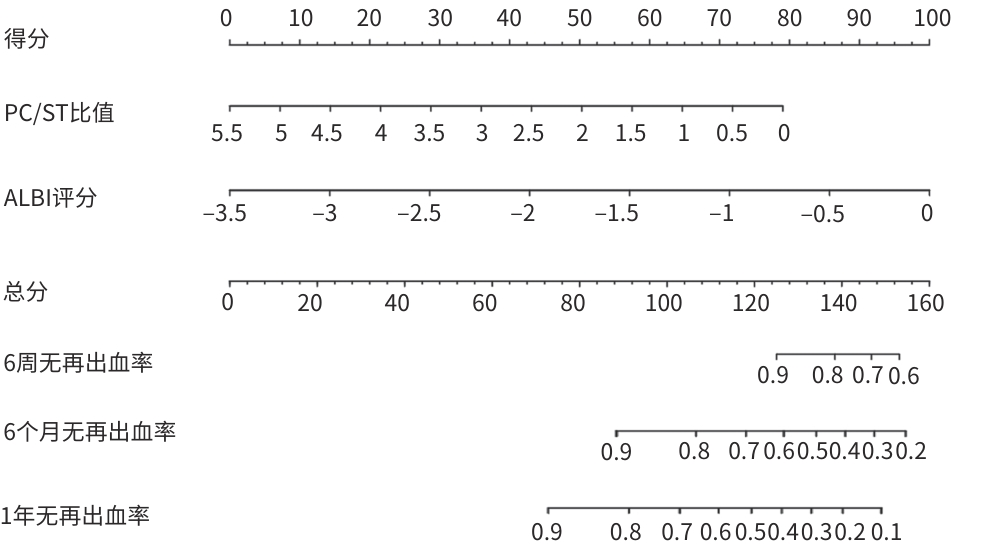
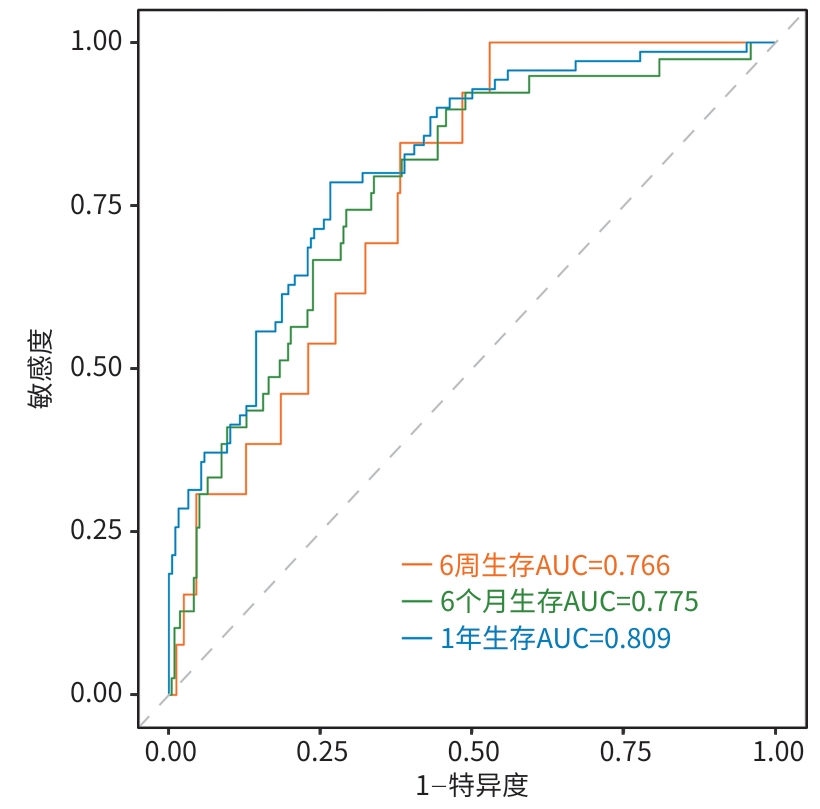
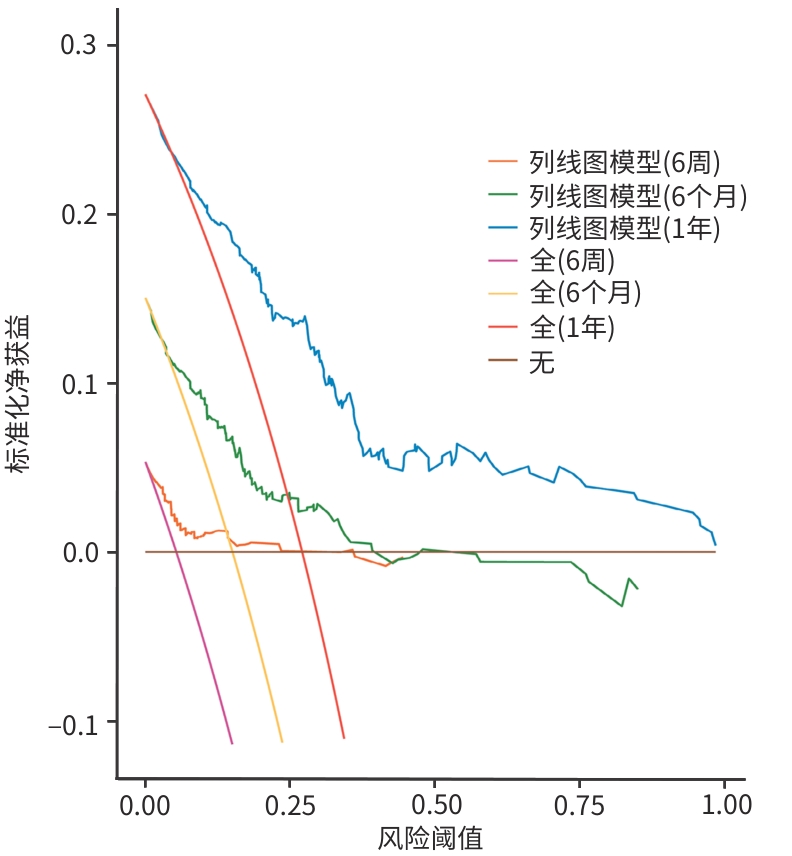
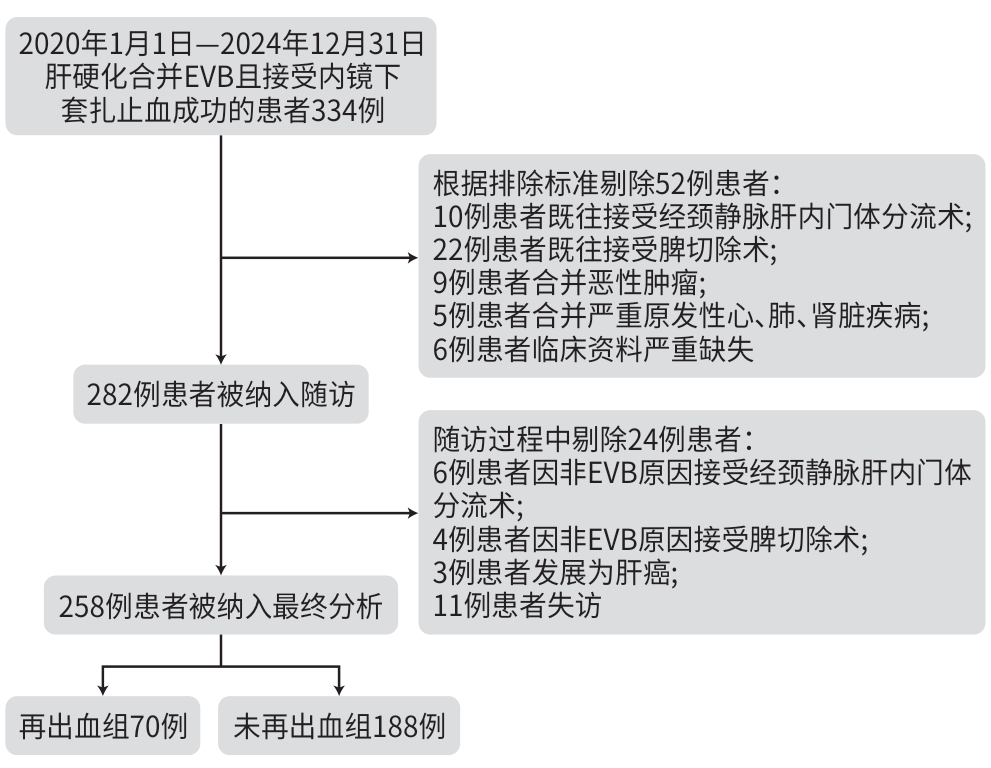
目的 探讨白蛋白-胆红素(ALBI)评分联合血小板计数/脾脏厚度(PC/ST)比值对肝硬化食管胃静脉曲张破裂出血(EVB)患者经内镜下套扎治疗后1年内再出血风险的预测价值,评估该联合模型的风险预测能力,进而为临床预防再出血提供参考依据。 方法 回顾性收集2020年1月1日—2024年12月31日于甘肃省人民医院住院的肝硬化EVB患者的临床资料。所有患者均经内镜下套扎治疗成功止血,根据术后1年内是否发生再出血分为再出血组与未再出血组。计量资料两组间比较采用成组t检验或Mann-Whitney U检验。计数资料两组间比较采用χ2检验或Fisher确切概率法。采用单因素及多因素Cox回归分析筛选再出血的独立影响因素,基于筛选出的因素构建预测模型,并绘制列线图实现模型可视化。应用受试者操作特征曲线评估模型的区分度,计算曲线下面积;校准曲线评估模型的校准度;决策曲线分析(DCA)评估模型的临床净获益。 结果 共纳入258例患者,其中1年内发生再出血70例,再出血率为27.1%。多因素Cox回归分析显示,ALBI评分(风险比=4.679,95%置信区间:2.952~7.417,P<0.001)和PC/ST比值(风险比=0.461,95%置信区间:0.318~0.668,P<0.001)是肝硬化EVB患者再出血的独立影响因素。基于这两项指标构建的模型预测6周、6个月及1年内再出血风险的曲线下面积分别为0.766(95%置信区间:0.667~0.866)、0.775(95%置信区间:0.699~0.851)和0.809(95%置信区间:0.752~0.866)。校准曲线显示,该模型对6周及6个月内再出血概率的预测存在系统性低估,而对1年内再出血概率的预测结果与理想曲线贴合度良好。DCA结果显示,模型对1年内再出血的预测具有明确的临床净获益。 结论 ALBI评分联合PC/ST比值构建的模型对肝硬化EVB患者内镜下套扎术后1年内再出血风险具有良好的预测效能。 Abstract:Objective To investigate the value of albumin-bilirubin (ALBI) score combined with platelet count-to-spleen thickness ratio (PC/ST) in predicting rebleeding within one year after endoscopic variceal ligation in liver cirrhosis patients with esophagogastric variceal bleeding (EVB), to evaluate the risk assessment ability of this model, and to provide a reference for clinical prevention of rebleeding. Methods A retrospective analysis was performed on the clinical data of liver cirrhosis patients with EVB who were hospitalized in Gansu Provincial Hospital from January 1, 2020 to December 31, 2024. All patients achieved successful hemostasis after endoscopic variceal ligation, and according to whether rebleeding occurred within one year after surgery, they were divided into rebleeding group and non-rebleeding group. The independent-samples t test or the Mann-Whitney U test was used for comparison of continuous data between two groups, and the chi-square test or the Fisher’s exact test was used for comparison of categorical data between two groups. The univariate and multivariate Cox regression analyses were used to identify independent influencing factors for rebleeding. A prediction model was constructed based on the factors identified, and a nomogram was plotted for model visualization. The receiver operating characteristic (ROC) curve was used to assess the discriminatory ability of the model, and the area under the ROC curve (AUC) was calculated; calibration curve was used to assess calibration; decision curve analysis was used to assess the net clinical benefit of the model. Results A total of 258 patients were enrolled, among whom 70 patients experienced rebleeding within one year, resulting in a rebleeding rate of 27.1%. The multivariate Cox regression analysis showed that ALBI score (hazard ratio [HR]=4.679, 95% confidence interval [CI]: 2.952 — 7.417, P<0.001) and PC/ST (HR=0.461, 95%CI: 0.318 — 0.668, P<0.001) were independent influencing factors for rebleeding in liver cirrhosis patients with EVB. The model constructed based on these two factors yielded an AUC of 0.766 (95%CI: 0.667 — 0.866), 0.775 (95%CI: 0.699 — 0.851), and 0.809 (95%CI: 0.752 — 0.866), respectively, for predicting the risk of rebleeding at 6 weeks, 6 months, and 1 year. The calibration curve showed that the model systematically underestimated the probability of rebleeding at 6 weeks and 6 months, but its prediction for the probability of rebleeding at 1 year aligned well with the ideal curve. The decision curve analysis showed that the model provided a clear net clinical benefit for predicting rebleeding within 1 year. Conclusion The model constructed based on ALBI score and PC/ST had good performance in predicting the risk of rebleeding within 1 year after endoscopic variceal ligation in liver cirrhosis patients with EVB. -
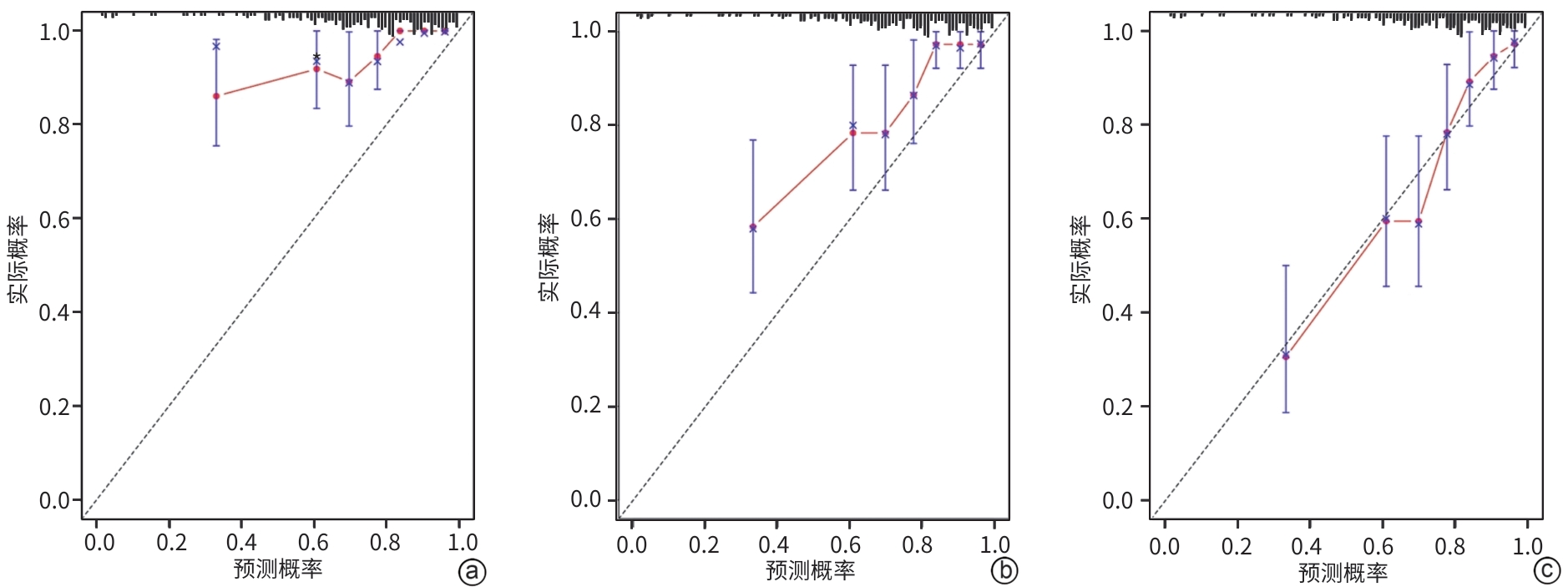
注: a, 6周内再出血概率校准曲线;b,6个月内再出血概率校准曲线;c,1年内再出血概率校准曲线。
图 4 校准曲线
Figure 4. Calibration curve
表 1 再出血组与未再出血组基线资料的比较
Table 1. Baseline characteristics of patients with and without rebleeding
指标 再出血组(n=70) 未再出血组(n=188) 统计值 P值 年龄(岁) 52.47±14.19 55.17±12.21 t=1.509 0.133 性别[例(%)] χ2=0.563 0.453 男 42(60.0) 103(54.8) 女 28(40.0) 85(45.2) 高血压[例(%)] χ2=0.003 0.953 有 8(11.4) 21(11.2) 无 62(88.6) 167(88.8) 糖尿病[例(%)] χ2=0.192 0.661 有 10(14.3) 23(12.2) 无 60(85.7) 165(87.8) 肝硬化病因[例(%)] χ2=2.633 0.612 乙型肝炎 55(78.6) 151(80.3) 丙型肝炎 5(7.1) 15(8.0) 酒精性肝病 1(1.4) 1(0.5) 原发性胆汁性胆管炎 3(4.3) 12(6.4) 自身免疫性肝炎 6(8.6) 9(4.8)  下载: 导出CSV
表 2 再出血组与未再出血组临床特征的比较
Table 2. Comparison of clinical characteristics between the rebleeding group and the non-rebleeding group
指标 再出血组(n=70) 未再出血组(n=188) 统计值 P值 红色征[例(%)] χ2=0.371 0.542 有 65(92.9) 170(90.4) 无 5(7.1) 18(9.6) 胃底静脉曲张[例(%)] χ2=0.889 0.346 有 34(48.6) 79(42.0) 无 36(51.4) 109(58.0) 门静脉高压性胃病[例(%)] χ2=0.813 0.367 有 19(27.1) 41(21.8) 无 51(72.9) 147(78.2) 腹水[例(%)] χ2=1.227 0.220 无 30(42.9) 87(46.3) 轻度 13(18.6) 52(27.7) 中重度 27(38.6) 49(26.1) 肝性脑病[例(%)] χ2=0.181 0.670 有 3(4.3) 6(3.2) 无 67(95.7) 182(96.8) 门静脉血栓[例(%)] χ2=0.024 0.877 有 6(8.6) 15(8.0) 无 64(91.4) 173(92.0) 脾脏厚度(mm) 58.00(50.00~64.75) 47.00(42.00~54.00) Z=-6.169 <0.001 门静脉内径(mm) 13.80(13.00~15.00) 13.00(12.00~14.00) Z=-2.561 0.010 序贯治疗[例(%)] χ2=5.411 0.020 有 16(22.9) 72(38.3) 无 54(77.1) 116(61.7) 服用NSBB[例(%)] χ2=0.417 0.518 有 12(17.1) 39(20.7) 无 58(82.9) 149(79.3) 注:NSBB,非选择性β受体阻滞剂。
下载: 导出CSV
表 3 再出血组与未再出血组实验室指标的比较
Table 3. Comparison of laboratory parameters between the rebleeding group and the non-rebleeding group
指标 再出血组(n=70) 未再出血组(n=188) 统计值 P值 WBC(×109/L) 4.00(2.30~5.73) 3.90(2.80~6.28) Z=-0.542 0.588 PLT(×109/L) 64.50(41.00~82.00) 75.00(51.00~101.75) Z=-3.253 0.001 HGB(g/L) 83.93±29.32 86.62±26.23 t=0.710 0.478 Alb(g/L) 29.50±5.48 33.56±4.39 t=6.145 <0.001 TBil(μmol/L) 31.81(25.93~42.35) 24.24(17.93~34.68) Z=-4.402 <0.001 ALT(U/L)) 26.00(19.40~37.00) 30.04(20.00~49.42) Z=-1.497 0.134 AST(U/L) 30.00(22.00~43.25) 37.00(23.00~60.00) Z=-1.903 0.057 ALP(U/L) 89.00(62.75~123.25) 86.00(67.00~114.66) Z=-0.296 0.767 GGT(U/L) 37.85(22.23~71.50) 32.22(21.01~73.76) Z=-0.408 0.683 Na+(mmol/L) 138.20(136.83~140.68) 138.90(137.00~140.10) Z=-0.656 0.512 PT(s) 17.00(15.50~18.50) 16.55(15.20~18.10) Z=-0.658 0.511 Cr(μmol/L) 61.56(51.86~77.37) 58.40(48.20~68.15) Z=-1.490 0.136 PC/ST比值 1.15(0.66~1.61) 1.63(1.00~2.36) Z=-4.841 <0.001 ALBI评分(分) -1.58(-1.86~-1.27) -1.89(-2.16~-1.66) Z=-5.913 <0.001 注:WBC,白细胞;PLT,血小板;HGB,血红蛋白;Alb,白蛋白;TBil,总胆红素;ALT,丙氨酸氨基转移酶;AST,天冬氨酸氨基转移酶;ALP,碱性磷酸酶;GGT,γ-谷氨酰转移酶;Na+,钠离子;PT,凝血酶原时间;Cr,肌酐;PC/ST,血小板计数/脾脏厚度;ALBI,白蛋白-胆红素。
下载: 导出CSV
表 4 单因素Cox回归分析
Table 4. Univariate Cox regression analysis
变量 HR(95%CI) P值 脾脏厚度 1.082(1.059~1.106) <0.001 门静脉内径 1.100(0.993~1.219) 0.067 是否序贯(否=0,是=1) 0.638(0.365~1.115) 0.115 血小板 0.987(0.980~0.995) 0.001 总胆红素 1.029(1.019~1.039) <0.001 白蛋白 0.882(0.846~0.920) <0.001 PC/ST比值 0.409(0.279~0.598) <0.001 ALBI评分 5.439(3.441~8.597) <0.001 注:HR,风险比;CI:置信区间;PC/ST,血小板计数/脾脏厚度;ALBI,白蛋白-胆红素。
下载: 导出CSV
-
[1] Chinese Society of Hepatology, Chinese Society of Gastroenterology, Chinese Society of Digestive Endoscopology of Chinese Medical Association. Guidelines on the management of esophagogastric variceal bleeding in cirrhotic portal hypertension[J]. J Clin Hepatol, 2023, 39( 3): 527- 538.中华医学会肝病学分会, 中华医学会消化病学分会, 中华医学会消化内镜学分会. 肝硬化门静脉高压食管胃静脉曲张出血的防治指南[J]. 临床肝胆病杂志, 2023, 39( 3): 527- 538. [2] Garcia-Tsao G, Abraldes J G, Berzigotti A, et al. Portal hypertensive bleeding in cirrhosis: Risk stratification, diagnosis, and management: 2016 practice guidance by the American Association for the study of liver diseases[J]. Hepatology, 2017, 65( 1): 310- 335. DOI: 10.1002/hep.28906. [3] Jakab S S, Garcia-Tsao G. Evaluation and management of esophageal and gastric varices in patients with cirrhosis[J]. Clin Liver Dis, 2020, 24( 3): 335- 350. DOI: 10.1016/j.cld.2020.04.011. [4] Yang J, Ge K, Chen L, et al. The efficacy comparison of carvedilol plus endoscopic variceal ligation and traditional, nonselective β-blockers plus endoscopic variceal ligation in cirrhosis patients for the prevention of variceal rebleeding: A meta-analysis[J]. Eur J Gastroenterol Hepatol, 2019, 31( 12): 1518- 1526. DOI: 10.1097/MEG.0000000000001442. [5] Nett A, Binmoeller K F. Endoscopic management of portal hypertension-related bleeding[J]. Gastrointest Endosc Clin N Am, 2019, 29( 2): 321- 337. DOI: 10.1016/j.giec.2018.12.006. [6] Johnson P J, Berhane S, Kagebayashi C, et al. Assessment of liver function in patients with hepatocellular carcinoma: A new evidence-based approach-the ALBI grade[J]. J Clin Oncol, 2015, 33( 6): 550- 558. DOI: 10.1200/JCO.2014.57.9151. [7] Liu Yuhua. The prognostic evaluation of ALBI score in endoscopic treatment of esophagogastric varices hemorrhage in liver cirrhosis[D]. Nanchang: Nanchang University, 2022. DOI: 10.27232/d.cnki.gnchu.2022.000447.刘宇华. ALBI评分对内镜治疗肝硬化食管胃静脉曲张破裂出血的预后评估[D]. 南昌: 南昌大学, 2022. DOI: 10.27232/d.cnki.gnchu.2022.000447. [8] He Yanting, Su Yousheng, Ye Yulong. The role of ALBI combined with NLR in predicting liver cirrhosis complicated with esophageal and gastric varices bleeding[J]. Guangzhou Med J, 2025, 56( 3): 387- 392. DOI: 10.20223/j.cnki.1000-8535.2025.03.016.何艳婷, 苏有盛, 叶宇龙. ALBI联合NLR预测肝硬化合并食管胃底静脉曲张破裂出血的作用[J]. 广州医药, 2025, 56( 3): 387- 392. DOI: 10.20223/j.cnki.1000-8535.2025.03.016. [9] Yao Jianhua, Chen Zhengyan. Evaluation of esophageal varices by changes of platelet count and spleen thickness in patients with liver cirrhosis[J]. Chin Hepatol, 2005, 10( 2): 150- 151. DOI: 10.3969/j.issn.1008-1704.2005.02.044.姚建华, 陈正言. 肝硬化患者血小板计数与脾脏厚度变化对食管静脉曲张的评价[J]. 肝脏, 2005, 10( 2): 150- 151. DOI: 10.3969/j.issn.1008-1704.2005.02.044. [10] Lin Xiaoyu, Hu Xiaomin, Chen Yongpeng. Value of noninvasive liver fibrosis markers in predicting high-risk gastroesophageal varices in patients with liver cirrhosis[J]. J Clin Hepatol, 2020, 36( 8): 1742- 1746. DOI: 10.3969/j.issn.1001-5256.2020.08.013.林小钰, 胡晓敏, 陈永鹏. 无创肝纤维化指标对肝硬化患者高风险胃食管静脉曲张的预测价值[J]. 临床肝胆病杂志, 2020, 36( 8): 1742- 1746. DOI: 10.3969/j.issn.1001-5256.2020.08.013. [11] Chinese Society of Gastroenterology, Chinese Medical Association. Chinese consensus on clinical diagnosis and therapy of liver cirrhosis[J]. J Clin Hepatol, 2023, 39( 9): 2057- 2073.中华医学会消化病学分会. 中国肝硬化临床诊治共识意见[J]. 临床肝胆病杂志, 2023, 39( 9): 2057- 2073. [12] Chinese Society of Spleen and Portal Hypertension Surgery, Chinese Society of Surgery, Chinese Medical Association. Expert consensus on the diagnosis and treatment of esophageal and gastric variceal rupture bleeding in cirrhotic portal hypertension(2025 edition)[J]. Chin J Dig Surg, 2025, 24( 3): 271- 280. DOI: 10.3760/cma.j.cn115610-20241228-00590.中华医学会外科学分会脾及门静脉高压外科学组. 肝硬化门静脉高压症食管、胃底静脉曲张破裂出血诊治专家共识(2025版)[J]. 中华消化外科杂志, 2025, 24( 3): 271- 280. DOI: 10.3760/cma.j.cn115610-20241228-00590. [13] de Franchis R, Bosch J, Garcia-Tsao G, et al. Baveno VII- Renewing consensus in portal hypertension[J]. J Hepatol, 2022, 76( 4): 959- 974. DOI: 10.1016/j.jhep.2021.12.022. [14] Zhang Shuai, Zhang Xiaobin, Liu Yingdi, et al. Endoscopic management of esophagogastric varices in patients with liver cirrhosis[J/OL]. Chin J Gastrointestial Endoscopy(Electronic Editon), 2024, 11( 3): 191- 194. DOI: 10.3877/cma.j.issn.2095-7157.2024.03.010.张帅, 张晓彬, 刘迎娣, 等. 肝硬化食管胃静脉曲张的内镜管理[J/OL]. 中华胃肠内镜电子杂志, 2024, 11( 3): 191- 194. DOI: 10.3877/cma.j.issn.2095-7157.2024.03.010. [15] Wang Xing, Hu Bing, Li Yiling, et al. A national questionnaire survey on endoscopic treatment for gastroesophageal varices in portal hypertension in China[J]. Chin J Dig Endosc, 2024, 41( 1): 43- 51. DOI: 10.3760/cma.j.cn321463-20230629-00190.王省, 胡兵, 李异玲, 等. 中国门静脉高压食管胃静脉曲张内镜治疗现状调研分析[J]. 中华消化内镜杂志, 2024, 41( 1): 43- 51. DOI: 10.3760/cma.j.cn321463-20230629-00190. [16] Wang Jingjing, Liu Ligai, Xie Wen. A re-understanding of the physiological function of albumin[J]. J Clin Hepatol, 2025, 41( 3): 404- 408. DOI: 10.12449/JCH250302.王菁菁, 刘丽改, 谢雯. 白蛋白生理功能再认识[J]. 临床肝胆病杂志, 2025, 41( 3): 404- 408. DOI: 10.12449/JCH250302. [17] Arroyo V, García-Martinez R, Salvatella X. Human serum albumin, systemic inflammation, and cirrhosis[J]. J Hepatol, 2014, 61( 2): 396- 407. DOI: 10.1016/j.jhep.2014.04.012. [18] Torres L N, Chung K K, Salgado C L, et al. Low-volume resuscitation with normal saline is associated with microvascular endothelial dysfunction after hemorrhage in rats, compared to colloids and balanced crystalloids[J]. Crit Care, 2017, 21( 1): 160. DOI: 10.1186/s13054-017-1745-7. [19] Jin Yan, Wang Xue, Zhang Lingjuan, et al. Risk factors for early rebleeding after esophageal variceal ligation in patients with liver cirrhosis[J]. J Clin Hepatol, 2017, 33( 11): 2147- 2151. DOI: 10.3969/j.issn.1001-5256.2017.11.019.金燕, 王雪, 张玲娟, 等. 肝硬化患者食管静脉曲张套扎术后早期再出血的危险因素分析[J]. 临床肝胆病杂志, 2017, 33( 11): 2147- 2151. DOI: 10.3969/j.issn.1001-5256.2017.11.019. [20] Wang Z, Xie Y W, Lu Q, et al. The impact of albumin infusion on the risk of rebleeding and in-hospital mortality in cirrhotic patients admitted for acute gastrointestinal bleeding: A retrospective study of a single institute[J]. BMC Gastroenterol, 2020, 20( 1): 198. DOI: 10.1186/s12876-020-01337-5. [21] Ramírez-Mejía M M, Castillo-Castañeda S M, Pal S C, et al. The multifaceted role of bilirubin in liver disease: A literature review[J]. J Clin Transl Hepatol, 2024, 12( 11): 939- 948. DOI: 10.14218/JCTH.2024.00156. [22] Wang Huiqun, Ye Chao, Xu Chao, et al. A 5-year follow-up study of rebleeding after endoscopic treatment of esophageal gastric varices rebleeding associated with liver cirrhosis[J]. J Pract Med, 2024, 40( 22): 3155- 3159. DOI: 10.3969/j.issn.1006-5725.2024.22.006.王慧群, 叶超, 许朝, 等. 肝硬化食管胃底静脉曲张破裂出血内镜治疗后再出血的5年随访研究[J]. 实用医学杂志, 2024, 40( 22): 3155- 3159. DOI: 10.3969/j.issn.1006-5725.2024.22.006. [23] Hu T T, Stock S, Hong W D, et al. Modified‘sandwich’ injection with or without ligation for variceal bleeding in patients with both esophageal and gastric varices: A retrospective cohort study[J]. Scand J Gastroenterol, 2020, 55( 10): 1219- 1224. DOI: 10.1080/00365521.2020.1803959. [24] Zhang Shengyan, Huang Hongchun, Wang Xiumin. Factors influencing prognosis for cirrhotic patients with esophagogastric variceal bleeding within 1 year after endoscopic variceal ligation[J]. Chin Hepatol, 2021, 26( 2): 155- 158. DOI: 10.14000/j.cnki.issn.1008-1704.2021.02.016.张生燕, 黄宏春, 王秀敏. 肝硬化食管胃底静脉曲张出血内镜套扎术后1年预后的影响因素观察[J]. 肝脏, 2021, 26( 2): 155- 158. DOI: 10.14000/j.cnki.issn.1008-1704.2021.02.016. [25] Eshkiki Z S, Khazaei R, Parsi A, et al. Comparing the predictive efficacy of MELD and ALBI scores in liver cirrhosis patients with acute upper gastrointestinal bleeding[J]. Arq Gastroenterol, 2025, 62: e24075. DOI: 10.1590/S0004-2803.24612024-075. [26] Sun Mengyuan, Xiang Xiaoxing. Value of albumin-bilirubin score in predicting the prognosis of cirrhotic patients with esophagogastric variceal bleeding[J]. J Clin Hepatol, 2021, 37( 3): 590- 595. DOI: 10.3969/j.issn.1001-5256.2021.03.017.孙梦园, 向晓星. ALBI评分对肝硬化食管胃底静脉曲张破裂出血患者预后的预测价值[J]. 临床肝胆病杂志, 2021, 37( 3): 590- 595. DOI: 10.3969/j.issn.1001-5256.2021.03.017. [27] Xavier S A, Vilas-Boas R, Boal Carvalho P, et al. Assessment of prognostic performance of Albumin-Bilirubin, Child-Pugh, and Model for End-stage Liver Disease scores in patients with liver cirrhosis complicated with acute upper gastrointestinal bleeding[J]. Eur J Gastroenterol Hepatol, 2018, 30( 6): 652- 658. DOI: 10.1097/MEG.0000000000001087. [28] Liu Y H, Wu S N, Cai S S, et al. The prognostic evaluation of ALBI score in endoscopic treatment of esophagogastric varices hemorrhage in liver cirrhosis[J]. Sci Rep, 2024, 14( 1): 780. DOI: 10.1038/s41598-023-50629-9. [29] Berzigotti A, Seijo S, Arena U, et al. Elastography, spleen size, and platelet count identify portal hypertension in patients with compensated cirrhosis[J]. Gastroenterology, 2013, 144( 1): 102- 111. DOI: 10.1053/j.gastro.2012.10.001. [30] Liu Z R, Zhang Y M, Cui Z L, et al. Effects of thrombopoietin pre-treatment on peri-liver transplantation thrombocytopenia in a mouse model of cirrhosis with hypersplenism[J]. World J Gastrointest Surg, 2023, 15( 10): 2115- 2122. DOI: 10.4240/wjgs.v15.i10.2115. [31] Tian Y C, Zong Y, Pang Y D, et al. Platelets and diseases: Signal transduction and advances in targeted therapy[J]. Sig Transduct Target Ther, 2025, 10: 159. DOI: 10.1038/s41392-025-02198-8. [32] Hu Jing, Yi Tingzhuang, Nong Xinlei, et al. Analysis of predictive value of serological indicators combined with Child-Pugh score on rebleeding after EVL in patients with liver cirrhosis complicated with esophageal varices bleeding[J]. Chin Hepatol, 2024, 29( 8): 934- 938. DOI: 10.14000/j.cnki.issn.1008-1704.2024.08.013.胡静, 易庭庄, 农欣蕾, 等. 血清学指标联合Child-Pugh评分对肝硬化食管静脉曲张破裂出血患者EVL术后再出血的预测价值[J]. 肝脏, 2024, 29( 8): 934- 938. DOI: 10.14000/j.cnki.issn.1008-1704.2024.08.013. [33] Zaman A, Becker T, Lapidus J, et al. Risk factors for the presence of varices in cirrhotic patients without a history of variceal hemorrhage[J]. Arch Intern Med, 2001, 161( 21): 2564- 2570. DOI: 10.1001/archinte.161.21.2564. [34] Wang Q, Zhao H, Deng Y, et al. Validation of Baveno VII criteria for recompensation in entecavir-treated patients with hepatitis B-related decompensated cirrhosis[J]. J Hepatol, 2022, 77( 6): 1564- 1572. DOI: 10.1016/j.jhep.2022.07.037. [35] Qian Yuxin, Du Mingshu, Zhang Pei. Efficacy evaluation of liver stiffness measurement, spleen thickness and splenic vein diameter in predicting esophageal varices in patients with hepatitis B cirrhosis[J]. Chin Hepatol, 2024, 29( 12): 1517- 1520. DOI: 10.14000/j.cnki.issn.1008-1704.2024.12.024.钱玉鑫, 杜明澍, 张培. 肝脏硬度值、脾脏厚度及脾静脉直径预测乙型肝炎肝硬化患者食管静脉曲张的效能评价[J]. 肝脏, 2024, 29( 12): 1517- 1520. DOI: 10.14000/j.cnki.issn.1008-1704.2024.12.024. [36] Yue Yuanyuan, Zhang Xu. Predictive value of platelet count and spleen thickness in esophageal varices in liver cirrhosis[J]. J Huaihai Med, 2020, 38( 1): 57- 59. DOI: 10.14126/j.cnki.1008-7044.2020.01.020.岳元元, 张旭. 血小板计数和脾脏厚度在肝硬化食管静脉曲张中的预测价值[J]. 淮海医药, 2020, 38( 1): 57- 59. DOI: 10.14126/j.cnki.1008-7044.2020.01.020. [37] Cheng Xiaojing. Correlation among hepatic transient elastography index, spleen thickness, portal vein inner diameter, FIB4, APRI and the degree of esophageal varices in liver cirrhosis[J]. Chin Foreign Med Res, 2023, 21( 14): 75- 78. DOI: 10.14033/j.cnki.cfmr.2023.14.020.程晓静. 肝瞬时弹性成像指标、脾脏厚度、门静脉内径及FIB4、APRI与肝硬化食管静脉曲张程度的相关性[J]. 中外医学研究, 2023, 21( 14): 75- 78. DOI: 10.14033/j.cnki.cfmr.2023.14.020. [38] Zhang F B, Zhou Y H, Li X, et al. Spleen thickness plus platelets can effectively and safely screen for high-risk varices in cirrhosis patients[J]. Diagnostics(Basel), 2023, 13( 20): 3164. DOI: 10.3390/diagnostics13203164. [39] Feng Shuang, Feng Huifen, Xu Jing, et al. Value of FibroScan and platelet count-to-spleen thickness ratio in predicting the degree of esophageal and gastric varices in liver cirrhosis[J]. J Clin Hepatol, 2021, 37( 12): 2819- 2823. DOI: 10.3969/j.issn.1001-5256.2021.12.018.封爽, 冯慧芬, 徐晶, 等. 肝硬度值和血小板计数/脾脏厚径比率对肝硬化食管胃底静脉曲张程度的预测价值[J]. 临床肝胆病杂志, 2021, 37( 12): 2819- 2823. DOI: 10.3969/j.issn.1001-5256.2021.12.018. [40] Liu H M, Zhang Q, Gao F Y, et al. Platelet count/spleen thickness ratio and the risk of variceal bleeding in cirrhosis with esophagogastric varices[J]. Front Med, 2022, 9: 870351. DOI: 10.3389/fmed.2022.870351. -

 本文二维码
计量
- 文章访问数: 12
- HTML全文浏览量: 5
- PDF下载量: 0
- 被引次数: 0