PDF下载 ( 1249 KB)

药物性肝损伤的临床现状、研究进展与挑战
DOI: 10.12449/JCH261001
利益冲突声明:本文不存在任何利益冲突。
作者贡献声明:黄德良、朱质斌负责设计论文框架,起草论文,修改论文;陈军负责拟定写作思路,指导撰写论文并最后定稿。
Drug-induced liver injury: Current status, research advances, and challenges in clinical practice
-
摘要: 药物性肝损伤(DILI)是临床常见且严重的药物不良反应,也是新药研发失败和上市后撤市的重要原因。近年来,免疫检查点抑制剂等新型抗肿瘤药的广泛应用、抗生素及抗结核药的持续使用、膳食补充剂与草药的日益普及,深刻改变了DILI的病因谱和临床表型。本文基于最新证据,系统综述DILI的全球流行病学、病因变迁、遗传易感性、发病机制、诊断工具、新型生物标志物及治疗策略,并展望未来方向。
-
关键词:
- 化学性与药物性肝损伤 /
- 流行病学 /
- 病理过程 /
- 治疗学
Abstract: Drug-induced liver injury (DILI) is a common and severe adverse drug reaction in clinical practice and a major cause of new drug development failures and post‑marketing withdrawals. In recent years, the widespread use of novel anti-neoplastic agents, especially immune checkpoint inhibitors, the continuous use of antibiotics and anti‑tuberculosis drugs, and the increasing prevalence of dietary supplements and herbal products have profoundly reshaped the etiological spectrum and clinical phenotypes of DILI. Based on the latest evidence, this article systematically reviews the global epidemiology, etiological shifts, genetic susceptibility, pathogenesis, diagnostic tools, emerging biomarkers, and therapeutic strategies for DILI and outlines the future directions. -
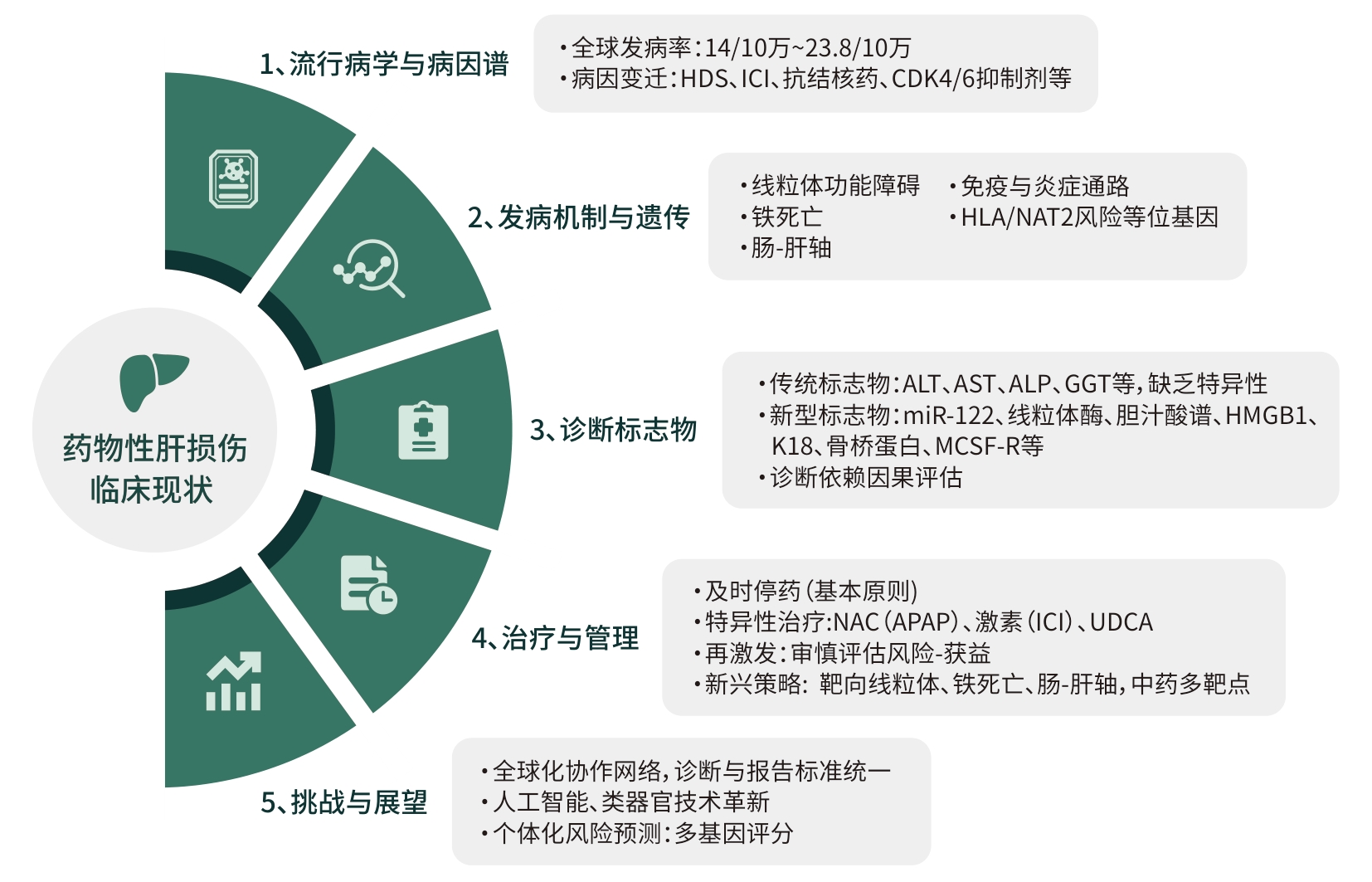
注: HDS,草药和膳食补充剂;ICI,免疫检查点抑制剂;CDK,细胞周期蛋白依赖性激酶;HLA,人类白细胞抗原;NAT2,N-乙酰转移酶2;ALT,丙氨酸氨基转移酶;AST,天冬氨酸氨基转移酶;ALP,碱性磷酸酶;GGT,γ-谷氨酰转移酶;miR-122,微RNA-122;HMGB1,高迁移率族蛋白B1;K18,角蛋白-18;MCSF-R,巨噬细胞集落刺激因子受体;NAC,N-乙酰半胱氨酸;APAP,对乙酰氨基酚;UDCA,熊去氧胆酸。
图 1 药物性肝损伤的临床现状、研究进展与挑战
Figure 1. Drug-induced liver injury: Current status, research progress, and challenges
-
[1] Hoofnagle J H, Björnsson E S. Drug-induced liver injury- types and phenotypes[J]. N Engl J Med, 2019, 381( 3): 264- 273. DOI: 10.1056/NEJMra1816149. [2] Andrade R J, Chalasani N, Björnsson E S, et al. Drug-induced liver injury[J]. Nat Rev Dis Primers, 2019, 5( 1): 58. DOI: 10.1038/s41572-019-0105-0. [3] Fontana R J, Bjornsson E S, Reddy R, et al. The evolving profile of idiosyncratic drug-induced liver injury[J]. Clin Gastroenterol Hepatol, 2023, 21( 8): 2088- 2099. DOI: 10.1016/j.cgh.2022.12.040. [4] Pocurull A, Moreta M J, Heitman D, et al. Anticancer drugs are the first cause of drug-induced liver injury in a reference hospital[J]. Liver Int, 2024, 44( 2): 286- 292. DOI: 10.1111/liv.15821. [5] Björnsson E S, Bergmann O M, Björnsson H K, et al. Incidence, presentation, and outcomes in patients with drug-induced liver injury in the general population of Iceland[J]. Gastroenterology, 2013, 144( 7): 1419- 1425. DOI: 10.1053/j.gastro.2013.02.006. [6] Chalasani N, Bonkovsky H L, Fontana R, et al. Features and outcomes of 899 patients with drug-induced liver injury: The DILIN prospective study[J]. Gastroenterology, 2015, 148( 7): 1340- 1352. DOI: 10.1053/j.gastro.2015.03.006. [7] Shen T, Liu Y X, Shang J, et al. Incidence and etiology of drug-induced liver injury in mainland China[J]. Gastroenterology, 2019, 156( 8): 2230- 2241. DOI: 10.1053/j.gastro.2019.02.002. [8] Wu J W, Zhu Y, Du X K, et al. Review on traditional Chinese medicine-induced liver injury[J]. J Ethnopharmacol, 2026, 358: 120949. DOI: 10.1016/j.jep.2025.120949. [9] Saukkonen J J, Cohn D L, Jasmer R M, et al. An official ATS statement: Hepatotoxicity of antituberculosis therapy[J]. Am J Respir Crit Care Med, 2006, 174( 8): 935- 952. DOI: 10.1164/rccm.200510-1666ST. [10] Tavkar V, Goyal A, Chopra V, et al. The role of NAT2 genetic variants in anti-tuberculosis drug-induced liver injury(AT-DILI): A meta-analysis[J]. Pharmacogenomics, 2025, 26( 17-18): 787- 803. DOI: 10.1080/14622416.2026.2624364. [11] Zhou J, Tan Y Z, Hu L L, et al. Inhibition of HSPA8 by rifampicin contributes to ferroptosis via enhancing autophagy[J]. Liver Int, 2022, 42( 12): 2889- 2899. DOI: 10.1111/liv.15459. [12] Huang D L, Peng J H, Lei L, et al. Time of liver function abnormal identification on prediction of the risk of anti-tuberculosis-induced liver injury[J]. J Clin Transl Hepatol, 2023, 11( 2): 425- 432. DOI: 10.14218/JCTH.2022.00077. [13] Sharma S K, Singla R, Sarda P, et al. Safety of 3 different reintroduction regimens of antituberculosis drugs after development of antituberculosis treatment-induced hepatotoxicity[J]. Clin Infect Dis, 2010, 50( 6): 833- 839. DOI: 10.1086/650576. [14] Soni H, Kumar-M P, Mishra S, et al. Risk of hepatitis with various reintroduction regimens of anti-tubercular therapy: A systematic review and network meta-analysis[J]. Expert Rev Anti Infect Ther, 2020, 18( 2): 171- 179. DOI: 10.1080/14787210.2020.1714436. [15] Vuppalanchi R, Li Y J, Rockey D C, et al. Clinical and genetic associations in cephalosporin-induced liver injury: Insights from the drug-induced liver injury network[J]. Aliment Pharmacol Ther, 2025, 62( 10): 1012- 1022. DOI: 10.1111/apt.70284. [16] Björnsson R A, Sigurdsson S S, Arnarson D T, et al. The frequency of drug-induced liver injury due to antibiotics among hospitalised patients[J]. Drug Saf, 2025, 48( 7): 795- 804. DOI: 10.1007/s40264-025-01541-w. [17] Ahmad J, Dellinger A, Nicoletti P, et al. Clinical and HLA associations of fluoroquinolone-induced liver injury: Results from the drug-induced liver injury network[J]. Am J Gastroenterol, 2026, 121( 1): 151- 158. DOI: 10.14309/ajg.0000000000003457. [18] Navarro V J, Barnhart H, Bonkovsky H L, et al. Liver injury from herbals and dietary supplements in the U.S. Drug-Induced Liver Injury Network[J]. Hepatology, 2014, 60( 4): 1399- 1408. DOI: 10.1002/hep.27317. [19] Hoofnagle J H, Bonkovsky H L, Phillips E J, et al. HLA-B*35: 01 and green tea–induced liver injury[J]. Hepatology, 2021, 73( 6): 2484- 2493. DOI: 10.1002/hep.31538. [20] Björnsson H K, Björnsson E S, Avula B, et al. Ashwagandha-induced liver injury: A case series from Iceland and the US Drug-Induced Liver Injury Network[J]. Liver Int, 2020, 40( 4): 825- 829. DOI: 10.1111/liv.14393. [21] Vuppalanchi R, Bonkovsky H L, Ahmad J, et al. Garcinia cambogia, either alone or in combination with green tea, causes moderate to severe liver injury[J]. Clin Gastroenterol Hepatol, 2022, 20( 6): e1416- e1425. DOI: 10.1016/j.cgh.2021.08.015. [22] Bessone F, García-Cortés M, Medina-Caliz I, et al. Herbal and dietary supplements-induced liver injury in Latin America: Experience from the LATINDILI network[J]. Clin Gastroenterol Hepatol, 2022, 20( 3): e548- e563. DOI: 10.1016/j.cgh.2021.01.011. [23] Halegoua-DeMarzio D, Navarro V, Ahmad J, et al. Liver injury associated with turmeric-a growing problem: Ten cases from the drug-induced liver injury network[DILIN][J]. Am J Med, 2023, 136( 2): 200- 206. DOI: 10.1016/j.amjmed.2022.09.026. [24] Atallah E, Welsh S J, O’Carrigan B, et al. Incidence, risk factors and outcomes of checkpoint inhibitor-induced liver injury: A 10-year real-world retrospective cohort study[J]. JHEP Rep, 2023, 5( 10): 100851. DOI: 10.1016/j.jhepr.2023.100851. [25] Hountondji L, Ferreira De Matos C, Lebossé F, et al. Clinical pattern of checkpoint inhibitor-induced liver injury in a multicentre cohort[J]. JHEP Rep, 2023, 5( 6): 100719. DOI: 10.1016/j.jhepr.2023.100719. [26] Zen Y, Yeh M M. Hepatotoxicity of immune checkpoint inhibitors: A histology study of seven cases in comparison with autoimmune hepatitis and idiosyncratic drug-induced liver injury[J]. Mod Pathol, 2018, 31( 6): 965- 973. DOI: 10.1038/s41379-018-0013-y. [27] Cohen J V, Dougan M, Zubiri L, et al. Liver biopsy findings in patients on immune checkpoint inhibitors[J]. Mod Pathol, 2021, 34( 2): 426- 437. DOI: 10.1038/s41379-020-00653-1. [28] Purde M T, Niederer R, Wagner N B, et al. Presence of autoantibodies in serum does not impact the occurrence of immune checkpoint inhibitor-induced hepatitis in a prospective cohort of cancer patients[J]. J Cancer Res Clin Oncol, 2022, 148( 3): 647- 656. DOI: 10.1007/s00432-021-03870-6. [29] Meunier L, Hountondji L, Jantzem H, et al. Cholangitis induced by immune checkpoint inhibitors: Analysis of pharmacovigilance data[J]. Clin Gastroenterol Hepatol, 2024, 22( 7): 1542- 1545. DOI: 10.1016/j.cgh.2023.12.008. [30] Pi B R, Wang J, Tong Y F, et al. Immune-related cholangitis induced by immune checkpoint inhibitors: A systematic review of clinical features and management[J]. Eur J Gastroenterol Hepatol, 2021, 33( 1 S Suppl 1): e858- e867. DOI: 10.1097/MEG.0000000000002280. [31] Chen K, He J, Xu J, et al. Effectiveness of immunosuppressant use for the treatment of immune checkpoint inhibitor-induced liver injury: A systematic review and meta-analysis[J]. Front Oncol, 2023, 13: 1088741. DOI: 10.3389/fonc.2023.1088741. [32] Riveiro-Barciela M, Barreira-Díaz A, Salcedo M T, et al. An algorithm based on immunotherapy discontinuation and liver biopsy spares corticosteroids in two thirds of cases of severe checkpoint inhibitor-induced liver injury[J]. Aliment Pharmacol Ther, 2024, 59( 7): 865- 876. DOI: 10.1111/apt.17898. [33] Hu H R, Shen X Y, Chen J J. Advances in mechanistic investigation and treatment of steroid-refractory ICI-induced liver injury[J]. Clin Exp Med, 2025, 25( 1): 288. DOI: 10.1007/s10238-025-01721-z. [34] McGuire H M, Shklovskaya E, Edwards J, et al. Anti-PD-1-induced high-grade hepatitis associated with corticosteroid-resistant T cells: A case report[J]. Cancer Immunol Immunother, 2018, 67( 4): 563- 573. DOI: 10.1007/s00262-017-2107-7. [35] Riveiro-Barciela M, Esteban P, Vega-Cano K S, et al. Clinical features and management for CDK4/6 inhibitor-DILI[J]. JHEP Rep, 2026, 8( 7): 101873. DOI: 10.1016/j.jhepr.2026.101873. [36] Saleh A K, El-Masry T A, El-Kadem A H, et al. Exploring drug-induced liver injury: Comprehensive insights into mechanisms and management of hepatotoxic agents[J]. Future J Pharm Sci, 2025, 11( 1): 38. DOI: 10.1186/s43094-025-00788-5. [37] Di Zeo-Sánchez D E, Díaz-Alberola I, Pinazo-Bandera J M, et al. Intestinal permeability and immune-inflammatory markers in patients with idiosyncratic drug-induced liver injury, drug-induced steatosis and metabolic dysfunction-associated steatotic liver disease(MASLD)[J]. Br J Pharmacol, 2025, 182( 21): 5303- 5316. DOI: 10.1111/bph.70123. [38] Mao X Y, Hu X J, Fang J J. Gut microbiota-metabolite interactions in drug-induced liver injury: Mechanisms, biomarkers, and therapeutic perspectives[J]. Front Cell Infect Microbiol, 2025, 15: 1737234. DOI: 10.3389/fcimb.2025.1737234. [39] Daly A K, Donaldson P T, Bhatnagar P, et al. HLA-B*5701 genotype is a major determinant of drug-induced liver injury due to flucloxacillin[J]. Nat Genet, 2009, 41( 7): 816- 819. DOI: 10.1038/ng.379. [40] Huang Deliang, Li Chaopeng, Wang Jiabo, et al. Correlational verification of drug-induced liver injury with HLA-B*35: 01 allele due to Polygonum multiflorum[J]. Chin J Hepatol, 2021, 29( 11): 1106- 1108. DOI: 10.3760/cma.j.cn501113-20210702-00312.黄德良, 李超鹏, 王伽伯, 等. 何首乌导致药物性肝损伤与HLA-B*35: 01等位基因的相关性验证[J]. 中华肝脏病杂志, 2021, 29( 11): 1106- 1108. DOI: 10.3760/cma.j.cn501113-20210702-00312. [41] Atallah E, Freixo C, Alvarez-Alvarez I, et al. Biomarkers of idiosyncratic drug-induced liver injury(DILI)- a systematic review[J]. Expert Opin Drug, 2021, 17( 11): 1327- 1343. DOI: 10.1080/17425255.2021.1999410. [42] Moosa M S, Russomanno G, Dorfman J R, et al. Analysis of serum microRNA-122 in a randomized controlled trial of N-acetylcysteine for treatment of antituberculosis drug-induced liver injury[J]. Br J Clin Pharmacol, 2023, 89( 6): 1844- 1851. DOI: 10.1111/bcp.15661. [43] Monte M J, Tran T D, Grove J I, et al. Usefulness of plasma bile acid profile as a prognostic biomarker for drug-induced liver injury[J]. EBioMedicine, 2026, 126: 106229. DOI: 10.1016/j.ebiom.2026.106229. [44] Saito K, Kagawa T, Tsuji K, et al. Identification and characterization of three novel biomarkers for mixed/cholestatic drug-induced liver injury[J]. Hepatol Res, 2026, 56( 1): 111- 124. DOI: 10.1111/hepr.70043. [45] Huang Deliang, Zhu Zhibin, Chen Jun. Paradigm shift in the treatment of acetaminophen poisoning: Evidence-based progress from long course of treatment to short-term rapid N- acetylcysteine regimen[J]. Chin Hepatol, 2026, 31( 1): 5- 7. DOI: 10.3969/j.issn.1008-1704.2026.01.003.黄德良, 朱质斌, 陈军. 对乙酰氨基酚中毒治疗的范式转变: 从长疗程到短程快速N-乙酰半胱氨酸方案的循证进展[J]. 肝脏, 2026, 31( 1): 5- 7. DOI: 10.3969/j.issn.1008-1704.2026.01.003. [46] Steplewski K, Walker L, Coffee N, et al. IQ DILIconsensus opinion: Best practices for rechallenge following suspected drug-induced liver injury in clinical trials[J]. Drug Saf, 2025, 48( 8): 855- 874. DOI: 10.1007/s40264-025-01540-x. [47] Jiang H, Zhang X Y, Yang W P, et al. Ferrostatin-1 ameliorates liver dysfunction via reducing iron in thioacetamide-induced acute liver injury in mice[J]. Front Pharmacol, 2022, 13: 869794. DOI: 10.3389/fphar.2022.869794. [48] Mao L L, Chen J, Cheng K, et al. Nrf2-dependent protective effect of paeoniflorin on α-naphthalene isothiocyanate-induced hepatic injury[J]. Am J Chin Med, 2022, 50( 5): 1331- 1348. DOI: 10.1142/s0192415x22500562. [49] Vento S, Cainelli F. Acute liver failure in low-income and middle-income countries[J]. Lancet Gastroenterol Hepatol, 2023, 8( 11): 1035- 1045. DOI: 10.1016/S2468-1253(23)00142-5. [50] Xiao T, Liu Y, Hu K M, et al. Drug-induced liver injury prediction based on graph convolutional networks and toxicogenomics[J]. PLoS Comput Biol, 2025, 21( 9): e1013423. DOI: 10.1371/journal.pcbi.1013423. [51] Zhao J Q, Huang D Q, Wang J L, et al. Microperfused biomimetic liver-on-a-chip for high-throughput hepatotoxicity screening[J]. Small, 2025, 21( 48): e05653. DOI: 10.1002/smll.202505653. -

 下载:
 本文二维码
图(1)
计量
- 文章访问数: 23
- HTML全文浏览量: 14
- PDF下载量: 4
- 被引次数: 0