PDF下载 ( 914 KB)

动态总胆固醇水平对乙型肝炎慢加急性肝衰竭患者预后的评估价值
DOI: 10.12449/JCH261017
Value of dynamic total cholesterol level in assessing the prognosis of patients with hepatitis B virus-related acute-on-chronic liver failure
-
摘要:
目的 观察乙型肝炎慢加急性肝衰竭(HBV-ACLF)患者动态总胆固醇(TC)水平的变化,探讨其与患者预后的关系。 方法 回顾性分析首都医科大学附属北京佑安医院肝病科2012年9月—2021年5月收治的112例HBV-ACLF患者的临床资料,收集TC、血常规、血生化、凝血功能等检验结果。根据患者90 d预后情况,将其分为存活组和死亡组,分析第1、3、7、14、21、28天TC的动态变化与患者预后的关系。正态分布的计量资料两组间比较采用成组t检验;偏态分布的计量资料两组间比较采用Mann-Whitney U检验。计数资料两组间比较采用χ2检验。通过二元Logistic回归进行多因素分析,筛选独立影响因素。TC与各变量之间的相关性分析采用Spearman相关分析法,不同时间点TC的比较采用重复测量资料方差分析。采用受试者操作特征(ROC)曲线评估TC对HBV-ACLF预后的预测效能,并利用约登指数确定最佳截断值。采用Kaplan-Meier法绘制生存曲线,通过Log-rank检验比较统计差异。 结果 112例患者TC水平随时间变化的组内效应具有统计学意义(F=7.424,P<0.001)。存活组与死亡组患者的TC水平整体差异显著(F=5.324,P=0.024)。时间与分组的交互效应显著(F=9.865,P<0.001),提示两组患者TC动态演变轨迹呈现不同的临床趋势,存活组逐渐改善,而死亡组持续恶化或波动。112例患者中,68例TC水平呈上升趋势,其28 d生存率为79.4%,90 d生存率为64.7%;44例TC水平呈下降趋势,其28 d生存率为52.3%,90 d生存率为25.0%,两组生存率比较,差异均有统计学意义(χ2值分别为9.158、16.852,P值均<0.05)。多因素Logistic回归分析显示,第21天TC水平是患者90 d预后的独立保护因素(比值比=0.350,95%置信区间:0.160~0.766,P=0.009)。第21天TC水平与凝血酶原活动度呈显著正相关(r=0.647,P<0.01)。第21天TC值预测患者预后的ROC曲线结果显示,曲线下面积为0.756(95%置信区间:0.643~0.868,P<0.001),最佳截断值为2.40 mmol/L。进一步分析显示,第21天TC>2.40 mmol/L的患者28 d生存率为96.8%,TC≤2.40 mmol/L的患者28 d生存率为80.0%;第21天TC>2.40 mmol/L的患者90 d生存率为79.4%,TC≤2.40 mmol/L的患者90 d生存率为25.0%,差异均有统计学意义(χ2值分别为4.145、20.071,P值均<0.05)。 结论 TC水平不仅可作为HBV-ACLF患者营养状况的评估指标,而且动态监测TC水平对患者预后具有显著的临床意义。第21天是通过TC监测评估HBV-ACLF患者预后的关键时间点,且TC>2.40 mmol/L可作为HBV-ACLF患者预后良好的评估指标。 Abstract:Objective To observe the dynamic change in total cholesterol (TC) level in patients with hepatitis B virus-related acute-on-chronic liver failure (HBV-ACLF), and investigate its association with prognosis. Methods A retrospective analysis was performed for the clinical data of 112 patients with HBV-ACLF who were admitted to Department of Hepatology, Beijing YouAn Hospital, Capital Medical University, from September 2012 to May 2021, and related data were collected, including TC, routine blood test results, blood biochemistry, and coagulation function. According to the 90-day prognosis of these patients, they were divided into a survival group and a death group. The dynamic changes of TC on days 1, 3, 7, 14, 21, and 28 were analyzed, and their association with prognosis was analyzed. The independent-samples t test was used for comparison of normally distributed measurement data between two groups; the Mann-Whitney U test was used for comparison of measurement data with skewed distribution between two groups; the chi-square test was used for comparison of categorical data between groups. The binary Logistic regression analysis was used to identify independent predictive factors. The Spearman correlation analysis was used to investigate the correlation between TC and each variable, and the repeated measures analysis of variance was used to compare the level of TC at different time points. The receiver operating characteristic (ROC) curve was used to assess the performance of TC in predicting the prognosis of HBV-ACLF, and Youden index was used to determine the optimal cut-off value. The Kaplan-Meier method was used to plot survival curves, and the Log-rank test was used for comparison between groups. Results The main effect of time on TC level in the 112 patients was statistically significant (F=7.424, P<0.001). There was a significant difference in TC level between the survival group and the death group (F=5.324, P=0.024). There was a significant interaction effect between time and group (F=9.865, P<0.001), suggesting that the dynamic evolution trajectory of TC presented different clinical trends in the two groups, with gradual improvement in the survival group and continuous deterioration or fluctuation in the death group. Among the 112 patients, 68 had a trend of increase in dynamic TC level, with a 28-day survival rate of 79.4% and a 90-day survival rate of 64.7%; 44 had a trend of reduction in dynamic TC level, with a 28-day survival rate of 52.3% and a 90-day survival rate of 25.0%; there was a significant difference in the survival rates between the two groups (χ2=9.158 and 16.852, both P<0.05). The multivariate Logistic regression analysis showed that TC level on day 21 (odds ratio=0.350, 95% confidence interval [CI]: 0.160 — 0.766, P=0.009) was an independent protective factor for the 90-day prognosis. TC level on day 21 was significantly positively correlated with prothrombin activity (r=0.647, P<0.01). The ROC curve analysis of TC level on day 21 for predicting prognosis showed an area under the ROC curve of 0.756 (95%CI: 0.643 — 0.868, P<0.001) and an optimal cut-off value of 2.40 mmol/L. Further analysis showed that the patients with TC>2.40 mmol/L on day 21 had a 28-day survival rate of 96.8%, and those with TC≤2.40 mmol/L had a 28-day survival rate of 80.0%; the patients with TC>2.40 mmol/L on day 21 had a 90-day survival rate of 79.4%, and those with TC≤2.40 mmol/L on day 21 had a 90-day survival rate of 25.0%, with a significant difference between these two groups of patients (χ2=4.145 and 20.071, both P<0.05). Conclusion TC level can be used as an assessment indicator for nutritional status in patients with HBV-ACLF, and dynamic monitoring of TC level has significant clinical significance for prognosis. Day 21 is a key time point for evaluating the prognosis of HBV-ACLF patients through TC monitoring, and TC>2.40 mmol/L can be used as an indicator for good prognosis in HBV-ACLF patients. -
Key words:
- Acute-On-Chronic Liver Failure /
- Hepatitis B, Chronic /
- Cholesterol /
- Prognosis
-
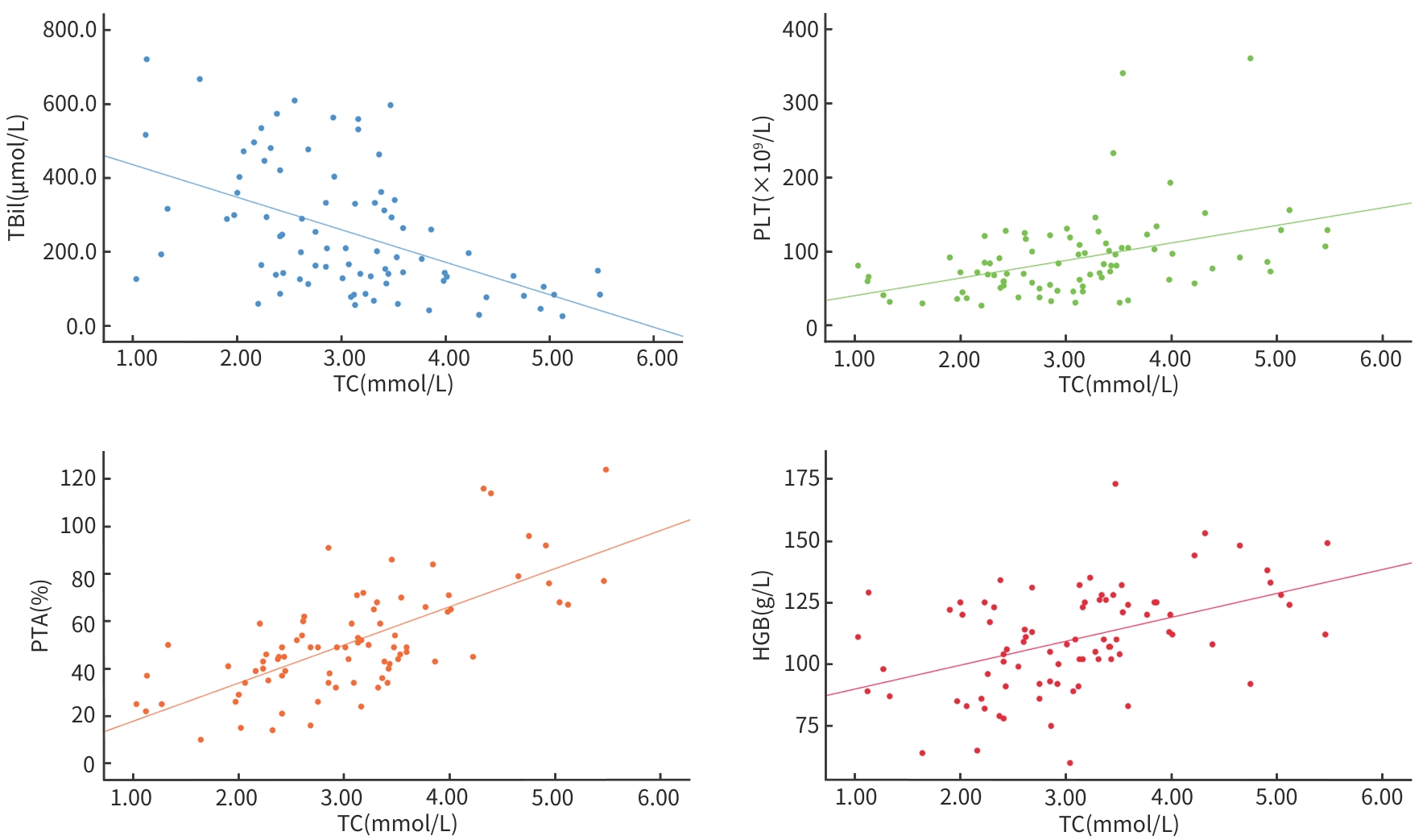
注: TC,总胆固醇;TBil,总胆红素;PLT,血小板;PTA,凝血酶原活动度;HGB,血红蛋白。
图 1 第21天TC水平与主要化验指标的相关性分析
Figure 1. Correlation between TC value on the 21st day and main laboratory indicators
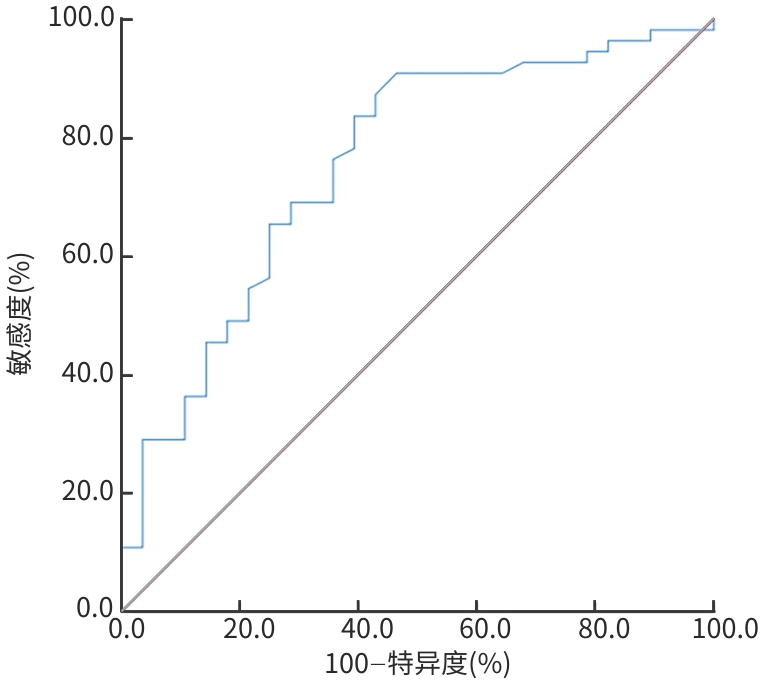
注: TC,总胆固醇;ROC曲线,受试者操作特征曲线。
图 2 第21天TC水平预测患者死亡的ROC曲线
Figure 2. The ROC curve of TC value on predicting patient mortality on the 21st day
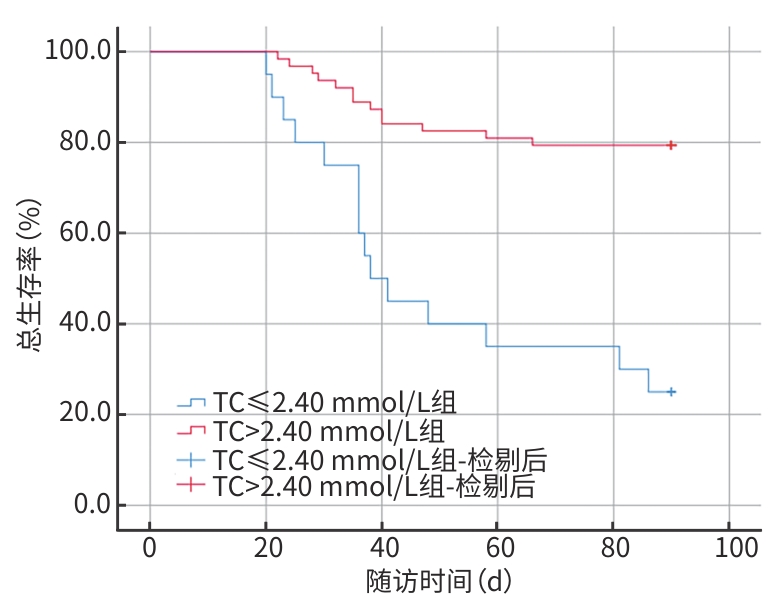
注: TC,总胆固醇。
图 3 第21天不同TC水平患者的生存曲线比较
Figure 3. Survival curves of patients with different TC levels on the 21st day
表 1 HBV-ACLF患者基线资料比较
Table 1. Baseline characteristics of patients with HBV-ACLF
项目 存活组(n=55) 死亡组(n=57) 统计值 P值 男[例(%)] 48(87.3) 49(86.0) χ2=0.041 0.839 年龄(岁) 43.7±10.9 49.2±12.2 t=2.520 0.013 肝硬化基础[例(%)] 34(61.8) 46(80.7) χ2=4.891 0.027 合并感染[例(%)] 45(81.8) 46(80.7) χ2=0.023 0.880 合并腹水[例(%)] 24(43.6) 43(75.4) χ2=11.778 0.001 合并HE[例(%)] 8(14.5) 19(33.3) χ2=5.400 0.020 ALT(U/L) 512.7(96.6,850.7) 238.0(70.3,697.9) Z=-1.886 0.059 AST(U/L) 256.2(116.3,588.0) 189.7(102.4,535.6) Z=-0.620 0.535 TBil(μmol/L) 301.8±131.5 414.3±173.9 t=3.853 <0.001 Alb(g/L) 31.4±3.9 31.7±4.1 t=0.394 0.695 INR 2.09(1.74,2.65) 2.26(1.89,3.23) Z=-1.374 0.170 PTA(%) 35±11 31±11 t=-1.963 0.052 WBC(×109/L) 6.7(5.2,8.5) 6.4(4.7,9.3) Z=-0.483 0.629 HGB(g/L) 128±21 124±24 t=-0.921 0.359 PLT(×109/L) 118±53 100±52 t=-1.757 0.082 注:HE,肝性脑病;ALT,丙氨酸氨基转移酶;AST,天冬氨酸氨基转移酶;TBil,总胆红素;Alb,白蛋白;INR,国际标准化比值;PTA,凝血酶原活动度;WBC,白细胞;HGB,血红蛋白;PLT,血小板;HBV-ACLF,乙型肝炎慢加急性肝衰竭。
 下载: 导出CSV
表 2 不同预后患者动态TC水平比较
Table 2. Comparison of dynamic TC levels among patients with different prognoses
项目 例数 基线TC
(mmol/L)第3天TC
(mmol/L)第7天TC
(mmol/L)第14天TC
(mmol/L)第21天TC
(mmol/L)第28天TC
(mmol/L)存活组 55 2.60±0.86 2.60±0.79 2.89±0.93 3.21±0.94 3.35±0.95 3.59±1.33 死亡组 57 2.63±0.78 2.65±0.69 2.64±0.79 2.58±0.79 2.54±0.68 2.61±0.84 注:TC,总胆固醇。
下载: 导出CSV
表 3 动态TC水平及相关因素对HBV-ACLF患者预后影响的Logistic回归分析
Table 3. The results of Logistic regression analysis of dynamic TC values and baseline factors
变量 单因素分析 多因素分析 OR 95%CI P值 OR 95%CI P值 年龄(岁) 1.042 1.008~1.078 0.016 1.009 0.951~1.070 0.777 肝硬化基础 0.387 0.165~0.909 0.029 0.532 0.139~2.030 0.356 合并腹水 3.967 1.774~8.872 0.001 2.820 0.849~9.361 0.090 合并HE 2.937 1.159~7.446 0.023 1.334 0.344~5.172 0.677 第1天TC(mmol/L) 0.983 0.642~1.503 0.935 第3天TC(mmol/L) 0.996 0.675~1.469 0.983 第7天TC(mmol/L) 0.752 0.495~1.144 0.184 第14天TC(mmol/L) 0.382 0.220~0.663 0.001 1.729 0.504~5.925 0.384 第21天TC(mmol/L) 0.336 0.175~0.644 0.001 0.350 0.160~0.766 0.009 第28天TC(mmol/L) 0.450 0.263~0.771 0.004 0.764 0.340~1.716 0.514 注:OR,比值比;95%CI,95%置信区间;TC,总胆固醇;HE,肝性脑病;HBV-ACLF,乙型肝炎相关慢加急性肝衰竭。计数资料赋值方式如下,肝硬化基础:无=0,有=1;合并腹水:无=0,有=1;合并HE:无=0,有=1。
下载: 导出CSV
表 4 90 d存活组和死亡组患者第21天主要化验指标比较
Table 4. Comparison of main laboratory indicators of patients with different prognosis on the 21st day
项目 存活组(n=55) 死亡组(n=28) 统计值 P值 TC(mmol/L) 3.28(2.75,3.86) 2.38(2.09,3.13) Z=-3.790 <0.001 TBil(μmol/L) 152.6(112.0,288.5) 453.7(196.3,532.7) Z=-3.939 <0.001 Alb(g/L) 34.2(32.0,37.3) 32.4(30.9,35.5) Z=-1.734 0.083 PTA(%) 52(43,70) 39(26,47) Z=-3.898 <0.001 WBC(×109/L) 5.3(4.4,6.9) 7.0(5.3,11.9) Z=-2.504 0.012 HGB(g/L) 115±17 100±26 t=-3.080 0.003 PLT(×109/L) 85(61,121) 66(42,89) Z=-2.538 0.011 注:TC,总胆固醇;TBil,总胆红素;Alb,白蛋白;PTA,凝血酶原活动度;WBC,白细胞;HGB,血红蛋白;PLT,血小板。
下载: 导出CSV
表 5 第21天不同TC水平患者的临床资料比较
Table 5. Comparison of main data of patients with different TC levels on the 21st day
项目 TC≤2.40 mmo/L组(n=20) TC>2.40 mmol/L组(n=63) 统计值 P值 男[例(%)] 17(85.0) 56(88.9) χ2 =0.208 0.649 年龄(岁) 50.4±9.7 43.7±11.2 t=-2.238 0.018 肝硬化基础[例(%)] 17(85.0) 40(63.5) χ2 =3.264 0.071 合并感染[例(%)] 16(80.0) 52(82.5) χ2 =0.065 0.799 合并腹水[例(%)] 15(75.0) 31(49.2) χ2 =4.088 0.043 合并HE[例(%)] 8(40.0) 9(14.3) χ2 =5.569 0.018 TBil(μmol/L) 380.1(216.1,510.1) 158.5(104.4,292.0) Z=-3.407 0.001 PTA(%) 36(25,44) 51(43,68) Z=-4.299 <0.001 WBC(×109/L) 6.6(5.1,11.6) 5.7(4.4,7.3) Z=-0.985 0.325 HGB(g/L) 101±22 113±20 t=2.410 0.028 PLT(×109/L) 66(37,82) 85(58,121) Z=-2.897 0.004 注:TC,总胆固醇;HE,肝性脑病;TBil,总胆红素;PTA,凝血酶原活动度;WBC,白细胞;HGB,血红蛋白;PLT,血小板。
下载: 导出CSV
-
[1] Karvellas C J, Bajaj J S, Kamath P S, et al. AASLD practice guidance on acute-on-chronic liver failure and the management of critically ill patients with cirrhosis[J]. Hepatology, 2024, 79( 6): 1463- 1502. DOI: 10.1097/HEP.0000000000000671. [2] Moreau R, Tonon M, Krag A, et al. EASL clinical practice guidelines on acute-on-chronic liver failure[J]. J Hepatol, 2023, 79( 2): 461- 491. DOI: 10.1016/j.jhep.2023.04.021. [3] Li J Q, Liang X, You S L, et al. Development and validation of a new prognostic score for hepatitis B virus-related acute-on-chronic liver failure[J]. J Hepatol, 2021, 75( 5): 1104- 1115. DOI: 10.1016/j.jhep.2021.05.026. [4] Choudhury A, Kulkarni A V, Arora V, et al. Acute-on-chronic liver failure(ACLF): The‘Kyoto consensus’-steps from Asia[J]. Hepatol Int, 2025, 19( 1): 1- 69. DOI: 10.1007/s12072-024-10773-4. [5] Singal A K, Wong R J, Dasarathy S, et al. ACG clinical guideline: Malnutrition and nutritional recommendations in liver disease[J]. Am J Gastroenterol, 2025, 120( 5): 950- 972. DOI: 10.14309/ajg.0000000000003379. [6] Wu Juan, Jia Lin, Li Yuanyuan, et al. Association of complications development with clinical prognosis in patients with HBV-related acute-on-chronic liver failure[J]. Beijing Med J, 2018, 40( 10): 907- 911.吴娟, 贾琳, 李元元, 等. HBV相关慢加急性肝衰竭患者的并发症与预后分析[J]. 北京医学, 2018, 40( 10): 907- 911. [7] Lai J C, Tandon P, Bernal W, et al. Malnutrition, frailty, and sarcopenia in patients with cirrhosis: 2021 practice guidance by the American Association for the Study of Liver Diseases[J]. Hepatology, 2021, 74( 3): 1611- 1644. DOI: 10.1002/hep.32049. [8] Meng Q H, Hou W, Yu H W, et al. Resting energy expenditure and substrate metabolism in patients with acute-on-chronic hepatitis B liver failure[J]. J Clin Gastroenterol, 2011, 45( 5): 456- 461. DOI: 10.1097/MCG.0b013e31820f7f02. [9] Society of Infectious Diseases, Chinese Medical Association. Expert consensus on diagnosis and treatment of end-stage liver disease complicated with infections(2021 version)[J]. J Clin Hepatol, 2022, 38( 2): 304- 310. DOI: 10.3969/j.issn.1001-5256.2022.02.010.中华医学会感染病学分会. 终末期肝病合并感染诊治专家共识(2021年版)[J]. 临床肝胆病杂志, 2022, 38( 2): 304- 310. DOI: 10.3969/j.issn.1001-5256.2022.02.010. [10] Lin Yong, Yan Gengjie, Feng Feng, et al. Association between cholesterol and liver regeneration and its significance and potential value in clinical treatment of liver failure[J]. J Clin Hepatol, 2022, 38( 3): 708- 713. DOI: 10.3969/j.issn.1001-5256.2022.03.044.林镛, 颜耿杰, 冯逢, 等. 胆固醇与肝再生关系及其在肝衰竭治疗中的意义和潜在价值[J]. 临床肝胆病杂志, 2022, 38( 3): 708- 713. DOI: 10.3969/j.issn.1001-5256.2022.03.044. [11] Alvarez-Sola G, Uriarte I, Latasa M U, et al. Bile acids, FGF15/19 and liver regeneration: From mechanisms to clinical applications[J]. Biochim Biophys Acta BBA Mol Basis Dis, 2018, 1864( 4): 1326- 1334. DOI: 10.1016/j.bbadis.2017.06.025. [12] de Giorgi M, Jarrett K E, Burton J C, et al. Depletion of essential isoprenoids and ER stress induction following acute liver-specific deletion of HMG-CoA reductase[J]. J Lipid Res, 2020, 61( 12): 1675- 1686. DOI: 10.1194/jlr.RA120001006. [13] Fuchs C D, Simbrunner B, Baumgartner M, et al. Bile acid metabolism and signalling in liver disease[J]. J Hepatol, 2025, 82( 1): 134- 153. DOI: 10.1016/j.jhep.2024.09.032. [14] Guan Min, Li Jiani, Gao Yinjie, et al. Value of blood lipid parameters in predicting the progression of HBV-related acute-on-chronic pre-liver failure[J]. J Clin Hepatol, 2023, 39( 7): 1564- 1569. DOI: 10.3969/j.issn.1001-5256.2023.07.009.官敏, 李嘉妮, 高银杰, 等. 血脂指标对乙型肝炎相关慢加急性肝衰竭前期进展的预测价值[J]. 临床肝胆病杂志, 2023, 39( 7): 1564- 1569. DOI: 10.3969/j.issn.1001-5256.2023.07.009. [15] Wang Hang, Sun Changfeng, He Chuan, et al. Predictive value of blood lipid level on short-term prognosis of HBV-related patients with chronic and acute liver failure[J]. Shandong Med J, 2022, 62( 8): 74- 77.王航, 孙长峰, 何川, 等. 血脂水平对HBV相关慢加急性肝衰竭患者短期预后的预测价值[J]. 山东医药, 2022, 62( 8): 74- 77. [16] Wu Fengping, Li Yaping, Yang Ying, et al. Blood glucose and total cholesterol in the prognosis of patients with liver failure[J]. J Pract Hepatol, 2018, 21( 3): 413- 416. DOI: 10.3969/j.issn.1672-5069.2018.03.024.吴凤萍, 李亚萍, 杨颖, 等. 血糖和总胆固醇水平对肝衰竭患者预后的影响[J]. 实用肝脏病杂志, 2018, 21( 3): 413- 416. DOI: 10.3969/j.issn.1672-5069.2018.03.024. -

 本文二维码
计量
- 文章访问数: 20
- HTML全文浏览量: 9
- PDF下载量: 1
- 被引次数: 0